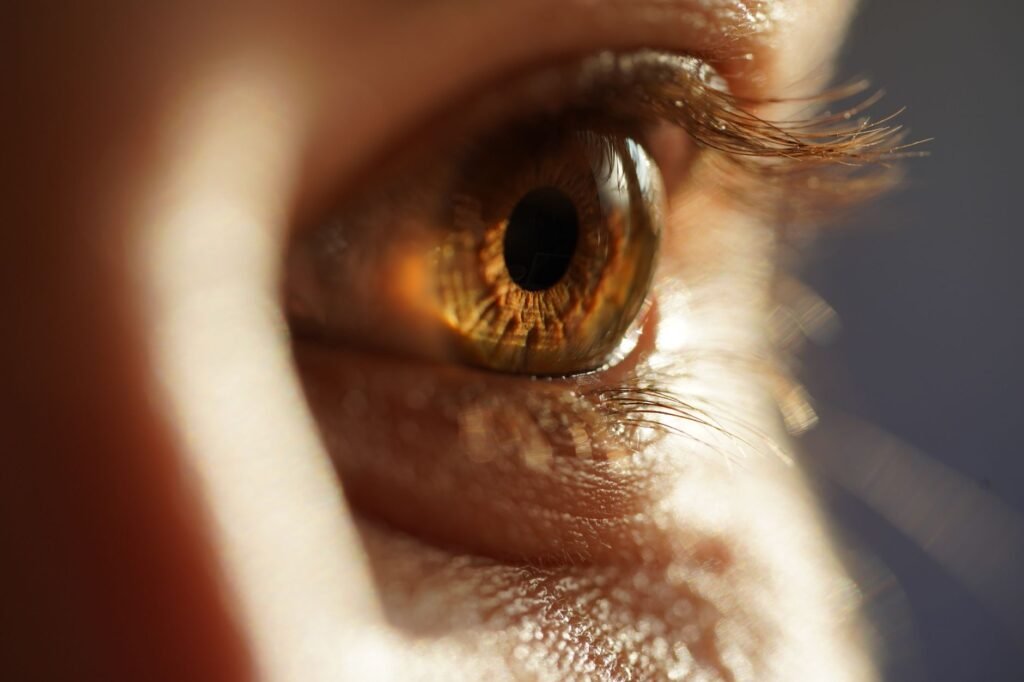
SCLERA, six letters, answers the white of the eye crossword clue. It is the tough opaque coat wrapping most of the eyeball. CORNEA and RETINA also run six letters and share the same anatomical clue style, so the definition rather than the count is what separates them.
Why one part is white and its neighbor is clear
The sclera and the cornea are not two different materials. They are one continuous outer shell made of the same collagen, meeting at a ring called the limbus, which is the visible border where the white stops and the clear window begins. Everything that makes them look like opposites comes down to how the fibers inside them are arranged.
In the cornea the collagen fibrils are uniform in thickness and laid out in regular, tightly ordered sheets, with the spacing between them smaller than the wavelength of visible light. Under those conditions the light that scatters off one fiber is cancelled by the light scattering off its neighbors, and the tissue transmits almost everything that hits it. In the sclera the same protein is bundled into fibrils of mixed diameters running in irregular directions. Light entering that arrangement bounces in every direction instead of passing through, and scattered light across all wavelengths is what the eye reads as white.
The cornea pays a price for that order. It carries no blood vessels at all, since vessels would wreck the transparency, so it draws oxygen from the air and nourishment from tears and from the fluid behind it. One consequence is that corneal grafts are among the least likely transplants to be rejected, because the immune system has no easy route in.
What the sclera is holding together
Its main job is mechanical. The eye is a pressurized sphere, and the sclera is the casing that keeps it spherical, because an eyeball that changes shape changes where the image lands. The six muscles that aim the eye anchor onto its outer surface, and at the back the optic nerve exits through a perforated patch of it.
Color is the reason the word leaves the clinic at all. A healthy adult sclera is white because it is dense tissue with little surface blood supply. Infant sclera can look faintly blue simply because it is thinner and the darker layer underneath shows through. Redness is almost always the surface vessels widening rather than the sclera itself changing, and a lasting shift toward yellow is the kind of thing worth mentioning to a doctor rather than diagnosing at home.
Eye terms by slot length
Anatomy clues cluster tightly around four to seven squares, which is exactly why constructors keep returning to them.
| Length | Term | Part of the eye |
|---|---|---|
| 4 | IRIS | The colored ring that sets pupil size |
| 4 | UVEA | The middle vascular layer |
| 4 | LENS | The focusing element behind the pupil |
| 5 | PUPIL | The opening itself |
| 5 | FOVEA | The sharpest patch of the retina |
| 6 | SCLERA | The white outer coat |
| 6 | CORNEA | The clear front window |
| 6 | RETINA | The light sensing layer at the back |
| 7 | CHOROID | The vascular layer feeding the retina |
Telling the six-letter candidates apart
Three of the most common eye entries in American puzzles are all six squares long, so counting gets you nowhere on its own. The definitions do separate cleanly, though. Only SCLERA is ever clued as the white. CORNEA belongs to any clue about a clear front covering. RETINA belongs to anything about light, images or the back of the eye.
Letter shape finishes the job quickly. All three carry a consonant cluster or a distinctive opening, and a single crossing on the first two squares settles which one you have. The real trap in this family is IRIS, since it doubles as a flower and as a given name, so the constructor has to signal anatomy explicitly. If the surface has bothered to say eye at all, take the signal at face value.