
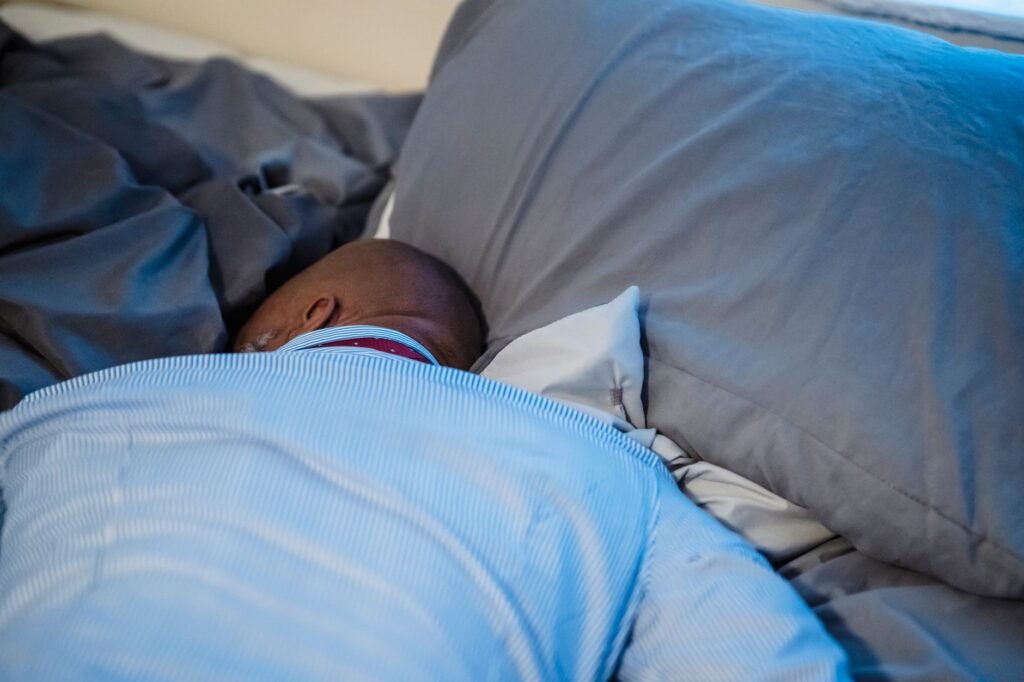
You snore more on your back because gravity pulls your tongue and soft palate toward the back of your throat. That narrows the channel air has to pass through, so the same breath moves faster through a smaller gap and the loose tissue flutters. Turning onto your side usually takes that pressure off.
What gravity does to your airway at night
Lie face up and everything soft in your throat settles backward. The base of the tongue drops toward the throat wall. The soft palate and the little flap of tissue hanging behind it, the uvula, sag into the same space. Meanwhile the muscles that hold all of that open during the day lose tone the moment you fall asleep, so nothing is bracing against the drop.
Air still has to get through. A narrow channel forces it to move faster, and fast air over slack tissue makes that tissue vibrate. The vibration is the sound. Nothing is closing off, in ordinary snoring, it is just fluttering, the way a flag snaps in wind but hangs still in a calm room.

Why the noise changes through the night
Snoring is rarely steady. Muscle tone drops further during REM sleep, so the rattle often gets deeper and more ragged in the second half of the night. Several everyday things push it the same direction:
- Alcohol in the evening. It relaxes airway muscles for hours after the buzz is gone.
- Sedating cold or allergy medicine. Same relaxing effect on the same tissue.
- A blocked nose. If you cannot draw air easily through the nose you pull harder, and harder suction draws the soft tissue inward.
- Being badly short on sleep. Overtired people fall into deeper sleep faster and snore harder doing it.
How to tell if you are a positional snorer
Positional means the noise mostly happens in one position. It is worth knowing, because the fix is free.
- Record a full night with a phone app that logs a timeline rather than a single loudness score.
- Note the position you fell asleep in and the one you woke up in.
- Repeat for three or four nights so a bad cold or a late dinner does not skew the picture.
- Then try three nights deliberately on your side, with a pillow behind your back to make rolling over harder, and compare the recordings.
If side nights are dramatically quieter, position is doing most of the work. If the noise barely moves, something else is driving it and position tricks will disappoint you.
When back snoring is worth raising with a doctor
Snoring on its own is common and usually just noise. A few patterns are worth mentioning at a regular appointment rather than filing away: loud snoring almost every night, anyone witnessing pauses in your breathing or gasping, waking up unrefreshed after a full night, heavy daytime sleepiness, or morning headaches that fade through the day.
Those can be signs of sleep apnea, which is a medical condition that needs a doctor to evaluate. Do not try to grade how serious it is from a phone recording. Bring the recording along instead and let the appointment do the rest.