
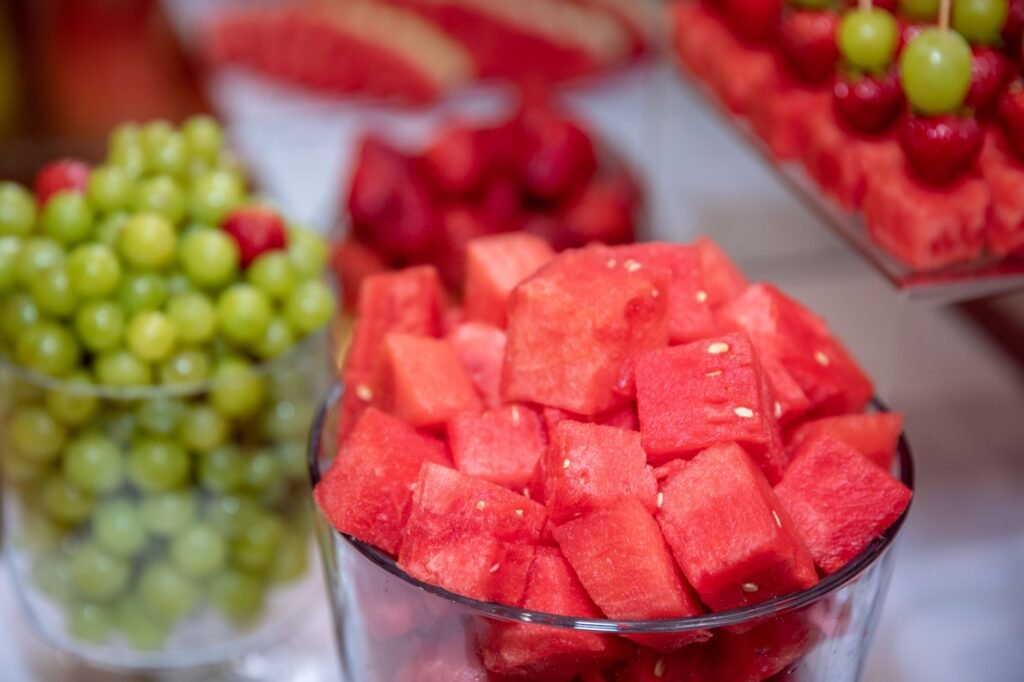
Keep a whole watermelon at cool room temperature and refrigerate it only once it is cut. After cutting, press plastic wrap flat against the exposed flesh or move the fruit into a sealed container, because that wet surface both dries out and absorbs the smell of everything else on the shelf.
An uncut melon is happier on the counter

The rind is doing its job. It is thick, sealed and built to protect the fruit, so an intact melon holds up fine in a cool corner of the kitchen away from direct sun. Long cold storage actually works against it, since melons are sensitive to chill and lose some of their sweetness and deep color sitting in the refrigerator for a week.
None of that means serving it warm. Move the melon into the refrigerator the morning you plan to cut it and it will be cold when it hits the plate without spending days in there.
| State of the melon | Where it belongs |
|---|---|
| Whole and uncut | Cool counter or pantry, out of sunlight |
| Whole, serving today | Refrigerator for a few hours beforehand |
| Halved or quartered | Refrigerator, wrap pressed onto every cut face |
| Cubed | Sealed container in the refrigerator |
| Cut and left out | Back in the cold quickly, this is the risky one |
Cutting starts a much shorter clock
Once the rind is open the melon becomes an ordinary perishable food. Federal food safety guidance treats cut melon that way and puts it back in the refrigerator within two hours of cutting, or sooner outdoors on a hot day. A tray of cubes sitting out through a long barbecue is the classic version of this problem.
Cut only what the table will get through. A half melon under wrap keeps its texture far better than the same melon already diced into a bowl.
Press the wrap onto the flesh
Draping wrap loosely over the top of a cut half leaves an air pocket right where the damage happens. The surface dries into a pale, slightly slimy layer and picks up odors at the same time. Push the film down until it touches the entire cut face with no gaps.
- Blot the cut surface with a paper towel so the wrap has something to cling to.
- Lay film directly on the flesh and smooth it outward to the rind.
- Set the half cut side down on a plate as a second line of defense.
- For cubes, use a rigid container with a real lid and pour off the liquid that collects.
- Keep it away from onions, garlic and open leftovers, which are what the melon will taste like otherwise.
Freezing it for drinks
Freeze cubes spread in a single layer on a tray, then bag them once solid so they stay separate. Use them in blended drinks, or drop a few into lemonade where they chill the glass and then dissolve into it. Do not plan on serving thawed watermelon as fruit, because it comes back limp and watery every time.
Where half a melon usually gets wasted
Cubing the entire thing on day one is the most common error, since every cut face starts breaking down and the pieces sit in their own juice.
Then there is wrapping only the top of a half, storing the cut melon in the door where it warms each time the refrigerator opens, leaving a platter out through an afternoon party, stacking heavy jars on the cut half until it bruises, and saving the melon so long uncut on a sunny windowsill that it ferments quietly inside. Slicing on a board that just held raw meat is the serious one, and that is a cleaning habit rather than a storage one.
Mealy, or genuinely spoiled
Grainy, dry flesh and a dull flavor mean an old melon, not an unsafe one. Blend it and nobody notices. Some separation of juice in a container of cubes is also normal.
Stop at a sour or fizzy smell, slime on the surface, fuzzy spots, or flesh that has turned translucent and sits in cloudy liquid. A cut melon that spent a hot afternoon on a table goes in the bin regardless of how it looks.