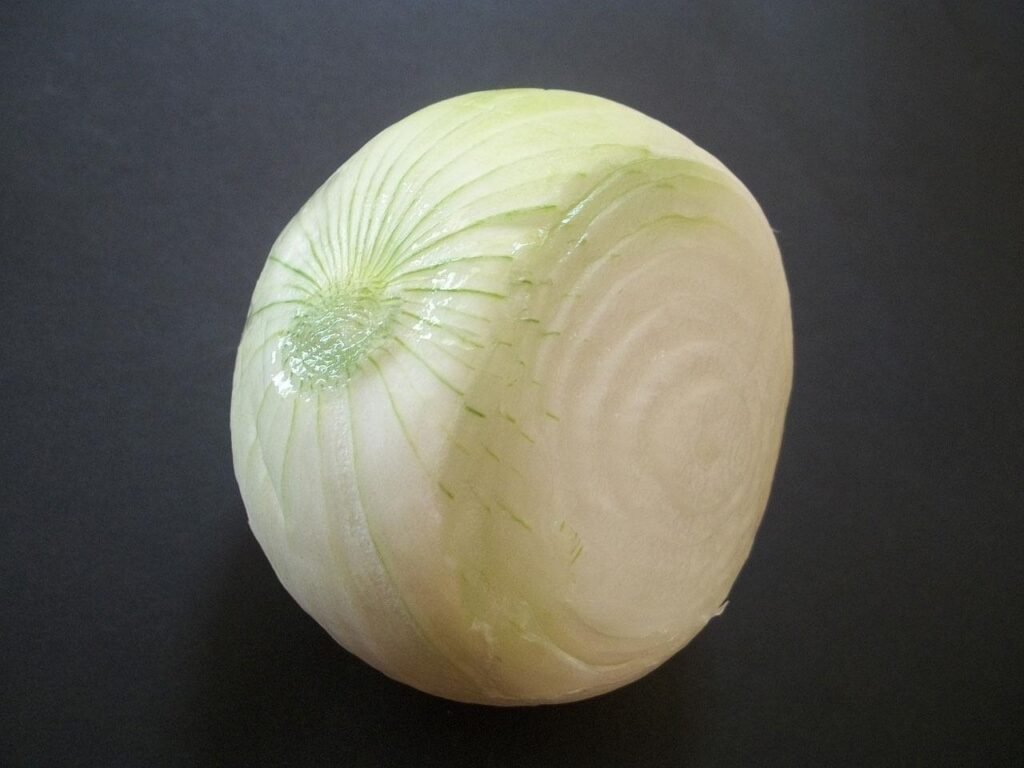
Put the cut half in a glass container with a proper seal and refrigerate it, cut face down against the base. Plastic wrap on a plate is not enough, and a plastic tub keeps the smell for good. The point of the seal is containing what the cut surface is giving off.
Cutting the onion starts a reaction

An intact onion is chemically quiet. Its sulfur compounds and the enzyme that acts on them are kept in separate compartments inside the cells, and nothing happens while those walls stay whole. Slicing the bulb ruptures thousands of them at once and lets the two meet. The enzyme goes to work immediately, producing the volatile compound that stings your eyes along with a family of related sulfur molecules that carry the smell.
Two properties of those molecules explain everything about storing a half. They are volatile, so they leave the cut face continuously as a gas and drift wherever the air goes. And they are readily soluble in fat, which is why butter, cream, soft cheese and even a cut avocado in the same refrigerator pick up onion within a day while the lettuce next to them does not. The same affinity is why plastic containers and plastic wrap absorb the smell semi permanently, since those materials are essentially solid hydrocarbons. Glass and stainless steel do not take it up, and that single difference decides the container.
Sealing the half properly
- Leave the papery skin on the uncut portion. It is still doing a protective job on that side.
- Blot the cut face dry with a paper towel. Surface moisture is where softening and sliminess begin.
- Set the half cut face down on the base of a glass container, so the open surface has the least air contact possible.
- Seal the lid properly. A lid resting on top is only a partial measure here.
- Store it on a shelf rather than the door, where the temperature swings every time someone opens it.
- Keep it away from butter, cream and soft cheese anyway, as cheap insurance against a leaky gasket.
- Before using it, slice a thin piece off the exposed face if it has dried or darkened.
Ranking the places people put a cut half
| Method | What happens |
|---|---|
| Sealed glass container, refrigerated | Best. Keeps texture and keeps the smell contained |
| Zip bag with the air pressed out | Works, but the bag holds the odor afterward |
| Plastic tub with a snap lid | Acceptable once, then that tub is the onion tub forever |
| Cut face down on a saucer | Fridge smells like onion by morning |
| Loosely wrapped in foil or plastic wrap | Dries out at the edges and still leaks smell |
| Left on the counter | Softens and sours fastest of all |
A refrigerated half generally stays good for something like a week to ten days, with sweet varieties running shorter than yellow ones. How long it sat out before you put it away matters more than the exact number.
The mistakes that season an entire refrigerator
The saucer and foil routine is the one almost everybody has done, usually because the onion is going back into a pan in an hour and an hour turns into three days. It leaks continuously, and the cost shows up in the butter dish rather than on the onion.
Storing a cut half in the door is the second. That shelf is the warmest part of the refrigerator and it swings with every visit, which is exactly what a cut vegetable does not want. Third is reusing one favorite plastic container for onions and then wondering why oatmeal tastes strange. Dedicate one container or use glass.
The fourth is chopping a whole onion on Sunday to save time midweek. Chopped pieces have vastly more cut surface than a single half, so they dry, soften and off gas far faster. If you want a head start, chop and freeze rather than chop and refrigerate.
Judging a half before you use it
A slightly dried, dull looking cut face is normal and you can trim it off. So is a stronger smell than a fresh onion has, since the reaction has had days to run.
Throw it out if the layers have gone slippery or translucent, if liquid has collected in the container, if there is any fuzzy growth or a black powdery film between the layers, or if the smell has turned sour rather than sharp. A green shoot pushing through the center is not spoilage, just the bulb waking up, and the surrounding onion is still fine to cook with.