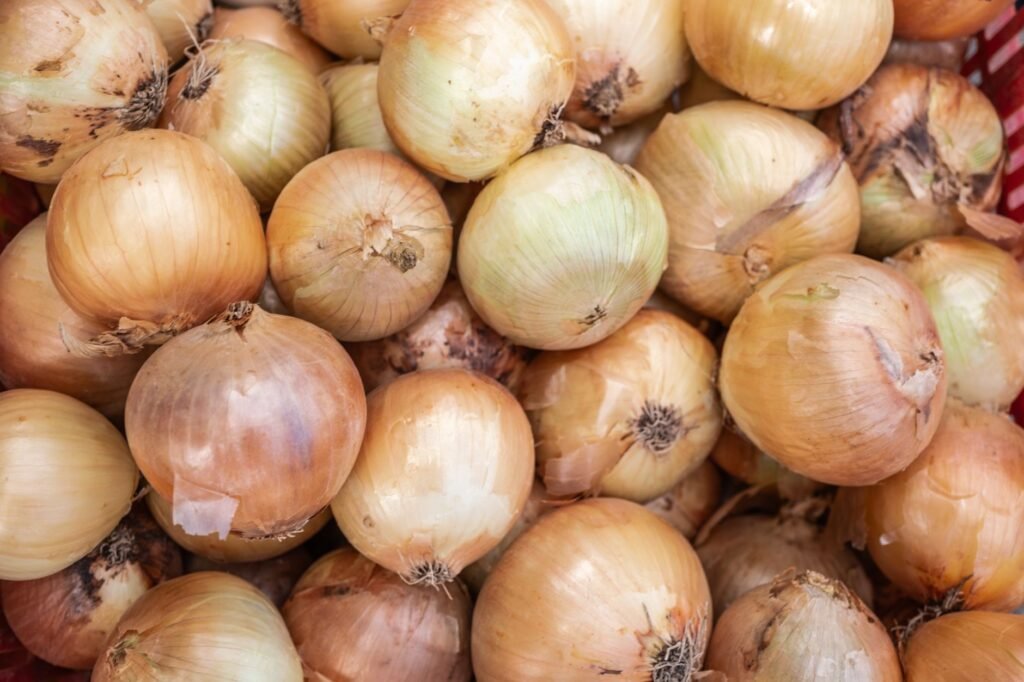
Store whole, unpeeled onions in a mesh bag or open basket somewhere cool, dark, and dry with air moving around them. A pantry shelf, unheated closet, or basement works well, and good storage varieties hold for weeks to months. Peeled or cut onions go in a sealed container in the refrigerator instead.
Onions Want Dark, Dry, and Moving Air
A cured onion is essentially a package of layered scales protected by papery skins. Those skins only do their job while they stay dry. Humidity softens them, and any trapped moisture against the surface becomes the starting point for mold at the neck. Darkness matters for a separate reason, since light signals the bulb to break dormancy and push out a shoot.
Airflow ties the two together. Onions sitting in a solid bowl or a knotted plastic bag sit in their own humidity. A mesh sack, a wire basket, an old pantyhose leg with knots between each bulb, or a slatted crate all let air pass on every side.
Keep Them Away From the Potato Bin
These two get stored together constantly, and the pairing shortens the life of both. Potatoes are roughly four fifths water and they release a steady amount of it as vapor. Onions sitting nearby soak that moisture into their dry outer skins, which is precisely the condition they were cured to avoid. Going the other direction, onions and the ethylene in a shared bin nudge potatoes toward sprouting and softening.
Give each its own container on a different shelf, or at minimum a few feet of separation with nothing enclosing them.
How Long Different Onions Hold
| Type | Where it belongs | Rough keeping window |
|---|---|---|
| Yellow and other storage onions | Cool dark pantry, mesh bag | Longest of the group, often months |
| Red onions | Cool dark pantry | Shorter than yellow, weeks to a couple of months |
| Sweet onions such as Vidalia | Refrigerator, spaced apart | Shortest of the whole onions |
| Shallots | Cool dark pantry | Similar to storage onions |
| Scallions and green onions | Refrigerator, roots in a little water or wrapped | Days to a week or two |
| Cut or peeled onion | Refrigerator, airtight container | A few days |
Where People Go Wrong With Onions
The plastic grocery bag is the biggest offender. It goes straight from the store into a cabinet, still knotted, and the bulbs steam themselves. Dump them into something open the moment you get home.
The cabinet under the sink is the second trap, because it collects warmth from pipes and humidity from the drain. Washing onions before storage is a third, since you have just added the exact thing they cannot handle. Refrigerating whole onions is a fourth, as the cold damp air turns them soft and sometimes moldy, with the exception of sweet varieties and anything already cut.
One more habit worth breaking is tossing a bruised or soft onion back in with the good ones. Rot spreads by contact in a bin, so pull anything questionable out and use it first. Stacking bulbs deep in a closed container does the same thing from the bottom up, since the ones underneath carry the weight and the moisture.
Reading an Onion That Has Turned
Press the neck first, since that is where trouble starts. A firm onion gives almost nothing. A neck that feels soft, hollow, or damp means the interior layers are breaking down even if the outside looks fine. Black dusty powder between the papery skins is a mold, and while you can peel back to clean layers on a lightly affected bulb, heavy growth means it goes out.
A slimy layer, a brown wet spot, or a smell that has gone from sharp to sour and off are all clear stopping points. Trust the smell, because a rotting onion announces itself long before it looks bad.