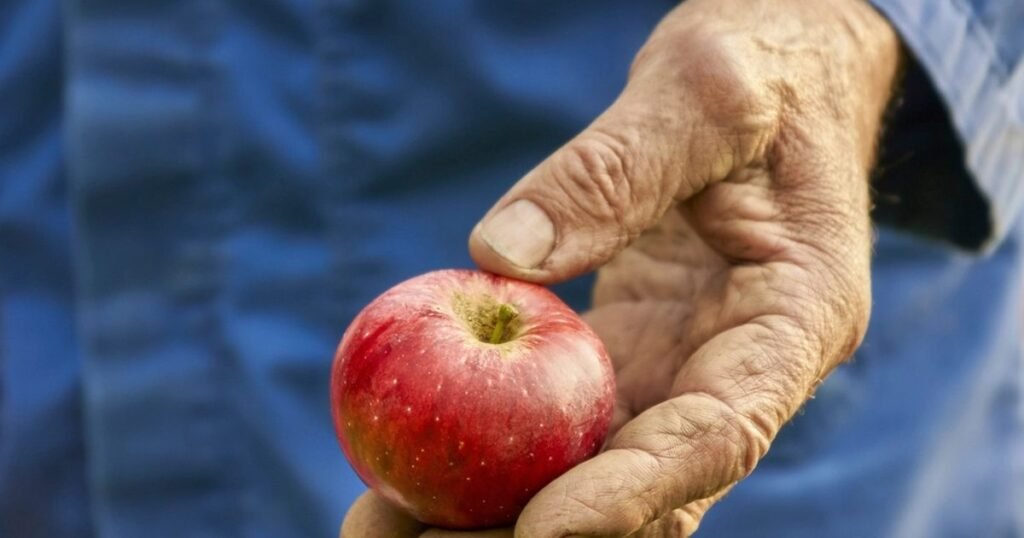
The answer is AGING, five letters. Getting up there is a gentle American idiom for growing old, and the clue works by letting you hear height or climbing first. The gerund ending on the clue is also quietly promising a gerund in the grid.
The grammar rule hiding in the clue
One of the most dependable mechanical rules in American crosswords is that clue and answer have to be swappable inside a sentence, which forces them to match in form. A clue ending in ing takes an answer ending in ing. A past tense clue takes a past tense answer. A plural clue takes a plural answer.
Getting up there ends in ing, so AGING qualifies and CLIMB does not, and that observation alone removes several tempting misreadings before meaning enters the picture. The same rule explains why AGEING sits at six letters and is genuinely correct in British puzzles, which use that spelling as standard rather than as a variant.

Why English has so many polite ways to say old
Getting up there belongs to a large family of expressions that exist mainly to avoid the plain word. Getting on. Up in years. No spring chicken. Over the hill. Of a certain age. Long in the tooth. Past his prime. Advancing in years.
The size of the family is the interesting part. A language grows euphemisms in rough proportion to how uncomfortable its speakers are with a subject, which is why English also carries dozens for money, for drunkenness and for death, and almost none for furniture. Crossword editors like this cluster because every member is short, fixed and instantly recognizable, so any one of them can clue any other.
Two of these idioms have traceable origins
Long in the tooth is the clearest case. A horse’s gums recede as it ages, so an older animal shows more of each tooth, and buyers used that to judge age at market. The phrase walked from the stable into ordinary speech about people.
No spring chicken is generally explained by the poultry trade, where birds hatched in spring were sold young and tender while stock carried through the winter was not. Over the hill treats a life as a climb with a summit somewhere in the middle. That is the same spatial picture getting up there uses, pointed in the opposite direction, which is probably why the two feel like relatives even though they disagree about which way you are heading.
Sorting the candidates by length
Form and surface between them do all the work here.
| Letters | Answer | Reading |
|---|---|---|
| 5 | AGING | The idiom, American spelling |
| 5 | OLDER | When the clue is comparative |
| 6 | AGEING | British spelling, British puzzles |
| 6 | RISING | Prices or levels, not people |
| 7 | SOARING | Height, taken literally |
| 8 | MATURING | Softer, and used of cheese and wine |
| 8 | CLIMBING | The literal reading, rare |
Two filters cut this down fast. The form rule kills anything that is not a present participle or a comparative. After that the surface decides: a clue mentioning a number, a price or a level means a quantity going up, while a clue mentioning a person, a birthday or a knee means the idiom.