
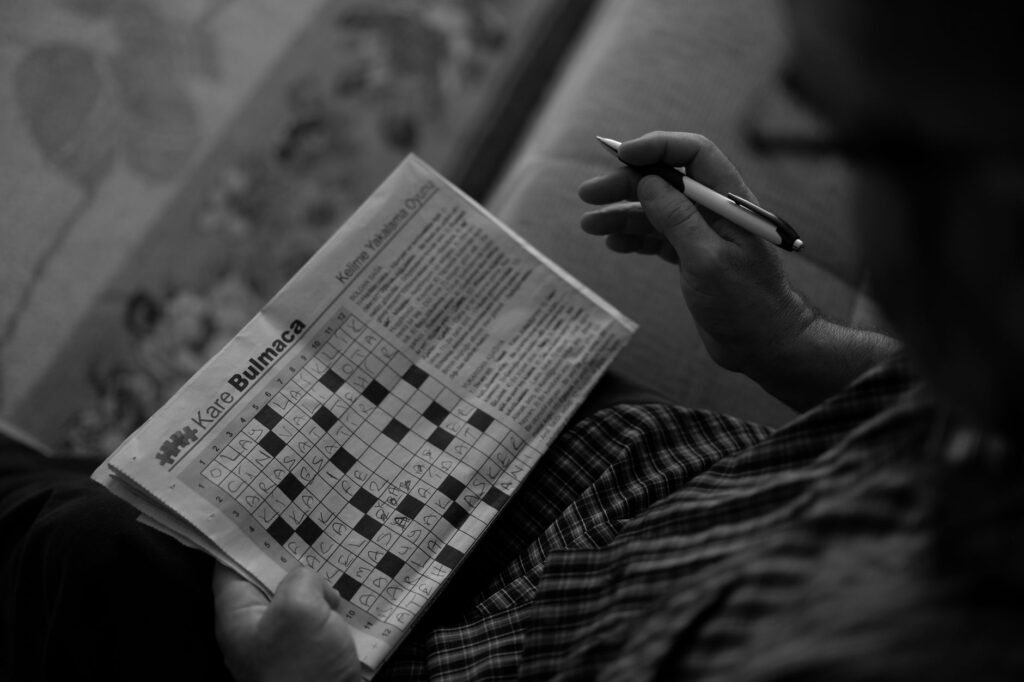
News site crosswords are commissioned for a coffee break, not for competitive solvers. Expect steady easy to moderate difficulty, clues drawn from current affairs and popular culture, and very little of the elaborate trickery that late week puzzles at specialist outlets are built around.
A news site puzzle is built for a coffee break
A crossword published beside news coverage has a specific job. It has to be finishable by a general reader in one sitting, on a phone, without any background in solving conventions. That brief produces a recognizable house style: definitions that mean what they say, entries drawn from ordinary vocabulary rather than crosswordese, and topical references that assume you read the rest of the site.
What gets traded away is the theme engineering and the wordplay machinery that specialist puzzles use. For most of the audience that is the feature rather than the shortcoming, because a puzzle you abandon halfway is not entertainment.
Most publishers do not build the puzzle themselves
The grid you play on a news site is usually an embedded player supplied by an outside puzzle platform, with the publisher commissioning or licensing the content that fills it. This is why crosswords at unrelated publications look and behave identically, down to the timer, the check and reveal buttons, and the way the grid reflows on a phone.
It also explains two things that confuse readers. Progress is often saved per browser rather than per account, so switching devices loses an unfinished grid. And when a publisher drops the platform, the entire archive can vanish at once rather than fading out gradually.
Where it sits against puzzles you already know
| Puzzle | Rough difficulty |
|---|---|
| News site dailies | Easy to moderate, steady day to day |
| Major daily, early week | Easy, climbing as the week goes on |
| Major daily, Friday and Saturday | Hard, themeless, heavy wordplay |
| Mini and quick grids | Two to four minutes, small grid, direct clues |
| Cryptic crosswords | A separate discipline with its own rulebook |

When a puzzles section quietly disappears
- Search the publisher’s own domain for games or puzzles rather than clicking an old link.
- Check the site footer, where games sections are often listed even after they leave the main navigation.
- Look at the publisher’s social accounts, which usually announce a move or a shutdown.
- If nothing turns up, treat it as retired. Puzzle sections at news publishers open and close frequently, and most closures are never announced on the page itself.
The daily habit transfers easily. Several major syndicated puzzles publish free online, and the newer short word games occupy the same few minutes with no subscription attached.
Speed on easy grids is what makes hard grids possible
- Fill the three and four letter entries first. Short slots are the most constrained in any grid, and they hand you crossings across the whole board.
- Read every clue once before solving anything. The ones you know instantly cost no time and open up whole corners.
- Learn the recurring fill. A small set of short vowel heavy words appears constantly across every puzzle family, and recognizing them on sight saves minutes.
- Track the constructor’s habits. Publications that use one setter repeatedly develop tells, and noticing them is most of what people mean by getting on a puzzle’s wavelength.
None of that is wasted effort if you later move to harder grids. The vocabulary, the conventions and the habit of reading a definition two ways are all learned faster on puzzles you can finish than on ones that defeat you.