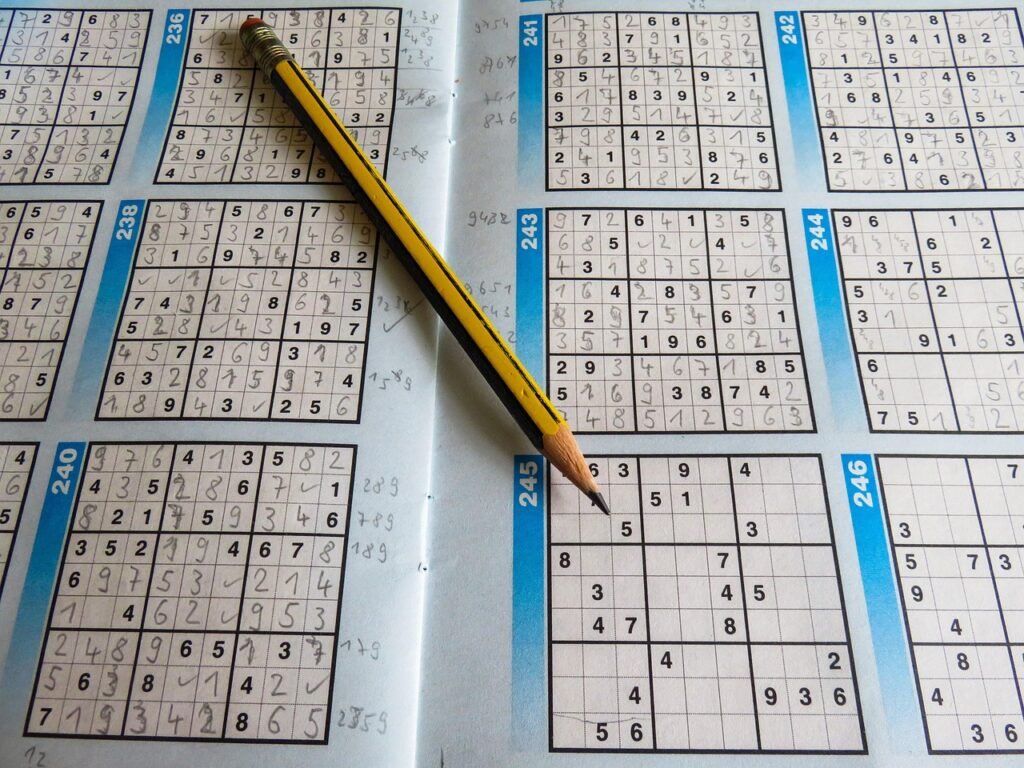
To play sudoku, fill the empty squares of a 9×9 grid so that each row, each column and each of the nine 3×3 boxes contains the digits 1 through 9 exactly once. Some numbers are given at the start, and you use logic, not guessing or arithmetic, to work out the rest.
The only three rules in sudoku
Every sudoku, from the easiest newspaper grid to the hardest, runs on the same three constraints.
- Each of the nine rows must contain 1 through 9 with no repeats.
- Each of the nine columns must contain 1 through 9 with no repeats.
- Each of the nine 3×3 boxes, outlined with thicker lines, must contain 1 through 9 with no repeats.
The grid has 81 squares, usually called cells. The numbers are only symbols, so you never add them up; a puzzle would work the same with letters or colors. A properly made puzzle has one solution, which means every cell can be reached by reasoning.
Scanning a box for the missing digit
The first technique most people learn is cross-hatching. Pick a digit, say 5, and a box that doesn’t have a 5 yet. Look along the rows and columns that pass through that box. Every 5 elsewhere in those lines rules out the cells it crosses. If only one empty cell in the box is left, the 5 goes there.
Work through the digits 1 to 9 this way, box by box. On an easy puzzle, scanning alone can often finish the grid. Each new number you place opens up more eliminations, so the puzzle tends to speed up as you go.
Finding the cell with only one possible number
The second technique flips the question. Instead of asking where a digit goes, pick an empty cell and ask what could go in it. Check its row, its column and its box, and cross off every digit already present in any of them. If eight digits are ruled out, the ninth is the answer.
A related move is the hidden single. Sometimes a cell still has several possible digits, but one of those digits has nowhere else to go in its row, column or box. If a 4 can only fit in one cell of a row, that cell is the 4, even though it could technically hold other numbers.
This works best on cells in crowded areas of the grid, where the row, column and box are already mostly filled. Switching between scanning for digits and checking single cells keeps you moving when one approach stalls.
Using pencil marks when the easy moves dry up
Medium and hard puzzles eventually stop giving up cells to quick scanning. That is the moment for pencil marks, also called candidates. Write the possible digits in small print in the corner of each empty cell, then erase them as the puzzle develops.
Pencil marks reveal patterns you can’t see in your head. If two cells in the same row can only hold the same two digits, say 3 and 7, those digits must go in those two cells, so you can erase 3 and 7 from the rest of the row. This is called a naked pair, and it’s often the first advanced move people pick up. Many sudoku apps have a notes mode that does the same job.
Fixing mistakes and choosing your first puzzles
If you discover a duplicate in a row, column or box, something earlier went wrong. Rather than erasing everything, look for the most recent placement you weren’t sure of and work back from there. Writing in pencil, or using an app with undo, saves a lot of frustration.
Start with puzzles labeled easy or beginner. They have more given numbers and can be finished with scanning and single-cell checks, which builds the habit of looking for forced moves. Move up a level once easy grids start to feel automatic. Guessing is tempting, but a correct solve never requires it, and it tends to create errors that are hard to trace.
Frequently asked questions
Do you need to be good at math to play sudoku?
No. Sudoku uses digits as labels, not quantities, so there is no adding or multiplying. The skill is logical elimination, spotting which positions are ruled out. The same puzzle could be printed with letters or symbols and would be solved in exactly the same way.
Can a sudoku puzzle have more than one solution?
A well-made sudoku has exactly one solution, and most published puzzles are checked for that. Poorly generated puzzles sometimes allow two, which shows up as a point where two digits can be swapped with no way to decide. When that happens, the puzzle itself is flawed.
How long does it take to learn sudoku?
Most people understand the rules in a few minutes and can finish an easy grid in their first sitting. Getting comfortable with medium puzzles usually takes more practice, mainly learning to use pencil marks. Harder levels introduce named techniques that are easiest to learn one at a time.
What advanced techniques help you solve harder sudoku puzzles?
Once singles run out, add pencil marks and look for patterns among the candidates. Naked and hidden pairs or triples, pointing pairs and box line reduction come next. Tougher grids call for patterns such as the X-Wing and Swordfish, which use two or three rows or columns at once to rule a digit out of other cells.
Is sudoku good for your brain?
Puzzles like sudoku are linked with sharper thinking. In a 2019 study of more than 19,000 adults aged 50 and over, researchers at the University of Exeter and King's College London found that people who did number puzzles more often scored better on tests of memory, attention and reasoning. It showed a link, not proof that puzzles prevent dementia.
How do you pronounce sudoku?
It is pronounced soo-DOH-koo, with the stress on the middle syllable, according to Merriam-Webster. The name is short for a Japanese phrase that the dictionary translates as the numerals must remain single, which describes the rule that each digit appears only once in every row, column and box.