The answer is JUDO, four letters. Martial art has drawn JUDO again and again, including several times in the syndicated Eugene Sheffer puzzle, and at four squares it has almost no competition. Longer slots are a different story: KARATE is just as common at six, where KUNGFU, AIKIDO and TAICHI crowd in too.
Judo was rebuilt from jujutsu
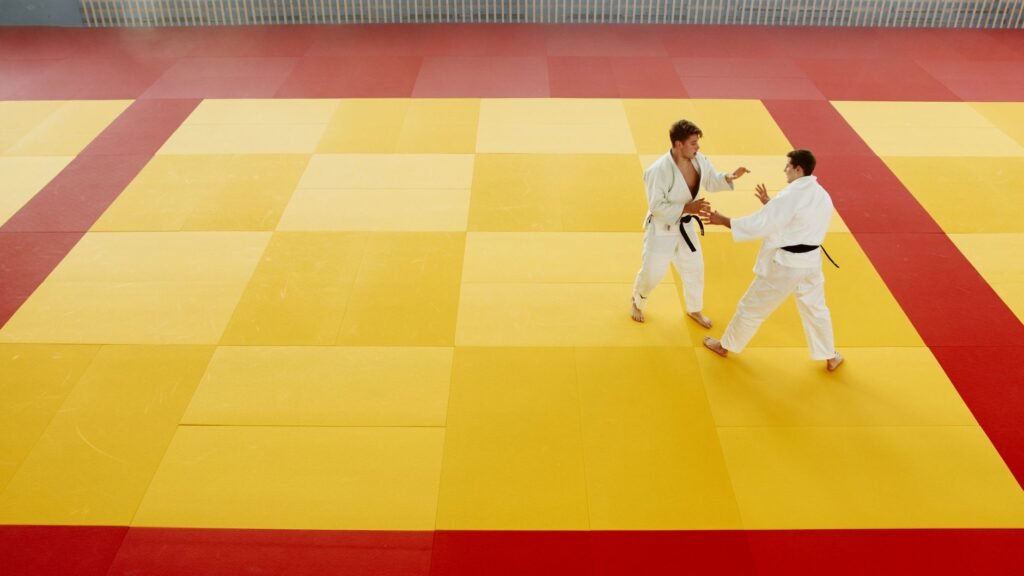
Jigoro Kano founded judo in Tokyo in 1882, and his school became the Kodokan, a name the International Judo Federation translates as the place where the way is studied. He drew on older jujutsu schools, and the change of name tells you what he was after. Ju means gentle or yielding in both words. Jutsu means art or technique, while do means way or path, so judo is the gentle way rather than the gentle technique.
Kano set his method apart from older schools with an emphasis on randori, free sparring. Judo sorts its techniques into throws, controls and striking techniques, and in competition the striking techniques are not allowed. It became an Olympic sport at the Tokyo Games in 1964, and women’s judo was added as a medal event in 1992.
Watch for DO at the end
Because do means way, it closes a whole family of fills. JUDO ends in it, and so does KENDO, the way of the sword, practiced in protective armor with a shinai, a practice sword made of four bamboo slats held together by leather fittings. AIKIDO ends in it too: ai is harmony, ki is energy or spirit, and the art took that official name in 1942, after Morihei Ueshiba developed it through the late 1920s and the 1930s. The Korean TAEKWONDO follows the same pattern, with tae for striking with the foot, kwon for striking with the hand and do for the way, and it has been an Olympic medal sport since Sydney in 2000.
So if the crossings hand you D and O in the last two squares, the entry is very likely JUDO, KENDO, AIKIDO or TAEKWONDO, and the length tells you which. If the final letters are anything else, turn to the arts that never took the ending.
Martial arts by the number of squares
The field, sorted for the blanks you actually have:
| Letters | Answer | Where it comes from |
|---|---|---|
| 4 | JUDO | Japan, throws and holds |
| 5 | KENDO | Japan, bamboo swords |
| 6 | KARATE | Okinawa, the empty hand |
| 6 | KUNGFU | China, entered as one word |
| 6 | AIKIDO | Japan, named for harmony |
| 6 | TAICHI | China, slow flowing forms |
| 7 | JUJITSU | Japan, the older art judo grew from |
| 9 | TAEKWONDO | Korea, foot and fist |
| 10 | KICKBOXING | A combat sport built on kicks and punches |
The four sixes separate cleanly from the third square on, where every letter differs. Only the opening squares cause trouble: KARATE and KUNGFU share a K, and KARATE and TAICHI share an A in second place.
Karate changed its meaning and kept its sound
KARATE developed in the Ryukyu Kingdom, today Okinawa, where local fighting methods called te, meaning hand, blended with Chinese techniques. For a long time the name was written with characters meaning Tang hand or Chinese hand. In the 1930s, amid rising nationalism in Japan, the writing was switched to characters pronounced the same way that mean empty hand. The spoken word never changed, which is why the six letters in your grid survived the whole shift.
Karate made its Olympic debut at the Tokyo Games held in 2021 and was left off the program for Paris in 2024.
Kung fu first meant any hard-won skill
KUNGFU is the other six-letter fill with a surprise in its history. In Chinese the term originally referred to any discipline or skill achieved through hard work and practice, not necessarily fighting at all, and the literal Chinese term for martial arts is wushu. The Chinese community itself only began using kung fu for martial arts in the late 20th century. Grids run it together as one word, the same way they handle TAICHI, short for tai chi chuan.
JUJITSU brings a spelling problem. The standard modern romanization is jujutsu, but in the first half of the 20th century the preferred spellings were jiu-jitsu and ju-jitsu, and several versions are still in use. Published grids have used JUJITSU for this clue, so pencil in that spelling at seven squares and use the fourth square, I or U, to rule JUJUTSU in or out.