

The answer is MIRTH, five letters. It is the closest relative of the clue word itself, since mirth and merry grew from the same Germanic root. If your slot has four squares, GLEE is the usual fill, and a three-square slot generally takes FUN.
Merry, mirth and a root about time passing quickly
MIRTH comes from the Old English myrgth, which meant joy or pleasure and could stretch as far as eternal bliss or salvation. By the early 1200s it covered outward displays of happiness, and by the middle 1300s it had settled into the sense this clue wants, a state of merriment, jollity or hilarity. Merry comes from the Old English myrge, meaning pleasing or agreeable, and the Online Etymology Dictionary traces both words to a Germanic root that probably meant short-lasting.
The link between shortness and pleasure is the idea of time flying. Something enjoyable makes an hour seem brief, and German preserves the same thought in Kurzweil, a word for pastime that literally means a short time. So a setter who writes Merriment and expects MIRTH is pairing two relatives, which is part of why the match feels so natural once you have seen it.
GLEE meant music as much as mood
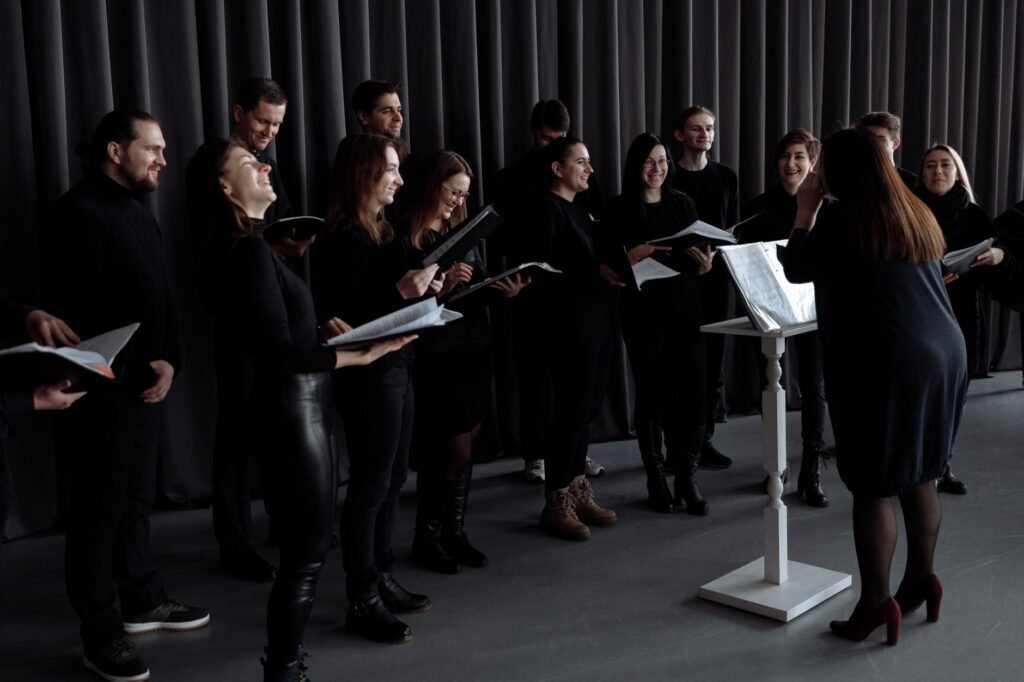
GLEE is the other workhorse, and its past is more tangled. The Old English gliu or gleo covered entertainment, jest, play and sport, usually with music implied. The word then fell out of use from about 1500 to about 1700 and returned to currency in the late 1700s. In the meantime it had gained a technical meaning. From the 1650s a glee was a composition for three or more solo voices, unaccompanied, and the form was popular from roughly 1760 to 1830.
The glee club, recorded from 1814, takes its name from that musical sense rather than from anybody’s mood. So a clue about choirs or college singers that lands on GLEE is using the song form, while a bare Merriment clue is using the feeling. The spelling is identical either way, so GLEE the part song and GLEE the good mood look the same in the grid, and for solving that difference never matters.
From FUN to AMUSEMENT, by length
Match the blanks first:
| Letters | Answer | What tips it |
|---|---|---|
| 3 | FUN | Short, casual slots |
| 4 | GLEE | The standard four-letter fill |
| 5 | MIRTH | The closest match, and the default at five |
| 5 | CHEER | Festive or seasonal wording |
| 6 | GAIETY | A slightly formal, old-fashioned tone |
| 7 | JOLLITY | Parties and plenty of noise |
| 8 | HILARITY | Laughter getting out of hand |
| 9 | AMUSEMENT | The long, mild option |
The five-letter pair is the only real collision, and it is an easy one. Line them up and MIRTH and CHEER never match box for box, M against C, I against H and on down the word, so whichever crossing you get first decides it. CHEER tends to suit festive or seasonal wording, while MIRTH suits laughter. At six and seven squares there is no contest: GAIETY and JOLLITY are the only common fills, and both carry a slightly old-fashioned tone.
Merriment is a noun, so the answer is one too
Merriment is a noun, and crossword convention keeps the part of speech the same on both sides of the clue. That rules out MERRY, JOLLY and JOVIAL, which are adjectives and which solvers reach for first because they sound so close to the clue word. It also rules out verbs such as REVEL. If the clue wanted an adjective, it would be worded as one.
Watch for small additions that shift the target. A clue reading Sound of merriment wants the noise rather than the feeling, and that wording has produced LAUGH, LAUGHTER, GUFFAW and HAHA. A plural clue needs an S at the end. When the wording adds a setting, such as a holiday or a party, the tone of that setting usually helps you choose between CHEER, JOLLITY and GAIETY.
Loud merriment and quiet merriment
The candidates also sit at different volumes, and any modifier in the clue is a hint about which one is wanted. HILARITY is the loud end, laughter that has stopped being polite. AMUSEMENT is the quiet end, closer to a smile than a roar. MIRTH, GLEE and CHEER sit in the comfortable middle, which is exactly why the bare clue lands there. If the wording adds wild, great or helpless, lean toward HILARITY. If it adds mild or quiet, AMUSEMENT becomes the better bet, and the square count will usually confirm the choice within a crossing or two.
Frequently asked questions
What is the answer to the Merriment crossword clue?
MIRTH is the standard five-letter answer, and it shares a Germanic root with merry. For four squares use GLEE, for three use FUN, and for longer slots try GAIETY, JOLLITY, HILARITY or AMUSEMENT depending on the count.
Why is GLEE connected to glee clubs?
A glee was a musical composition for three or more unaccompanied solo voices, popular from about 1760 to 1830. Glee clubs, recorded from 1814, were named after that song form, not after the singers being especially cheerful, although the word also means merriment.
Can the answer be MERRY or JOLLY?
Not for this exact clue. Merriment is a noun, and crossword answers match the part of speech of their clues. MERRY and JOLLY are adjectives, so they belong to clues worded as adjectives. Stick to nouns such as MIRTH, GLEE, FUN and GAIETY.