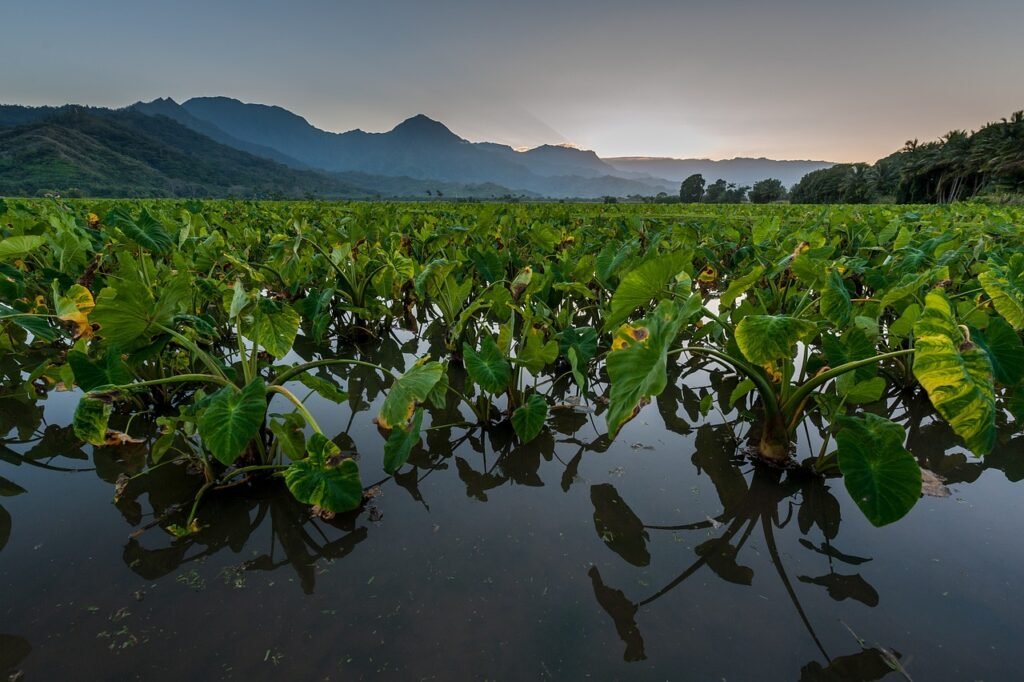
The answer is TARO, four letters. Taro is the large-leafed food plant grown across the tropics for its starchy corm, and a recent American newspaper puzzle gave it as the answer to Tropical plant, word for word. The clue is loose enough to admit other plants too, so the table further down sorts the field by length.
A corm, not a root, is what gets eaten
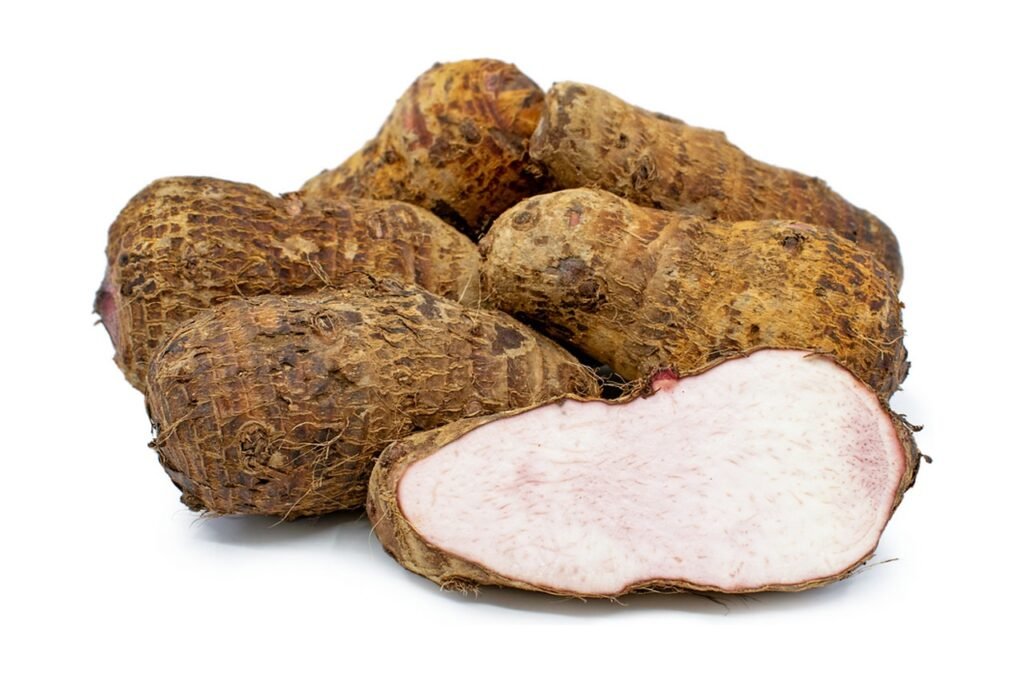
Clues call taro a root or a tuber, and botanically neither is quite right. The main part people eat is a corm, the swollen base of the stem that sits underground and stores starch. Above it rise long stalks carrying very large leaves, which is why taro and its relatives grown as ornamentals are known as elephant ears.
The word is Polynesian and reached English in 1769. Hawaiian has its own form, kalo, and in Hawaii the corms are steamed and mashed with water to make poi, a staple that gives setters an easy way into this entry. If poi appears anywhere in a clue, TARO is the likely fill, with EDDO, a close relative also grown for its corms, as the four-letter alternative. The plant may have been domesticated more than once, with New Guinea, mainland Southeast Asia and northeastern India all proposed as places where it happened.
Why raw taro stays off the menu
Taro belongs to the arum family, the aroids, and most members of that family produce calcium oxalate crystals. In taro they take the form of microscopic needles called raphides, and they make the raw plant toxic to people and pets. Cooking renders the corm palatable, and so does steeping it in cold water overnight.
The family resemblance shows up in plenty of living rooms. Philodendron, monstera and anthurium are all aroids, and so is dieffenbachia, known as dumb cane because chewing it can cause swelling and a temporary inability to speak. Taro is the most widely cultivated of the family’s food plants.
The adjective in front of plant steers the fill
Setters often add one word to this clue, and each addition points at a different plant. Starchy leads to TARO. Showy, flowering or lilylike leads to CANNA, a genus native to the tropical and subtropical Americas that is often called a canna lily but is not a true lily; botanists place it in the same order as gingers and bananas. Palmlike leads to CYCAD, a seed plant often mistaken for a palm, although the two are so distantly related that they are classified in different phyla.
The bare two-word version is where the longer entries have appeared. BEGONIA, PASSIONFLOWER and even BIRDOFPARADISE have all run under exactly the same wording, which is why the length of your slot matters more here than the definition does.
Four squares up to fourteen
| Letters | Answer | What points to it |
|---|---|---|
| 4 | TARO | Starchy, poi, or the bare clue |
| 4 | ALOE | The other four-letter regular |
| 5 | CANNA | Showy, flowering or lilylike |
| 5 | CYCAD | Palmlike |
| 5 | AGAVE | Spiky rosette, mostly British grids |
| 5 | YUCCA | Dry-country shrub, see below |
| 7 | BEGONIA | Houseplant with lopsided leaves |
| 13 | PASSIONFLOWER | Long slots only |
| 14 | BIRDOFPARADISE | Long slots only |
TARO and ALOE disagree at all four squares: T against A, A against L, R against O, O against E. Whichever crossing you land first, it picks the plant.
BEGONIA, the seven-letter option, carries a person’s name. The French botanist Charles Plumier coined it to honor Michel Bégon, a former governor of the French colony of Saint-Domingue, and the name first appeared in print in 1700. Its leaves are usually lopsided, one side larger than the other.
YUCCA and yuca are two different plants
The five-letter YUCCA is a trap for anyone who knows the produce aisle. Yucca, with two Cs, is a genus of spiky shrubs and trees grouped in the same subfamily as agave; its native range covers North and Central America, and it is built for dry conditions. Yuca, with one C, is a common name for cassava, the starchy root crop native to South America, and the single-C spelling is often used precisely to keep the food apart from the shrub.
For the grid, that means a clue about eating points toward TARO, while a clue about spiky leaves or dry ground points toward YUCCA or AGAVE, even though the clue itself says tropical.
Frequently asked questions
What is the four-letter answer to tropical plant?
TARO is the lead answer, a food plant grown across the tropics for its starchy corm, and it has appeared under this exact wording in an American newspaper puzzle. The table lists the other common four-letter fill, and the two share no letter in any position.
What five-letter tropical plants fit this clue?
CANNA, CYCAD, AGAVE and YUCCA all take five squares. CANNA suits clues that mention showy or lilylike flowers, CYCAD suits palmlike, and AGAVE or YUCCA suit spiky leaves. Read the adjective in the clue before you commit to any of them.
Is yucca the same plant as yuca?
No. Yucca, spelled with two Cs, is a genus of spiky shrubs related to agave and adapted to dry conditions. Yuca, with one C, is a common name for cassava, a starchy root crop native to South America. The two spellings are often used to keep them apart.