Cover graphic by KnackDaily.
Run a full reservoir of equal parts white vinegar and water through the brew cycle, pausing halfway to let it sit in the tank, then follow with two or three cycles of plain water. Wash the basket and carafe by hand with dish soap, because the acid handles scale and the soap handles oil.
Your machine has two different problems inside it
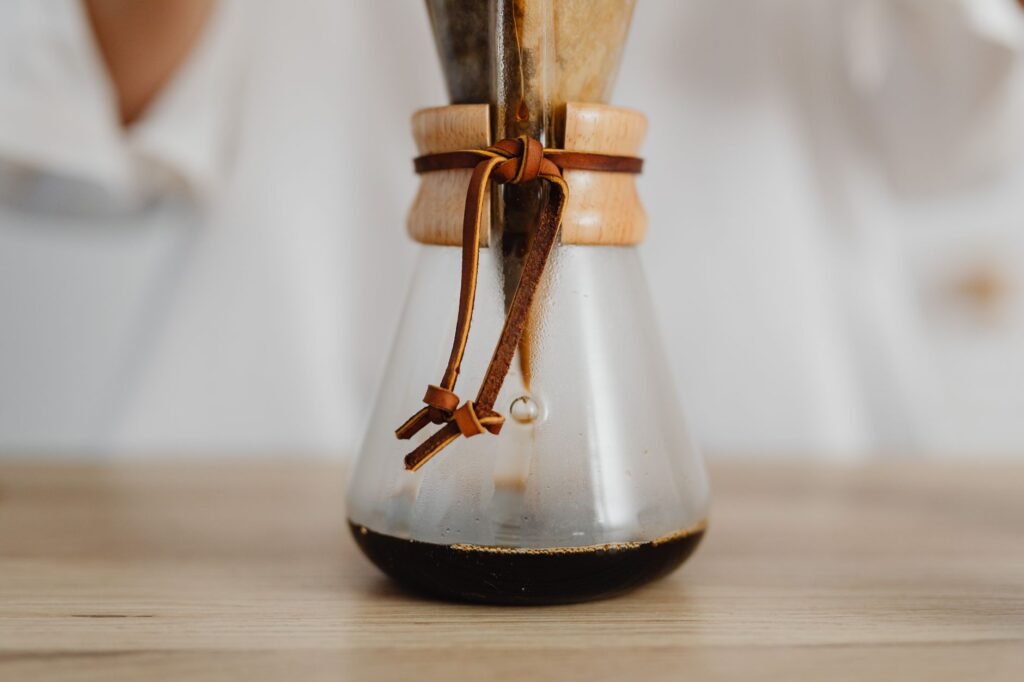
Everything upstream of the brew basket suffers from scale. Water is heated, some of it flashes to steam, and the dissolved calcium and magnesium it was carrying come out of solution as a hard carbonate crust on the heating element and inside the tube. Scale is alkaline, so it dissolves in acid, which is the entire logic behind the vinegar cycle. The carbonate reacts, fizzes off as carbon dioxide, and leaves as a solution.
Everything downstream suffers from oil. Coffee is full of lipids that coat the basket, the spray head and the carafe in a thin brown film, and that film goes rancid within days. Acid does very little to a fat. Soap does, because a surfactant can wrap an oil droplet and carry it into water. Using vinegar alone leaves the bitter film exactly where it was, which is why a descaled machine can still brew sour coffee.
Why the machine slows down before it tastes bad
Scale builds inside a narrow tube, so the effect on flow shows up early. A brew that used to take a few minutes stretches out, the machine gets louder, and it sputters at the end of the cycle. Less obviously, a scaled element cannot hand its heat to the water efficiently, so brew temperature drops. Coffee brewed cooler under extracts, which reads to most people as weak and sour rather than as a hardware problem.
How fast that happens is set by your water. Hard water areas can crust a machine within a couple of months, soft water areas can go much longer, and a filtered or distilled fill slows it further still. Rather than following a fixed schedule, watch for the sputtering and the longer cycle, and check what your local water utility publishes about hardness if you want a real answer for your address.
The full clean, in order
- Empty the carafe and remove the used grounds and the filter basket.
- Take out any charcoal water filter cartridge before descaling, since acid ruins it.
- Fill the reservoir with equal parts white vinegar and water, or with the manufacturer’s descaler if the manual names one.
- Start a brew and stop it about halfway. Let the hot solution sit in the tank and tube for around half an hour so it has contact time.
- Finish the cycle, discard the liquid, and run two or three full cycles of clean water until no vinegar smell remains.
- Wash the carafe, lid, basket and any permanent mesh filter in hot soapy water, scrubbing the mesh with a soft brush.
- Wipe the spray head underside and the warming plate, then leave the reservoir lid open so it dries out.
What each method actually fixes
| Treatment | Works on | Does nothing for |
|---|---|---|
| Vinegar or citric acid cycle | Mineral scale in the tank, element and tube | Rancid coffee oil in the basket and carafe |
| Dish soap and a soft brush | Oil film on carafe, basket, mesh filter | Scale you cannot reach by hand |
| Commercial descaler | Scale, often faster and with less smell | Anything on the downstream side |
| Baking soda in the reservoir | Little, it is alkaline like the scale itself | Both problems, mostly |
| Bleach anywhere in the machine | Nothing you want | Everything, and it is dangerous with vinegar |
| Using filtered water daily | Slowing how fast new scale forms | Scale already in there |
Two cautions before you start. Never combine vinegar with bleach or with any chlorine cleaner, since the mix releases chlorine gas. And check your manual first, because some manufacturers specifically advise against vinegar for their machines and will point you to their own descaling product instead.