
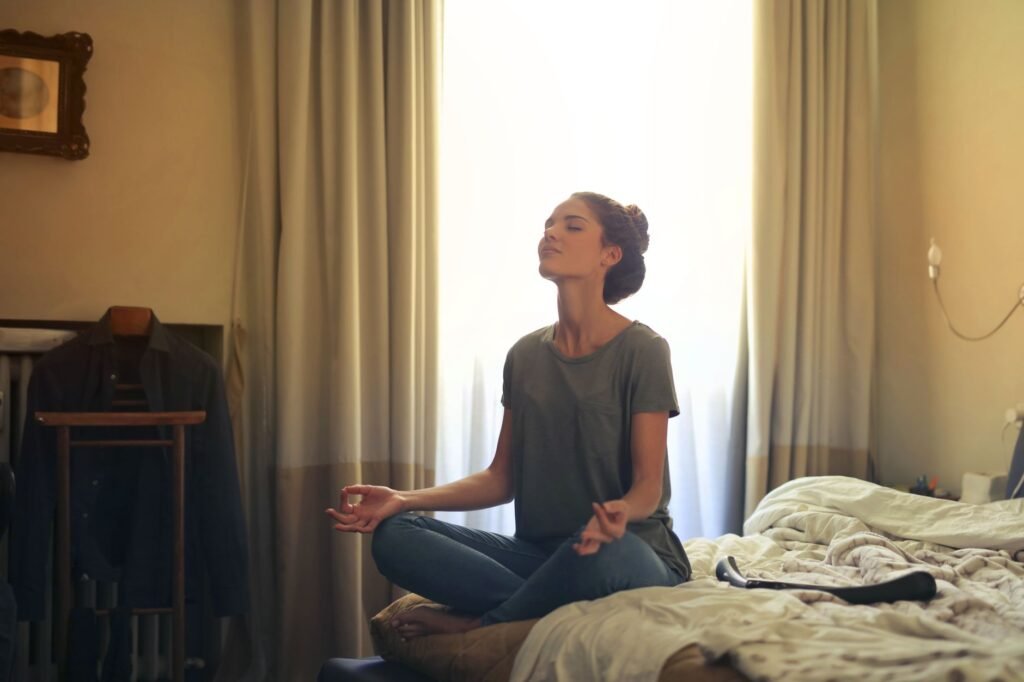
To meditate, sit comfortably, set a timer for a few minutes, and rest your attention on the feeling of your breath. Whenever your mind wanders, which it will, notice where it went and gently bring it back. Coming back is the practice itself, not a sign you are doing it wrong.
Choosing a spot, a posture and a timer
You don’t need special gear. Pick a place where you are unlikely to be interrupted for a few minutes, silence your phone notifications, and sit in a way you can hold without strain.
A kitchen chair works well. Sit toward the front edge with your feet flat, back upright but not rigid, and hands resting on your thighs. A cushion on the floor is fine too, as long as your knees and hips are comfortable. Let your eyes close or rest your gaze softly on the floor a few feet ahead.
Use a timer so you aren’t checking the clock. Five minutes is a sensible first target. Longer sessions come later and on their own.

Your first sitting, one breath at a time
- Start the timer and take two or three slower breaths to settle in.
- Let the breath return to its normal rhythm. You aren’t controlling it, only watching it.
- Pick one place to feel it, such as the air at the nostrils, the chest rising or the belly moving.
- Stay with each in breath and each out breath as closely as you can.
- When you notice you are thinking, silently note “thinking” and return to the breath.
- When the timer sounds, sit for a few more seconds, notice how you feel, then open your eyes.
That’s a complete session. It may feel like you spent most of it distracted. Almost everyone does at first.
What to do when thoughts keep pulling you away
A wandering mind isn’t failure. The moment you notice you drifted is the moment of attention you are training, so each return counts as a repetition, like lifting a weight.
A few tricks help when the mind is especially busy. Counting breaths from one to ten and starting over whenever you lose count gives the attention something concrete to do. Silently saying “in” and “out” works in a similar way. If a sound or itch keeps grabbing you, make that sensation the object for a few breaths, then return to the breath.
Try not to judge the session. A restless ten minutes still counts, and some days are noisier than others.
Other styles to try once breath practice feels familiar
Breath focus is the usual starting point, but it is one of many approaches. Each one swaps in a different anchor for your attention.
| Style | What you pay attention to | Good when |
|---|---|---|
| Body scan | Sensations moving slowly from feet to head | You feel tense or can’t settle |
| Loving kindness | Silently repeating wishes of well being for yourself and others | You want a warmer, less analytical practice |
| Walking meditation | The feel of each step as you walk slowly | Sitting still is uncomfortable |
| Mantra | A word or phrase repeated silently | Busy thinking crowds out the breath |
| Open awareness | Whatever arises, without holding on to it | You already have some steadiness |
Guided recordings from apps, libraries and community centers are an easy way to sample these without having to remember the instructions.
Making it daily and knowing when to talk to someone
Consistency beats length. A few minutes at the same time each day, tied to something you already do such as morning coffee or brushing your teeth, builds a habit faster than an occasional long sit. Add a minute or two when the current length feels easy.
The National Center for Complementary and Integrative Health says meditation is usually considered to have few risks, though some people report unpleasant experiences such as anxiety. Its overview of meditation and mindfulness also stresses that meditation shouldn’t replace medical care. If sessions bring up distress that lingers, or you are managing a physical or mental health condition, talk with a health care provider or a trained teacher.
Frequently asked questions
How long should a beginner meditate?
Five minutes is a comfortable place to start, and even two or three minutes counts if that is what you can manage. A daily habit counts for more than the length. Once a session feels easy, add a minute or two at a time rather than jumping to half an hour.
Is it okay to meditate with music?
Soft instrumental music or nature sounds can make it easier to settle, especially at first. Lyrics tend to pull attention toward the words, so many people choose tracks without them. Some also practice with the music as the focus, returning to the sound each time the mind wanders.
What is the difference between meditation and mindfulness?
Meditation is the broad term for practices that train attention, such as focusing on the breath, a sound or a phrase. Mindfulness means keeping present moment awareness without judging it. You can build it through sitting meditation, and you can also bring it into walking, eating or washing dishes.
How do you do walking meditation?
Pick a quiet path about 10 to 30 paces long and walk it more slowly than usual, paying attention to the feeling of each foot lifting and touching down. At the end, pause, turn around slowly and walk back. When your mind wanders, notice where it went and return to the sensations of the next step.
How do you deal with boredom during meditation?
Treat the boredom as one more thing to notice rather than a sign the practice is failing. Get curious about it, such as where you feel it in the body and what thoughts come with it, since interest is the opposite of boredom. Short, regular sessions help, and so does switching to counting breaths for a while.
What are the benefits of meditation?
Research reviewed by the National Center for Complementary and Integrative Health suggests meditation and mindfulness practices may ease symptoms of anxiety and depression, improve sleep quality and help lower blood pressure in some people. Much of that research is preliminary, though, so treat meditation as a complement to medical care, not a replacement for it.