To write a novel outline, start with a one-sentence premise, decide your ending and key turning points, then break the story into a list of scenes that each move a character toward or away from a goal. Keep it flexible. An outline is a map for drafting, not a contract.
Deciding how detailed your novel outline should be
Writers fall along a range. Some plan every scene before drafting, others start with a character and a vague destination and discover the rest. Neither is wrong, and the right level of detail is the one that keeps you writing instead of stalling. Pick a format that matches how much you like to know ahead of time.
| Outline format | What it contains | Good for |
|---|---|---|
| One-page synopsis | The whole story in a few paragraphs, ending included | Writers who like room to improvise |
| Turning point outline | Only the major events that change the story’s direction | A light skeleton before drafting |
| Scene list or spreadsheet | One line per scene with who, where and what changes | Complex plots and multiple viewpoints |
| Chapter by chapter outline | A paragraph or more for every chapter | Writers who want few surprises |
| Reverse outline | A summary made after drafting, scene by scene | Revising a messy first draft |

Building the outline from premise to scenes
- Write the premise in one sentence that names a character, what they want and what stands in the way.
- Decide how it ends, even loosely. Knowing the destination makes every earlier choice easier.
- Mark the big turning points, such as the event that starts the story, a midpoint shift, the lowest moment and the climax.
- Sketch how your main character changes between the first page and the last.
- Fill the gaps with scenes, noting for each one the character’s goal, the obstacle and how the scene ends differently than it began.
- Add subplots and check that each one touches the main plot at least once.
If a scene has no change in it, it may be a candidate for cutting or merging.
Using three-act structure as a scaffold
Three-act structure is the most common frame people reach for. Act one sets up the world and ends when the character commits to a problem they can’t walk away from. Act two raises the stakes through complications and usually includes a midpoint where something the character believed turns out to be wrong. Act three brings the final confrontation and its fallout.
Treat it as a way to spot gaps, not a formula. If your second act feels like a long stretch of the same kind of scene, the structure suggests where a reversal or new pressure could help. Other frames, such as a hero’s journey or a mystery built around clue placement, can do the same job.
Tracking subplots and timelines alongside the main plot
Longer novels get tangled when a subplot vanishes for a hundred pages or a character is in two places at once. A simple spreadsheet fixes most of that. Give each scene a row and add columns for chapter, viewpoint character, story date, location and the plot threads it advances. Color-coding the threads shows at a glance when one goes quiet for too long.
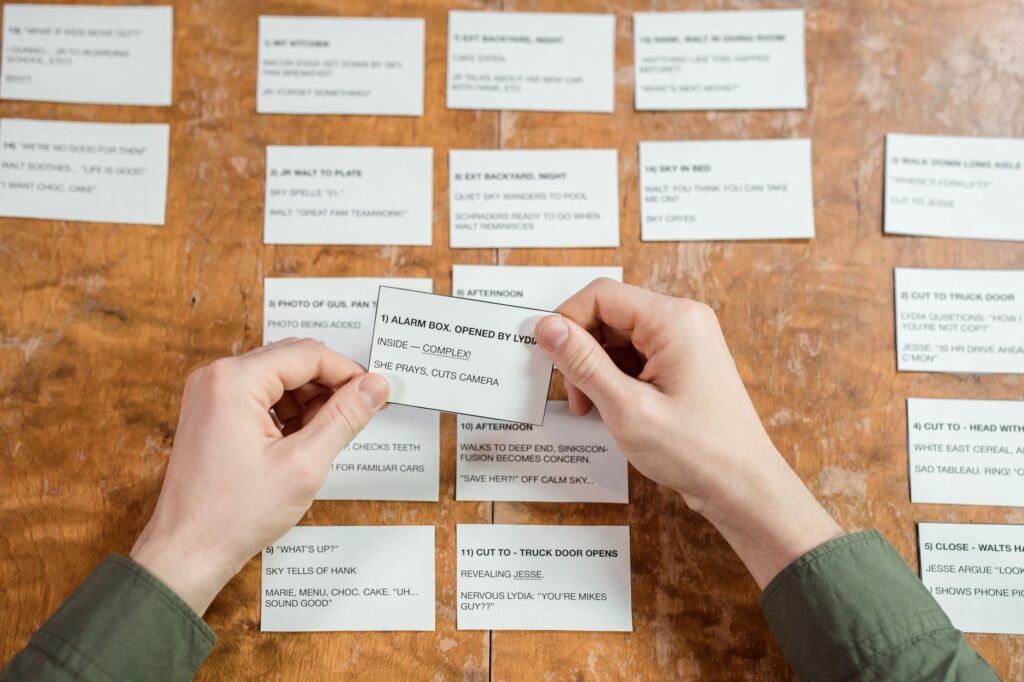
Index cards on a corkboard or a table do the same thing physically, and some writers find rearranging cards by hand makes structural problems easier to see. Writing apps built for long projects let you keep each scene as a separate file with a note attached, which makes moving chapters around painless.
Revising the outline once the draft starts pushing back
Characters will make choices the outline didn’t predict. When that happens, pause and update the outline from that point forward rather than forcing the draft back on course. Keep old versions in a separate file so you can recover an idea you abandoned.
After the first draft, build a reverse outline by summarizing each finished scene in a line or two. Comparing it with your original plan shows where the story drifted, which threads were dropped and where pacing sags, and that gives your revision a clear starting point.
Frequently asked questions
How long should a novel outline be?
There's no required length. A one-page synopsis can be enough for writers who like to discover the story while drafting, while others write outlines running dozens of pages. Aim for enough detail that you always know what the next scene needs to accomplish.
Should I outline before or after writing a first draft?
Either works. Outlining first can prevent stalled drafts and major rewrites. Drafting first and building a reverse outline afterward suits writers who find the story by writing it. Many writers mix the two, sketching key turning points first and outlining the rest as they go.
What is the difference between an outline and a synopsis?
An outline is a working tool for you, often broken into scenes or chapters with notes. A synopsis is a short prose summary of the entire story, ending included, usually written to show agents or editors what the book is about. An outline can help you write the synopsis later.
How can you write a novel in 30 days?
Set a daily word count and outline before day one, so every session starts with a scene already planned. The National Novel Writing Month challenge set a goal of 50,000 words during November's 30 days, which works out to about 1,667 words a day. Save revising for after the month ends so the draft keeps moving.
How long does it take to write a novel?
There is no standard timeline, since it depends on your daily pace and how much revising the book needs. You can estimate it from your word count. At 500 words a day, an 80,000-word draft takes about 160 days, and at 1,000 words a day about 80, with revision time on top.