
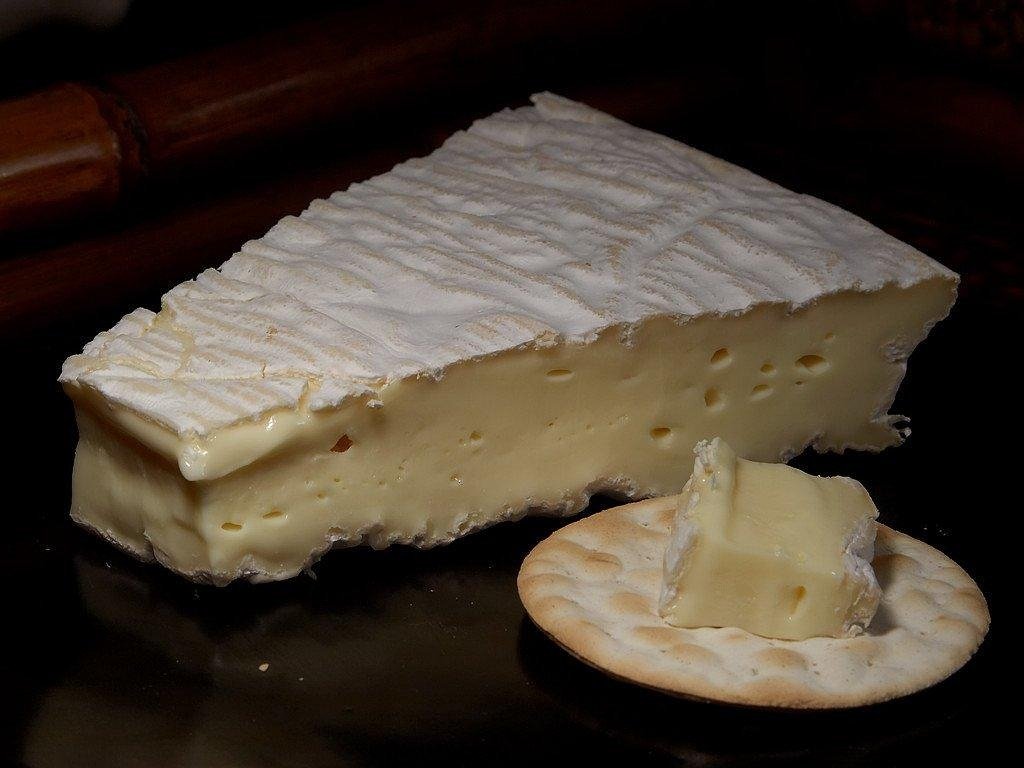
The answer is BRIE, four letters. The soft French cheese with the white, edible rind is one of the answers this clue has produced most often in American puzzles. The word type also lets in whole styles of cheese rather than single named ones, which is why the full list runs from four squares to ten.
Type lets in styles as well as names
Alongside named cheeses such as BRIE, FETA and GOUDA, this clue has accepted SWISS, AMERICAN, NACHO and BLEU. None of those is a single cheese from a single place. In North America, Swiss is a generic name for any cheese that resembles Emmental. American cheese is a processed cheese made from cheddar, Colby or similar cheeses with sodium citrate, which lets it be pasteurized without its components separating. NACHO names the cheese sauce, and BLEU is simply French for blue.
So when a slot seems to want something generic rather than a cheese with a hometown, try the category words first.
The white rind is a mold, and it is eaten
Brie is named for the French region it comes from, roughly the modern department of Seine-et-Marne, east of Paris, and it is often compared with Camembert, a similar cheese native to a different region of France. After the curd is drained, salted and inoculated with a culture such as Penicillium camemberti, the cheese ages for at least four or five weeks, and the white mold that grows becomes the rind. It is normally eaten along with the soft paste inside. Left for months instead of weeks, the cheese turns stronger, darker and drier, and is then called brie noir, black brie.
Only two Bries carry France’s protected designation, Brie de Meaux and Brie de Melun, both certified in 1980. Brie de Meaux is made from unpasteurized milk; Brie de Melun is smaller, with a stronger flavor and a more pungent smell. For the grid, all of it collapses into four letters.
Why Swiss cheese has eyes
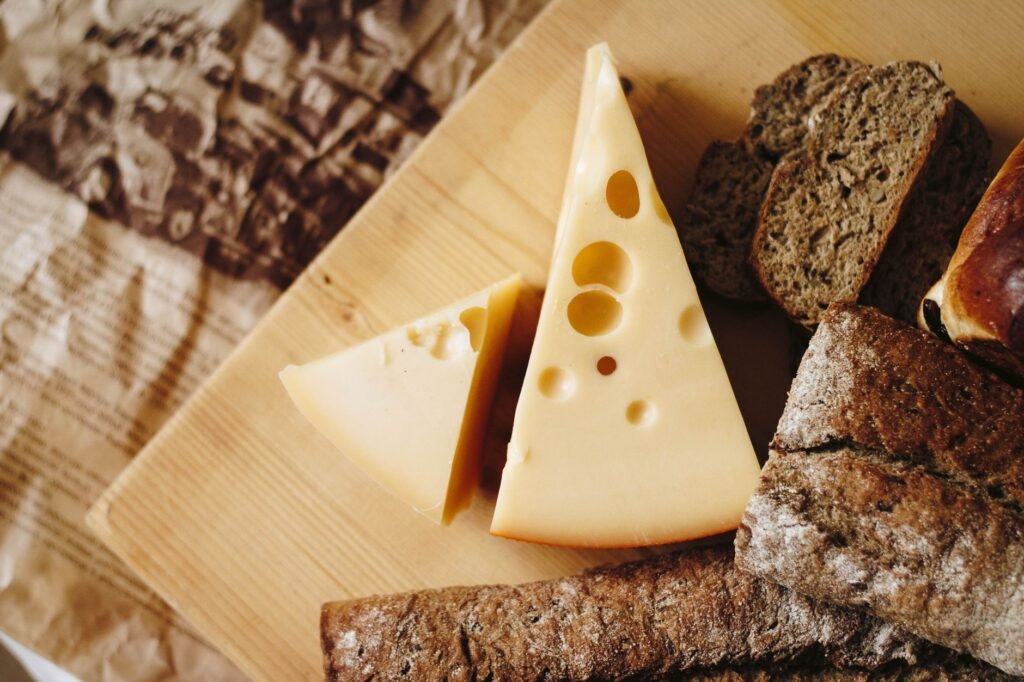
SWISS has answered this clue in American grids. The name is generic, but the model is Emmental, a yellow, medium-hard cheese that originated in the area around Emmental in Switzerland, and the defining feature is the holes, which cheesemakers call eyes. Bacteria make them. Propionibacteria in the cheese consume the lactic acid produced by the other bacteria and release acetate, propionic acid and carbon dioxide, and the gas slowly gathers into bubbles as the cheese ages. A cheese of this kind that comes out without holes is called blind.
Cheese answers by the number of squares
| Letters | Answer | Note |
|---|---|---|
| 4 | BRIE | Soft, white rind |
| 4 | EDAM | Dutch, the other common four |
| 4 | FETA | Greek, kept in brine |
| 4 | BLEU | French for blue |
| 5 | SWISS | A style, not a single cheese |
| 5 | GOUDA | Dutch |
| 5 | COLBY | Wisconsin, 1885 |
| 5 | NACHO | The sauce |
| 6 | ROMANO | Italian, hard |
| 7 | CHEDDAR | English in origin |
| 8 | AMERICAN | Processed |
| 8 | PARMESAN | Italian, hard |
| 8 | CHESHIRE | English |
| 8 | MUENSTER | American spelling, see below |
| 10 | DANISHBLUE | Space dropped |
At four squares only BRIE and BLEU share a position, the B in the first square, so the second square settles it: R for BRIE, L for BLEU.
COLBY has a well-documented American origin. Joseph Steinwand developed it in 1885 at a cheese factory near Colby, Wisconsin, the town it is named after, and he departed from the standard cheddaring process by washing the curd with cold water.
MUENSTER is not the French Munster
The eight-letter MUENSTER looks like a misspelling, which makes it easy to doubt, but it names a different cheese from its French near-namesake. American Muenster is a semi-soft cheese created in the United States and popularized in the early twentieth century; it is usually mild, and its orange rind comes from annatto. It may have begun as an imitation of Munster, a washed-rind cheese from Alsace familiar to German immigrants, but the French cheese is made from unpasteurized milk and is considerably more pungent. Nor does the name come from the German cities of Münster or Munster. The grid entry for this clue uses the American spelling.