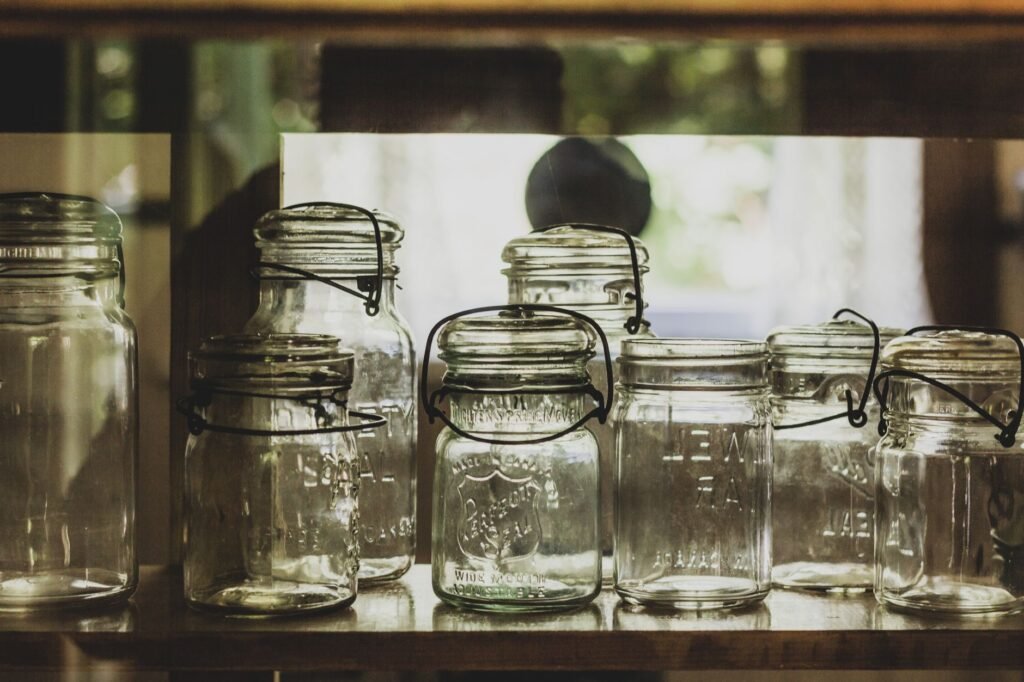
The answer is BIN, three letters. This is one of the least helpful clues in the language, because CAN, TIN, TUB, JAR, POT, JUG, KEG, URN and BOX all fit the same three squares. Nothing in the definition separates them, so treat the crossings as the real clue and the wording as a hint.
Why this clue is decided by everything except the clue
Most crossword entries work by reading a definition and retrieving a word. This one does not. With nine common fills at three letters, writing anything in on a first pass is close to a coin toss with nine sides, and experienced solvers simply skip the entry and come back once a crossing or two is down.
Two crossings is normally all it takes. The candidates share very little: the opening letters run B, C, T, J, P, K and U, and the middle letters are mostly A, I, O and U. Any confirmed square kills most of the field, and any two confirmed squares leave a single survivor far more often than not. The discipline is to resist filling it early, because a wrong guess here poisons two crossing entries at once.

The whole field, three squares to ten
Published answers for this clue and its close relatives, sorted by length:
| Letters | Answer | Wording that points at it |
|---|---|---|
| 3 | BIN | Storage, recycling, loose goods |
| 3 | CAN | Food, soda, aerosol |
| 3 | TIN | British wording, or cookies |
| 3 | JAR | Glass, lids, preserves |
| 3 | TUB | Butter, ice cream, bathing |
| 3 | POT | Cooking or plants |
| 3 | JUG | Liquid, with a handle |
| 3 | KEG | Beer, and nothing else |
| 3 | URN | Ashes, or coffee at a buffet |
| 3 | BOX | Cardboard, gifts, packing |
| 4 | CASE | Wine, instruments, luggage |
| 4 | PAIL | The old fashioned bucket |
| 6 | BUCKET | Carrying water or sand |
| 6 | VESSEL | Ships and containers at once |
| 10 | RECEPTACLE | The formal word |
What separates a tin from a can
In American English a can is the sealed metal food container and a tin is usually a shallow decorative box, the kind cookies arrive in around the holidays. British English runs it the other way: the sealed metal food container is a tin, and canned goods are tinned. American puzzles know the split and use it, so wording that sounds British, or a clue naming a British food, is a nudge toward TIN over CAN.
Tin is also the metal, element number fifty on the periodic table, which hands constructors a second clue angle entirely. If the surface mentions elements, plating or alloys, the container sense is not in play at all and you are answering a chemistry clue wearing a kitchen disguise.
Urn, keg and vat each come with a job
Some container words are general and some are not, and the specific ones are gifts when they appear. A keg holds beer and nothing else in ordinary speech. An urn holds ashes, or holds coffee in institutional quantities, and that pair of meanings is exactly why a setter reaches for it when a misdirection is wanted. A vat is industrial, a tank is fixed in place, and a carafe is for serving rather than storing.
When a clue names one of these instead of the bare word container, it is doing you a favor. The specificity that makes a word awkward in conversation is the same thing that makes it solvable in a grid, so a narrow clue is always better news than a broad one.
One word inside another: the cryptic containment clue
In a cryptic crossword, container is often not a definition at all. It is an instruction to place one string of letters inside another, and the wording carries it with words like in, around, holding, swallowing or grips. Solvers call these containment or insertion clues, and they are one of the standard cryptic devices.
Mainstream American dailies are not cryptics, so the device does not show up there, but variety sections and British imports use it constantly. The moment a clue reads like a sentence about one thing holding another, stop treating container as a noun and start treating it as an instruction.