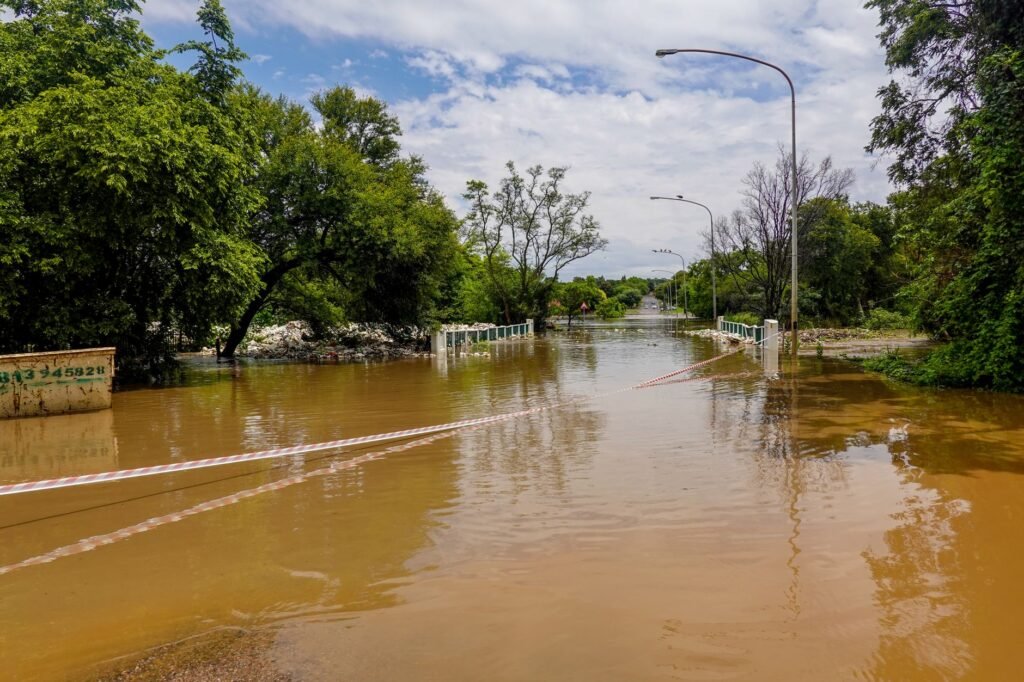
The answer is FLOOD, five letters. It works as a noun for an overwhelming rush of water and as a verb for swamping something, so it matches the clue in either role. SPATE fills the same five squares, while TORRENT, CASCADE and DOWNPOUR handle the longer slots.
Deluge is Latin for a washing away
DELUGE came into English in the late 1300s meaning an overflowing of water, a great flood, and in particular Noah’s Flood in Genesis. It came through Old French from the Latin diluvium, which is built on diluere, to wash away, from dis-, away, and a form of the verb to wash. The same diluvium sits inside antediluvian, literally before the Flood, a word coined in the 1640s by the English physician Sir Thomas Browne and used since the 1700s, often humorously, for anything hopelessly out of date. The figurative sense of anything that overflows, a deluge of letters or of questions, is recorded from the early 1400s.
FLOOD is the native English word for the same idea. Old English flod could mean a flowing of water, a tide, an overflow of land and Noah’s Flood too, and it grows from the same ancient root that gave English flow. The French phrase après moi, le déluge, after me the flood, is traditionally ascribed to Louis XV. The Telegraph’s quick crossword used FLOOD for this exact clue in September 2026.

Deluge can be a noun or a verb
The clue word works both ways, and your answer has to match. As a noun a deluge is the rush itself, which gives FLOOD, SPATE, TORRENT, DOWNPOUR, CASCADE, AVALANCHE, ONRUSH and INUNDATION. As a verb, recorded since the 1590s, to deluge is to overwhelm, which gives INUNDATE, ENGULF, DRENCH, OVERRUN and OVERWHELM. FLOOD is the rare answer that does both jobs, so it can go in before you know which role Deluge is playing.
If the clue is inflected, the answer follows. Deluged has been answered with SWAMPED, INUNDATED and OVERWHELMED, and Deluges with FLOODS, SPATES and TORRENTS. The New York Times has also used ONRUSH for the bare noun, a reminder that a deluge need not be water at all. Even the vessel that rode out the Flood gets clued this way, since ARK has answered Deluge refuge.
Flood words by the number of squares
Here is the field, shortest first.
| Letters | Answer | Noun or verb |
|---|---|---|
| 5 | FLOOD | Both, the default |
| 5 | SPATE | Noun, a sudden rise in a river |
| 6 | ONRUSH | Noun, a forceful surge |
| 6 | DRENCH | Verb, soak completely |
| 7 | TORRENT | Noun, a violent stream |
| 7 | CASCADE | Noun, falling water |
| 8 | DOWNPOUR | Noun, heavy rain |
| 8 | INUNDATE | Verb, the formal one |
| 9 | AVALANCHE | Noun, a mass of anything |
| 9 | OVERWHELM | Verb, figurative |
| 10 | INUNDATION | Noun, the formal one |
| 11 | POURINGRAIN | Two words run together |
INUNDATE came into English in the 1620s, from the Latin inundare, to overflow. If the slot has eight squares and the clue reads as a verb, INUNDATE is the fit, because DOWNPOUR only works as a noun.
Torrent once meant burning
TORRENT has a surprising history. It came into English around 1600 from the Latin torrens, rushing or roaring, but the older meaning of that adjective was burning, parching or hot, because it is the present participle of torrere, to parch. The leap from scorching heat to rushing water probably runs through the image of boiling water, and the same Latin verb gave English torrid. By the 1640s a torrent could be any violent flow, of words or feelings as much as water.
CASCADE, the other seven-letter answer, has a gentler history. It arrived in the 1640s from French, which took it from the Italian cascata, a waterfall, from cascare, to fall, and ultimately from the Latin cadere, to fall.
Spate began as a northern river word
SPATE began in Scotland and the north of England in the mid-1400s as a word for a sudden flood, especially one caused by heavy rain or melting snow. Nobody knows where it came from. The figurative sense of a sudden run of something, as in a spate of complaints, is recorded from the 1610s. In a grid it is the natural second choice after FLOOD, and since F, L, O, O, D and S, P, A, T, E never coincide, any checked letter will tell you which to write.
Frequently asked questions
What is the five letter answer for deluge?
FLOOD is the usual five-letter answer, and SPATE is the other one. The two share no letter in the same position, so a single crossing tells you which to write. FLOOD also works when the clue is a verb, which SPATE does not.
What does deluge literally mean?
It comes from the Latin diluvium, a flood, from a verb meaning to wash away. English borrowed it in the late 1300s for a great flood, and especially for Noah's Flood in Genesis, and since the early 1400s it has also meant any overwhelming rush.
Is INUNDATE an answer for deluge?
Yes, when the clue is a verb. To deluge something is to inundate it, overwhelm it or drench it, and grids have used all three. If the clue reads as a noun, look for FLOOD, TORRENT, DOWNPOUR or INUNDATION instead.