The answer is MODEL, five letters. It is pattern in the sense of something to copy, the example you work from, and the Mirror’s quick crossword gave it as the answer to Pattern in September 2026. MOTIF is the five-letter rival when the clue means decoration, and DESIGN and TEMPLATE cover six and eight squares.
Pattern and patron were one word
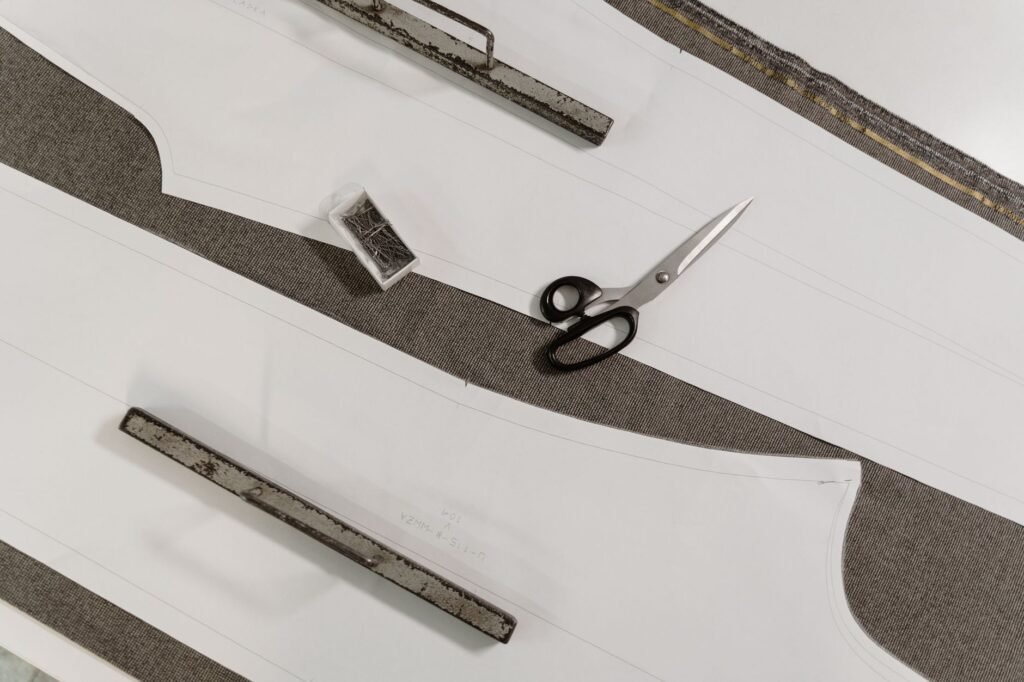
PATTERN began as a spelling of patron. The Old French patron meant a patron or protector and also a model or pattern, and English did not firmly separate the two forms and meanings until the 1700s. The model sense was there early. By the late 1300s the word could mean a figure matching the outline of something to be made, a guide to its shape and size, which is exactly what a dressmaker’s pattern is. That dressmaking sense is on record by 1792, in Jane Austen.
The decorative sense, a design repeated across a surface, is younger and dates to the 1580s. So the clue can point at two ideas, one about copying and one about ornament, and the answers split the same way.
MODEL has a pedigree of its own. It came through French and Italian from the Latin modulus, a small measure or standard. MOLD traces back to modulus too, arriving by way of Old French, so two of the copying answers are relatives. MODEL has meant a standard for imitation since the 1630s.

Sort the answers into copying and decorating
Sort the candidates into families and most of the difficulty disappears. The copying family is MODEL, TEMPLATE, its older spelling TEMPLET, MOLD and EXAMPLE, all things you follow to make another. The decorative family is MOTIF, DESIGN and FIGURE, the shapes on the surface. A smaller group reads pattern as a regularity rather than an object, and that is where TREND, NORM and RULE come from, as in a pattern of behavior. SCHEMA, FORMAT and MATRIX describe the arrangement underneath.
If the clue has a second word, it usually tells you which family to use. A pattern for a dress points at copying, a pattern on wallpaper points at decoration, and a pattern in the data points at TREND. That word took a long route. It began as a verb for the way a river or coastline runs or bends, recorded from the 1590s, and its figurative sense of a general tendency is recorded by 1863.
Eleven pattern answers, shortest first
With the family chosen, the count finishes the job.
| Letters | Answer | Family |
|---|---|---|
| 4 | NORM | Regular behavior |
| 4 | MOLD | Copying, by casting |
| 5 | MODEL | Copying, the default |
| 5 | MOTIF | Decoration that repeats |
| 5 | TREND | A regularity over time |
| 6 | DESIGN | Decoration in general |
| 6 | SCHEMA | Underlying structure |
| 7 | TEMPLET | Old spelling of template |
| 7 | EXAMPLE | Something to follow |
| 8 | TEMPLATE | A guide for cutting or shaping |
| 13 | CONSTELLATION | A pattern of stars |
CONSTELLATION is the outlier, thirteen letters for a pattern made of stars. MATRIX, a six-letter option, comes from a Latin word for a pregnant animal, later a womb, and has meant a mold in which something is cast or shaped since the 1620s.
Motif is the French cousin of motive
MOTIF entered English in 1848 for a theme or feature that recurs through a work of art, from the French motif, dominant idea. The French word comes from the Medieval Latin motivus, moving or impelling, and Middle English had already borrowed the same form in the late 1300s as a variant of motive. So motif and motive are one word that split into two jobs, much as pattern and patron did. When a clue leans on music or fiction, a recurring theme is a MOTIF rather than a design.
Templet is not a typo
TEMPLET looks like an error, but it is the older form. The word appears in the 1670s as templet, a horizontal piece under a girder or beam in building work, probably from a French word for a weaver’s stretcher. The meaning of a gauge showing the shape a finished piece should take is recorded by 1819, in masonry. The spelling shifted to template in the mid-1800s, probably under the influence of plate, and the Century Dictionary of 1895 still listed templet first. If the crossings insist on it, trust them.
Frequently asked questions
Is the answer MODEL or MOTIF?
Both take five squares, so the meaning of the clue decides. MODEL is pattern as something to copy, while MOTIF is a repeated decorative element, like a flower printed across fabric. Both start with MO, so a crossing in any of the last three squares separates them.
What is an eight letter word for pattern?
TEMPLATE fits eight squares. It names a guide used to cut or shape something to a set form. Its older spelling TEMPLET has seven letters and occasionally appears in older puzzles, and the two are the same word in different clothes.
Why do pattern and patron look alike?
They were once the same word. Old French patron meant both a protector and a model to copy, and English did not firmly separate the two spellings and meanings until the 1700s. Patron kept the protector sense, and pattern kept the model.