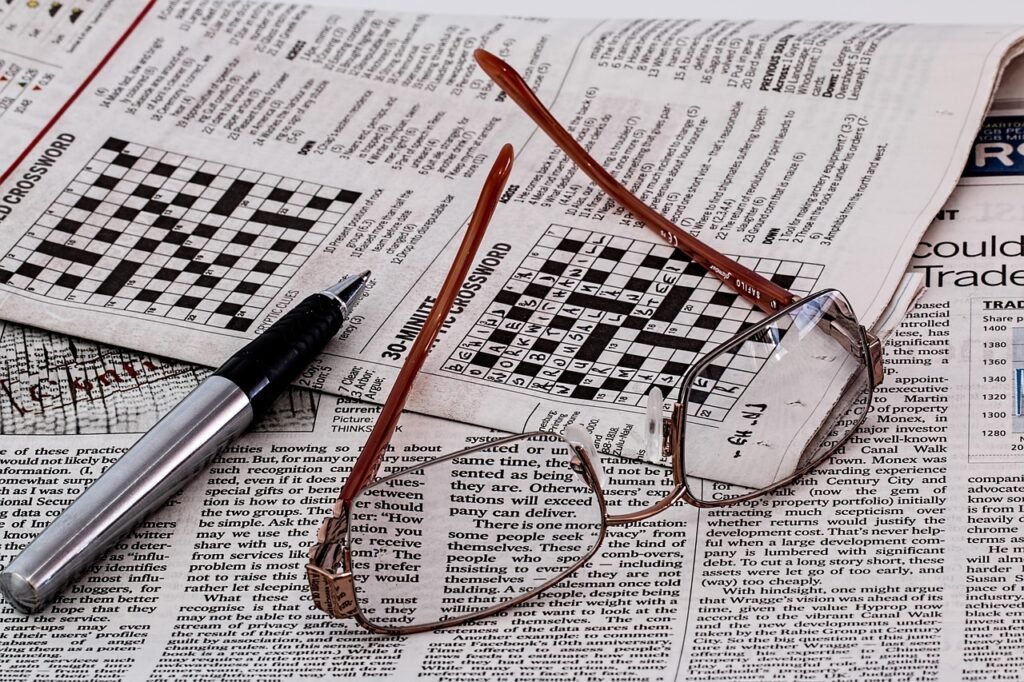
The answer is POSER, five letters. A poser is a question or problem that baffles whoever has to answer it, and it is the answer setters most often attach to Tricky puzzle. TEASER and ENIGMA share six squares, MINDBENDER takes ten and BRAINTEASER eleven.
A poser is named for the act of posing it
The word makes sense once you know an older meaning of pose. From the 1520s English used pose to mean putting questions to someone, interrogating them closely, and by the 1590s it also meant to puzzle or perplex. In the 1580s a poser was a person who asked testing questions. The question itself took the name later, with the first record from 1793.
So the puzzle is named for the act of setting it, which gives the word a slightly combative edge. A riddle can be a party game, but a poser is put to you on purpose, and the point is to see whether you can answer it.
The same five letters can mean a model or a fake
POSER does double duty. Apart from the puzzle sense, it can mean a person who poses, whether for a painter or a photographer, or a person who puts on an attitude to impress. That second sense, one who practices an affected attitude, is recorded from 1881, and it was revived as teenage slang by the early 1980s.
The ambiguity runs the other way in clues. When Poser is the clue rather than the answer, crossword databases list fills such as MODEL and PHONY, and PSEUD, British slang for a pretentious person, is listed too. So do not assume a puzzle is wanted just because the word looks familiar. The crossings will tell you which sense the constructor had in mind long before the clue does.
Puzzle words by the blanks they fill
POSER, TEASER and BRAINTEASER are the main fills listed for this exact wording. The others come from close variants such as tough puzzle, tricky problem, stumper and brainteaser, so treat them as backups when the count rules out the first three.
| Letters | Answer | Where it turns up |
|---|---|---|
| 3 | NUT | Brainteaser wording, a hard nut to crack |
| 5 | POSER | The default for tricky puzzle |
| 6 | TEASER | Short for brainteaser, same sense |
| 6 | TESTER | Tricky problem wording |
| 6 | ENIGMA | Tough puzzle wording, with mystery |
| 6 | RIDDLE | Stumper or brainteaser wording |
| 7 | STINKER | Informal, tough puzzle wording |
| 7 | BAFFLER | Describes the effect on the solver |
| 10 | MINDBENDER | Tough puzzle wording in a big grid |
| 11 | BRAINTEASER | The full form of TEASER |
Enigma and riddle both started as words about speech
ENIGMA came from Greek ainigma, a dark saying or riddle, derived from a Greek verb for speaking obscurely or in riddles, and that verb came from ainos, a tale or proverb. In English it first meant a statement that hides its meaning under obscure words, and the looser sense of anything baffling followed around 1600. A famous English use came in an October 1939 radio broadcast, when Winston Churchill said he could not forecast the action of Russia and called it a riddle wrapped in a mystery inside an enigma. That one line holds two of this clue’s answers.
RIDDLE has a stranger history. Old English had a noun, raedels, that covered a riddle but also counsel, conjecture and discussion. Its final S was later mistaken for a plural ending and dropped, which is how English ended up with riddle in the singular. The word is also linked to read, through the shared idea of interpreting something.
TEASER and TESTER differ in only two squares
Six blanks are where this clue gets crowded. ENIGMA and RIDDLE share no letter position with each other or with either of the T words, so any crossing separates them. TEASER and TESTER are the problem pair. TESTER is plain English for anything that tests, from a battery tester to a taste tester, and in a puzzle clue it means a problem that tests you. They match in the first, second, fifth and sixth squares and differ only in the third and fourth, A and S against S and T. If your crossings have given you T, E, E and R in those outer positions, do not guess. Solve a crossing through the middle first, and the right word will be obvious.