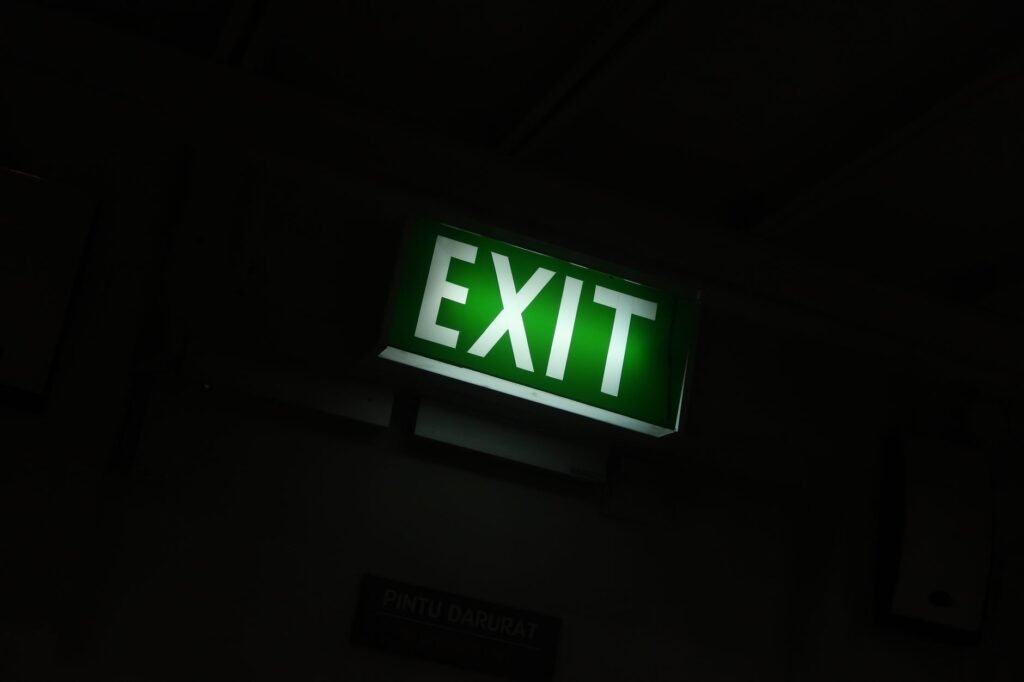
The answer is EGRESS, six letters. It is the formal noun for a way out, the word building codes and property documents use, and it is the standard six-letter fill for this clue. WAYOUT and BOWOUT have the same length, so check one crossing before you commit.
Egress is the word the building code uses
EGRESS came into English in the 1530s from Latin egressus, a going out, formed from ex, out, and gradi, to step or go. The same stepping verb sits inside progress, digress and aggression. At first the English word meant the act of leaving, and by the 1670s it could also mean the place you leave through.
Today it lives mostly in technical writing. The International Building Code gives a whole chapter to Means of Egress and defines a means of egress as a continuous, unobstructed path from any occupied part of a building to a public way. That path has three parts: the exit access, the exit and the exit discharge. In code language, then, the exit is only the protected middle stretch of an egress route, which neatly reverses the clue.
Property law uses the word as well, usually in the pair ingress and egress, the right to get onto a piece of land and back off it. Astronomers use the same pair. During a transit, when a planet crosses the face of the sun, ingress is the planet moving onto the disk and egress is the planet moving off it.

Exit is a Latin sentence in one word
The clue word has its own story. Exit entered English in the 1530s as a stage direction, and in Latin it is a complete sentence: he or she goes out. When more than one character leaves, the script says exeunt, they go out. The most famous example is in The Winter’s Tale, where Shakespeare sends Antigonus off with the direction Exit, pursued by a bear.
That history matters at the grid, because EXEUNT also has six letters. It only works when the clue signals a group leaving, so a plain Exit should not be answered with it. The sense of exit as a doorway came much later, in the 1780s, which is why the stage direction and the lighted sign over a door can feel like different words.
The Exit shortlist, four squares to nine
| Letters | Answer | Part of speech and use |
|---|---|---|
| 4 | QUIT | Verb, closing a computer program |
| 5 | LEAVE | Verb, the plain everyday fill |
| 5 | GOOUT | Verb phrase, entered as one word |
| 6 | EGRESS | Noun, formal, the default at six |
| 6 | WAYOUT | Noun, standard British sign wording |
| 6 | BOWOUT | Verb, to withdraw from a contest |
| 7 | STEPOUT | Verb, to leave briefly |
| 9 | DEPARTURE | Noun, the act of leaving |
Way out and bow out are different parts of speech
The two phrase answers at six squares split along grammar. WAYOUT is a noun, the thing you walk through, and Way Out has been the exit wording on London Underground signs since the early twentieth century. BOWOUT is a verb, meaning to withdraw from a race, a job or a contest, and it answers Exit only when the clue word is working as a verb.
So read the clue for its part of speech before anything else. A clue that uses Exit as a verb wants LEAVE, GOOUT or, when the context is a race or a competition, BOWOUT. A clue that uses it as a noun, such as fire exit, wants EGRESS or WAYOUT. The first letters differ, E, W and B, so a single crossing in square one separates all three six-letter options.
When the clue says No Exit
One more six-letter trap is worth knowing. No Exit is the English title of Huis clos, the one-act play by Jean-Paul Sartre first staged in Paris in 1944 and the source of the line usually translated as hell is other people. The play locks three dead characters in a single room for eternity, so the title describes the plot as well as the mood. A clue that names the play wants the playwright, and SARTRE takes six squares, the same count as EGRESS. American puzzles put titles in quotation marks, and that punctuation is the giveaway that the clue is about the play and not a door.