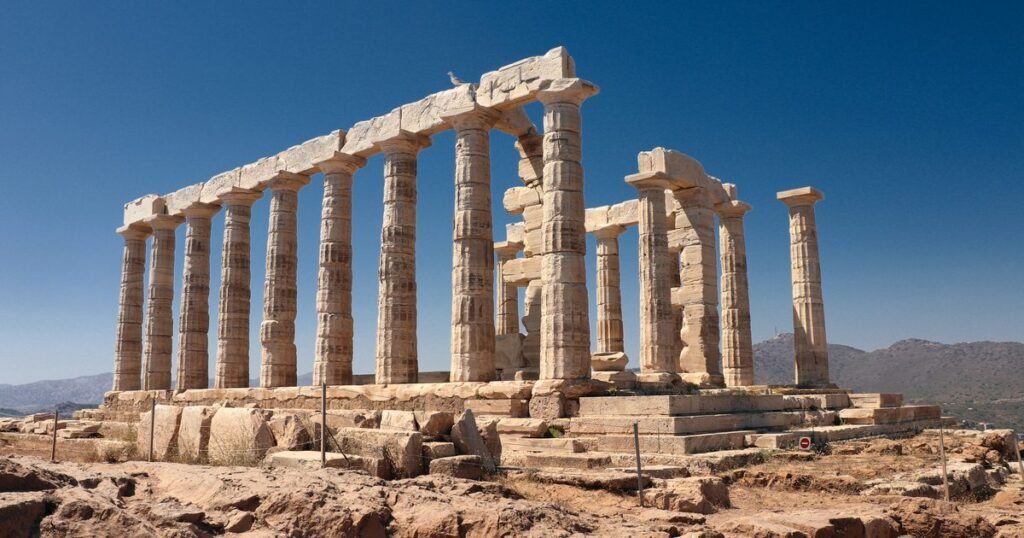
The answer is STOA, four letters. A stoa was the long roofed walkway that lined the edge of a Greek public square, columns along the open side and a solid wall behind. Editors reach for it constantly because four letters carrying three vowels will rescue almost any jammed corner of a grid.
What a stoa actually was
In Greek city planning the agora was an open square, and the stoa was the building that gave that square an edge. The plan is plain: a long rectangle, one side closed by a wall, the other left open behind a row of columns, with a roof spanning between them. Some were built two storeys high. Many had a line of small rooms cut into the back wall, rented out as shops or used as offices by officials.
The Stoa of Attalos in Athens, reconstructed in the twentieth century and now holding the Agora museum, gives the clearest sense of the scale. It runs the length of a city block with a double colonnade across its whole front, and walking it shows you immediately that this is a street with a roof rather than a room with a door.

The problem those columns solved
Greek public life happened outdoors, in a climate of fierce summer sun and hard winter rain. A fully enclosed building would have fixed the weather and killed the square, because the business being done there depended on people seeing and being seen. The stoa splits the difference. The roof gives shade and shelter, and the open colonnade keeps the inside continuous with the square.
So a trader can work from the shade while still facing the crowd, and a group in conversation can stand out of the rain without leaving public view. It is a building deliberately left half outdoors, which is a harder thing to design than either a wall or a field.
The same answer keeps getting rebuilt
Once the logic is visible you find it everywhere. Medieval market squares in Europe ran arcaded walkways along their edges for the same reason: cover for sellers who still needed to be seen. Nineteenth century civic buildings borrowed the colonnade wholesale for their fronts. The covered five foot walkways along shophouse rows across Southeast Asia, the arcaded streets of Bologna, and the awnings and colonnades of older American main streets all make the same move. Roof the pedestrian strip, leave the outer side open, keep the shops facing the street. The word stoa belongs to one place and one period. The idea it names does not.
Zeno taught on a porch and the porch named the school
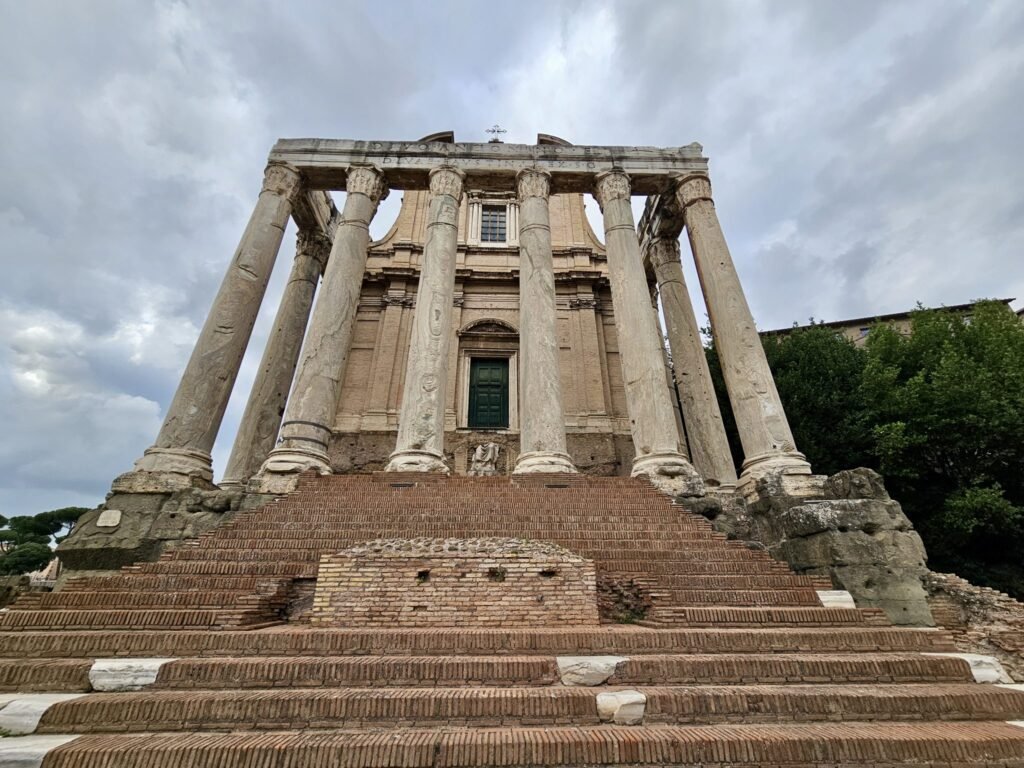
The Stoa Poikile, the painted porch on the north side of the Athenian agora, was decorated with battle scenes and was public property, so a teacher could gather students there without renting anything. Zeno of Citium did exactly that. His followers were labelled by the address rather than by any doctrine, which is how a philosophy of self command ended up named after a covered walkway. Puzzles use the double life of the word freely, and a surface about ancient architecture and a surface about ancient philosophy can both be pointing at the same four squares.
How the entry shows up in grids
Slot length separates the candidates, and the spread is wider than most solvers expect.
| Letters | Answer | What the surface is doing |
|---|---|---|
| 4 | STOA | Greek covered walkway, the default |
| 5 | PORCH | Plain English, domestic surface |
| 5 | STOAS | Plural clue, same word |
| 6 | ARCADE | A covered walkway of a later era |
| 6 | LOGGIA | Italian, open gallery on a facade |
| 7 | PORTICO | A columned entrance porch |
| 7 | VERANDA | Roofed walkway on a house |
| 9 | COLONNADE | A run of columns, period neutral |
Surfaces aiming at STOA tend to name Athens, the agora, Zeno or a colonnade. Surfaces aiming at PORTICO or COLONNADE usually name a building front rather than a walkway, since a portico is an entrance and a stoa is a route. The plural form is the cheapest way a constructor gets a five letter entry out of the same vocabulary, so a plural clue is worth spotting early.