The answer is SODDEN, six letters. Sodden means soaked through, and it is a standard fill for the clue in its wet sense. Six squares are crowded, though, because SOAKED, IMBUED and DOUSED share the length, so get the third letter from a crossing before committing to SODDEN.
Sodden once meant boiled
Sodden began life in the kitchen. It is the old past participle of seethe, which in Old English meant to boil, and around 1300 sodden simply meant boiled. By the 1590s it described something that looked as though it had been boiled a long time, and by 1820 it meant soaked or softened in water. Along the way seethe was pushed out of its literal meaning by boil and now survives mostly in figurative uses, so few people notice that sodden and seething are related.
The drift from heating in water to sitting in water is not unique. The word bath, at its root, is about warming rather than immersing, and the city of Bath in England took its name from its hot springs. Sodden simply made the same journey from the stove to the soak.

Saturated started out meaning full
The clue word has a parallel story. Saturate arrived in the 1530s meaning to satisfy or fill full, from Latin saturare, to fill, sate or drench, and ultimately satur, full. It shares an ancient root with sate, satiate, satisfy and even sad, which in Old English meant sated or weary of something. Chemists took the word in the 1680s for a substance combined with another until it could take no more, and the general sense of soaking something thoroughly was in use by 1756. Markets were being described as saturated by 1958, and saturate itself was being used as a noun for a saturated fat by 1959.
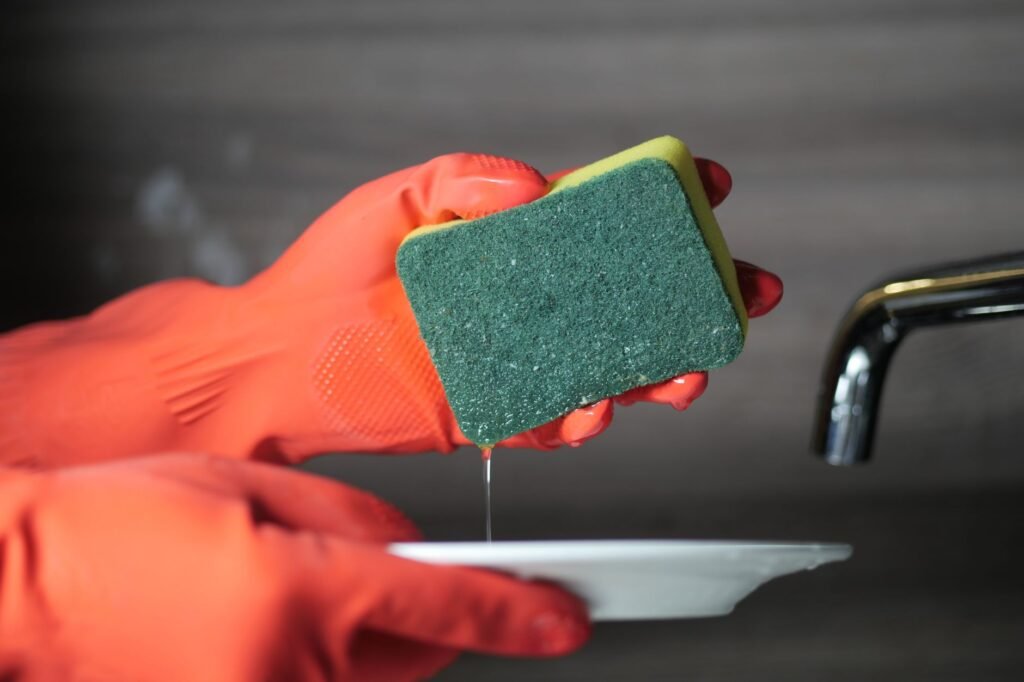
The chemist’s idea is the useful one at the grid. A saturated solution holds as much of a dissolved substance as it can, and a saturated fat is one whose carbon chains have only single bonds, with no double bonds left to take up more hydrogen. A saturated sponge works the same way. It holds as much water as it can, which is exactly the picture SODDEN and SOAKED paint.
Wet words laid out by length
| Letters | Answer | When it fits |
|---|---|---|
| 3 | WET | The shortest option |
| 5 | SOGGY | Wet and heavy |
| 5 | SOPPY | Soaked, a less common choice |
| 6 | SODDEN | The default at six |
| 6 | SOAKED | Same length, ends in D |
| 6 | DOUSED | Water thrown or poured on |
| 6 | IMBUED | The figurative sense, filled with |
| 6 | SOPPED | Soaked through |
| 7 | STEEPED | Soaked, literally or figuratively |
| 8 | PERVADED | Spread through |
| 9 | PERMEATED | Spread through every part |
| 11 | WATERLOGGED | Soaked until heavy |
| 15 | SOAKEDTOTHEBONE | The whole phrase |
The third square sorts the six letter field
Six squares hold five recorded answers, and the easy crossings will not help much. SODDEN, SOAKED, DOUSED and SOPPED all have O as their second letter, and four of the five finish on D. The third square is where they finally split: D for SODDEN, A for SOAKED, U for DOUSED, B for IMBUED and P for SOPPED. If you can get that one letter from a crossing, you have the answer. The final square is a useful second check, because SODDEN is the only candidate ending in N. Shorter slots follow the same logic. WET is the one to reach for when there are only three squares, and at five SOGGY and SOPPY share their first two letters, so the third square, G or P, does the sorting again.
When the saturation is figurative
Not every saturated thing is wet. A town can be saturated with history and a speech with emotion, and that is where IMBUED and STEEPED come in. Imbue first meant to keep wet or to soak in the early fifteenth century, from Latin imbuere, to moisten or saturate, and from the start it could also mean to make someone absorb feelings or opinions. Steep was first used of soaking barley or malt in the early fourteenth century, and the same verb now covers tea bags and people steeped in a subject. PERVADED and PERMEATED are the longer figurative choices when the grid has room.