
The answer is ARGON, five letters. Argon takes its name from a Greek word meaning lazy or inactive, which makes it the most literal answer the clue can have. Five squares can also hold XENON or RADON, so confirm the opening letters with a crossing, and switch to NEON if the slot has only four.
The element named for doing nothing
Argon was found through a small discrepancy. Nitrogen made from chemical compounds turned out to be about 0.5 percent lighter than nitrogen taken from the atmosphere, and in 1894 Lord Rayleigh and William Ramsay isolated the reason at University College London. By stripping oxygen, carbon dioxide, water and nitrogen out of a sample of clean air, they were left with a gas that would barely react with anything. The name comes from the Ancient Greek argon, meaning lazy or inactive, because the element undergoes almost no chemical reactions.
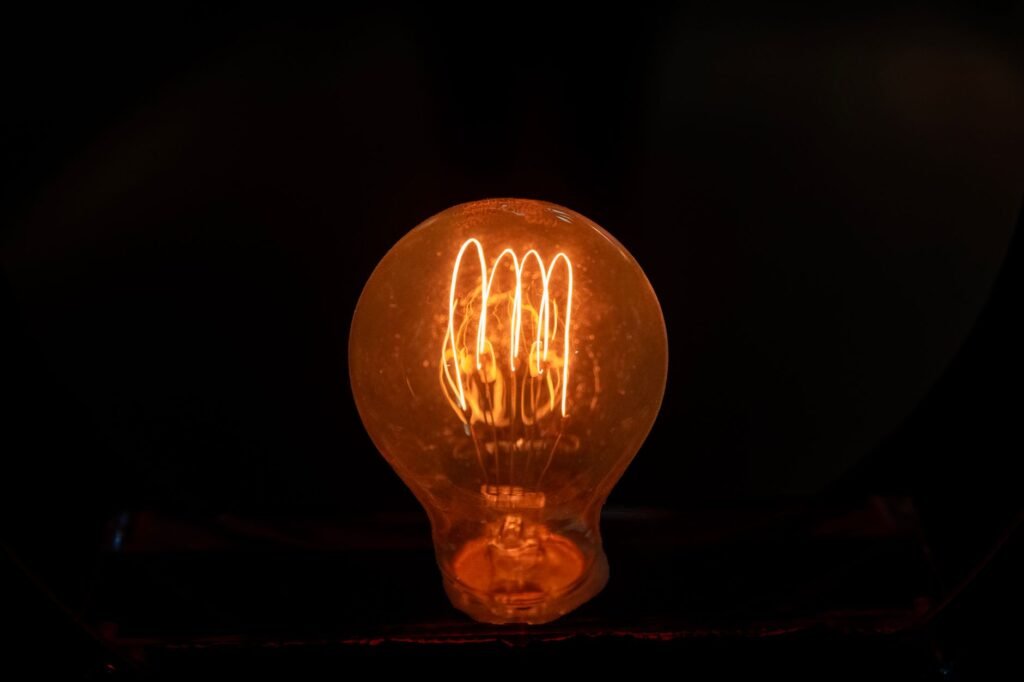
Lazy does not mean rare. Argon is the third most abundant gas in the atmosphere, 0.934 percent of it by volume, and more than 500 times as abundant as neon. That combination of plentiful and unreactive is exactly what industry wants. Incandescent bulbs are filled with argon so the hot filament does not oxidize, and some types of arc welding use it as a shielding gas that keeps nitrogen and oxygen away from the weld. In both jobs the point is a gas that will sit there and do nothing, which is the whole idea behind the clue.

Inert turned out to be the wrong word
For a long stretch chemists called this family the inert gases. That began to change in 1962, when Neil Bartlett made xenon hexafluoroplatinate, the first chemical compound of a noble gas. Many more compounds have followed, and the label inert is now considered outdated. Noble gases is the standard name today. Puzzles still use both wordings. “Noble gas” has drawn KRYPTON, XENON, ARGON, RADON, NEON and HELIUM in recent grids, the same set that answers “Inert gas,” so you can treat the two clues as one.
Ramsay went on to find neon, krypton and xenon in 1898, and all three got Greek names: neon means new, krypton hidden and xenon stranger. Helium had been spotted earlier, in 1868, as a bright yellow line in the spectrum of the sun during a total eclipse.
Every five letter candidate ends in ON
ARGON, XENON and RADON all close with O and N, which makes a crossing at either of those two squares useless. Work from the front instead. The first letters are A, X and R, and the second letters are R, E and A, so one crossing at either spot is enough. Older puzzles add a fourth option, NITON, the name Ramsay and Robert Whytlaw-Gray proposed for radon in 1910 from the Latin for shining. The name radon was chosen in 1923, so NITON mostly turns up in older grids. NEON and KRYPTON end the same way, and only HELIUM breaks the pattern. Its ending normally marks a metal, and Norman Lockyer, who named it after the Greek word for the sun, was an astronomer rather than a chemist, which is the likeliest reason the name looks out of place.
Gas names ranked by length
| Letters | Answer | When it fits |
|---|---|---|
| 4 | NEON | Four squares, Greek for new |
| 5 | ARGON | The default at five, Greek for lazy |
| 5 | XENON | X or E in the first two squares |
| 5 | RADON | R or A up front, the radioactive one |
| 5 | NITON | Older grids, the retired name for radon |
| 6 | HELIUM | Six squares, named for the sun |
| 7 | KRYPTON | Seven squares, Greek for hidden |
| 10 | IDLEGOSSIP | The clue ends in a question mark |
When a question mark turns chemistry into chatter
Tack a question mark onto Inert gas and the setter is telling you the words are being bent. Answer databases record IDLE GOSSIP, entered as IDLEGOSSIP, for the punning version “Inert gas?” Inert becomes idle, and gas becomes the slang sense of chatter. That answer runs to ten squares, far longer than any element in the family, so a slot that is much too long for KRYPTON is itself a hint that you are looking at wordplay rather than the periodic table.