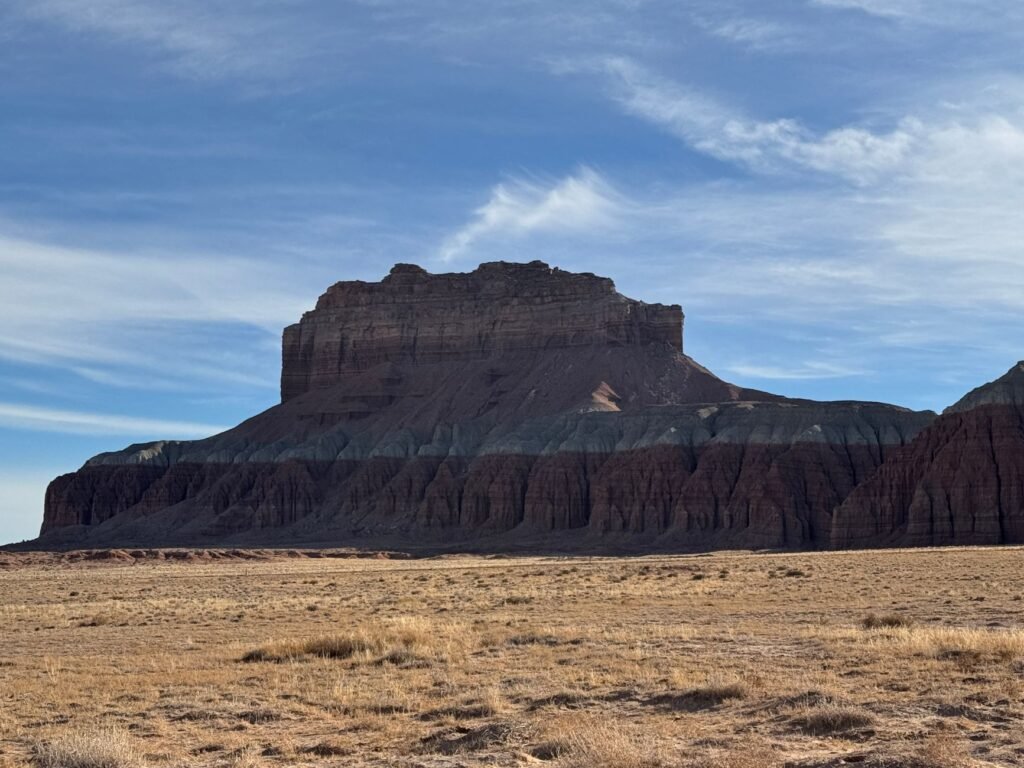
The answer is MESA, four letters. Mesa is the Spanish word for table, which makes the entry close to a literal translation of the clue and explains why setters lean on it. If the slot runs to seven squares the fill is PLATEAU, and five squares usually points at BUTTE.
Why a flat top and steep sides go together
A mesa is not a hill that happens to have been flattened. It is what survives when erosion carries off everything around a layer of rock tough enough to resist it. That durable layer, the caprock, is typically sandstone, limestone or an old sheet of lava, and it lies on softer material such as shale. Water strips the soft rock out from the edges, the caprock above loses its support, and slabs break off and fall. The cliff retreats inward but stays close to vertical, and the tabletop stays level because it was a flat bed of sediment long before it was a summit.
That is why the landform reads as architecture from a distance. Nothing shaped the top surface. It is the original bedding plane, and the sides are the working edge of a layer cake that is still being eaten away.
The shape also keeps its edges best in dry country, which is why the American Southwest is full of them. Where there is little soil and sparse vegetation, the cliff face stays bare and the rubble at its foot gets carried off rather than piling up into a gentle slope. In wetter regions the same rock sequence tends to be rounded over and buried before anything as crisp as a tableland can stand out from it.
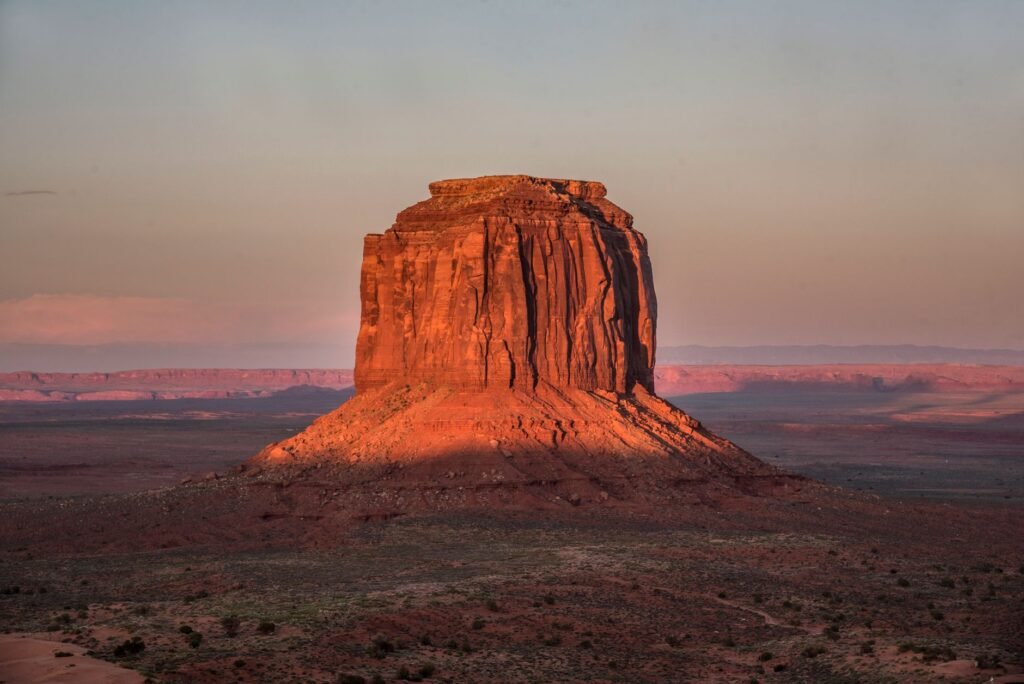
Mesa, butte and plateau are three sizes of one idea
Geologists separate the three by proportion rather than by height. A plateau is regional, a broad raised tract that can run for hundreds of miles, as the Colorado Plateau does across the corners of four states. A mesa is an isolated remnant whose flat top is wider than the formation is tall. Keep eroding that same mesa and the summit shrinks until the thing stands taller than it is broad, and at that point the standard term is butte, a word English borrowed from French, where it means a mound or knoll. Wear a butte down far enough and what is left is a spire, which is where words like pinnacle take over.
All of that matters at the grid, because setters use the distinction. Plain wording such as “Tableland” wants MESA or PLATEAU. Wording that stresses a narrow or lone summit, or that name checks Monument Valley, is angling for BUTTE instead.
Pick the entry that matches your blank count
| Letters | Answer | When it is right |
|---|---|---|
| 4 | MESA | The default, and Spanish for table |
| 4 | PUNA | Only when the clue names the Andes |
| 5 | BUTTE | Wording stresses a narrow or isolated top |
| 5 | KAROO | South African wording or a geography theme |
| 6 | UPLAND | General high ground, no named landform |
| 7 | PLATEAU | The broadest member of the group |
Where American grids get their mesas
The word turns up in American place names often enough that an editor can clue the same four squares three different ways. Mesa Verde in southwestern Colorado is a national park known for cliff dwellings built into the rock by Ancestral Puebloan people. Mesa, Arizona is a large city in the Phoenix metropolitan area, which hands constructors a proper noun clue for an identical entry. Grand Mesa, also in Colorado, is a broad flat topped highland east of Grand Junction. So if MESA looks right but the clue seems to be describing a place rather than a shape, you are probably still correct.
Flat is not the same as raised
PLAIN fits five squares and does mean level ground, but a plain is not lifted above anything, and tableland carries that elevation inside it. STEPPE has the same trouble at six squares: it describes dry grassland, a matter of climate and cover rather than a surface standing above its surroundings. MOOR and HEATH fail for the same reason. The clue is asking for a level top with an edge on it, so if your candidate does not imply a drop at the rim, leave it, solve a crossing entry, and come back with a letter in hand.