
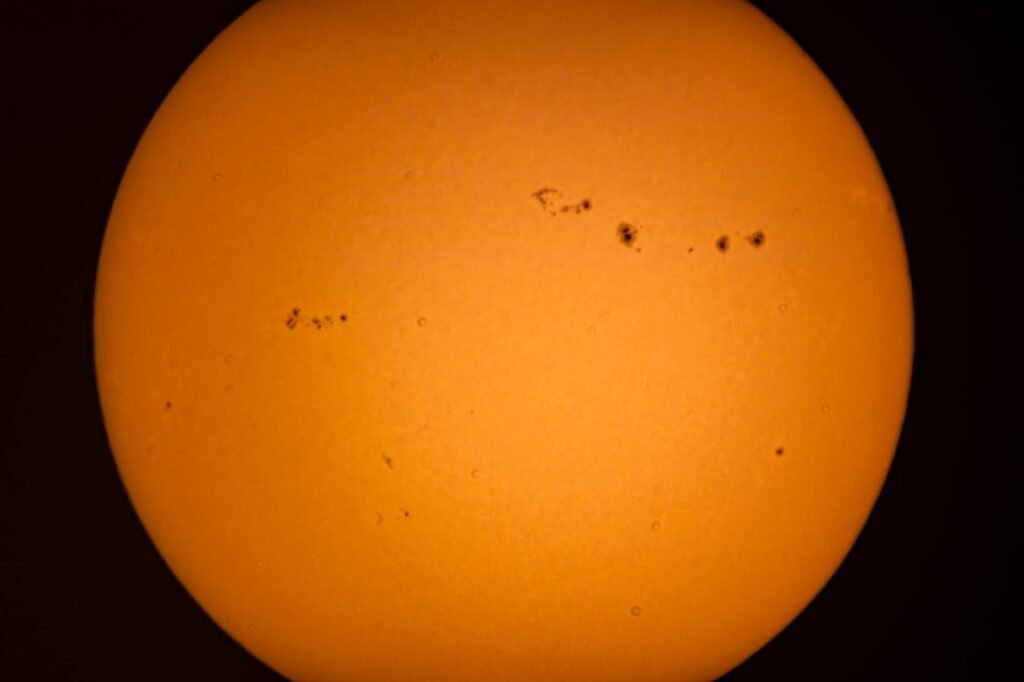
About 1,000 Jupiters could fit inside the Sun if you count by volume. Using NASA’s figures, the Sun’s volume works out to roughly 986 times Jupiter’s. That assumes the planets could be squished to fill every gap, and packed as solid balls the count drops to around 730 at most.
The volume math behind the 1,000 Jupiters figure
NASA describes the Sun as about 10 times wider than Jupiter. Volume grows with the cube of width, so 10 times wider means about 10 times 10 times 10, or 1,000 times the space inside. The exact numbers from NASA’s planetary fact sheets land very close to that shortcut.
| NASA figure | Sun | Jupiter | Ratio |
|---|---|---|---|
| Mean radius | 695,700 km | 69,911 km | About 9.95 to 1 |
| Volume | 1,412,000 x 10^12 cubic km | 143,128 x 10^10 cubic km | About 986 to 1 |
| Mass | 1,988,400 x 10^24 kg | 1,898.13 x 10^24 kg | About 1,048 to 1 |
Dividing the two volumes, 1,412,000 x 10^12 by 143,128 x 10^10, gives about 986.5. Round that and you get the familiar answer of roughly 1,000. In miles, NASA’s Sun overview gives a radius of about 435,000 miles and a diameter of about 865,000 miles, while Jupiter’s radius is about 43,441 miles.
Why solid Jupiters would not fill every gap
The 1,000 answer treats Jupiter’s volume like water you could pour into the Sun until it is full. Real spheres do not work that way. Stack oranges in a crate and you will see empty pockets between them no matter how carefully you arrange them.
Mathematicians have worked out the best you can do. The tightest possible arrangement of equal spheres fills about 74 percent of the space, a result known as the Kepler conjecture that Thomas Hales proved in 1998. Take 74 percent of 986 and you get roughly 730 Jupiters. That is a ceiling, not a firm count, because the curved inside wall of the Sun wastes extra space along the edges where whole spheres cannot fit.
So the fair answer depends on the question being asked. If Jupiter could be melted down and poured in, about 1,000 would fit. If each one has to stay a solid ball, the number falls to somewhere under 730, and working out the exact figure for a round container is a hard geometry puzzle in its own right.
Mass gives almost the same Jupiter count
Weigh the two instead and the numbers stay close. Divide NASA’s mass figures and the Sun comes out about 1,048 times heavier than Jupiter. Because that ratio is a bit higher than the volume ratio, the Sun is on average slightly denser than Jupiter.
Jupiter is made of the same ingredients as a star, but NASA notes it never grew massive enough to ignite. Even so, it is big by planet standards. It holds more than twice the material of all the other planets and bodies in the solar system combined, outside the Sun.
Why some sources give a smaller Jupiter count
Jupiter is not a perfect sphere. It spins fast and bulges at the middle, so NASA lists two sizes for it. The equatorial radius is 71,492 km, while the mean radius, which averages out that bulge, is 69,911 km.
If you plug the wider equatorial radius into the cube rule, the answer drops to about 920 Jupiters. That is the main reason you will see different totals quoted online. The mean radius, or better still NASA’s published volumes, gives the closer figure of about 986, because it accounts for the planet’s actual squashed shape.
Picturing the Sun and Jupiter at kitchen table scale
NASA offers a handy comparison. If Earth were the size of a grape, Jupiter would be about as big as a basketball. The Sun is about 100 times wider than Earth, so on that scale it would be a ball roughly ten basketballs across, big enough to fill a small room.
The same volume logic explains other famous numbers. NASA says about 1,000 Earths could fit inside a hollow Jupiter, and about 1.3 million Earths would fill the Sun’s volume. In every case the cube rule does most of the work, and the packing problem shrinks the count if you insist on keeping the planets round.
Frequently asked questions
How many Earths can fit in the Sun?
NASA says it would take about 1.3 million Earths to fill the Sun's volume. As with Jupiter, that figure assumes Earth could be poured in like liquid. Packing solid Earth sized balls would leave gaps, so a real stacked count would come in noticeably lower.
Is Jupiter the biggest planet in the solar system?
Yes. Jupiter is the largest planet, with a radius about 11 times Earth's, according to NASA. It holds more than twice the combined material of every other planet and body orbiting the Sun, though it is still only about a thousandth of the Sun's mass.
Could Jupiter ever become a star?
No. Jupiter is made mostly of the same gases as a star, but NASA notes it did not grow massive enough to ignite fusion in its core. It would need to gain an enormous amount of mass, and there is nothing in the solar system to supply it.
What is Jupiter made of?
Mostly hydrogen and helium, much like the Sun, according to NASA. Its upper clouds are likely ammonia ice, with water ice and vapor deeper down. Lower still, crushing pressure turns hydrogen into a liquid that conducts electricity like a metal, and data from NASA's Juno spacecraft suggest the core is partly dissolved rather than solid.
How many Earths can fit in Jupiter?
About 1,000, according to NASA, if Jupiter were a hollow shell that Earths could be poured into. Jupiter is about 11 times wider than Earth, which gives it that huge volume. As with the Sun, packing solid Earth sized balls would leave gaps between them, so a real stacked count would come in lower.
How far is Jupiter from the Sun?
Jupiter orbits at an average distance of about 484 million miles, or 778 million kilometers, from the Sun, according to NASA. That is 5.2 astronomical units, meaning 5.2 times Earth's average distance from the Sun. At that range, sunlight takes about 43 minutes to reach Jupiter.