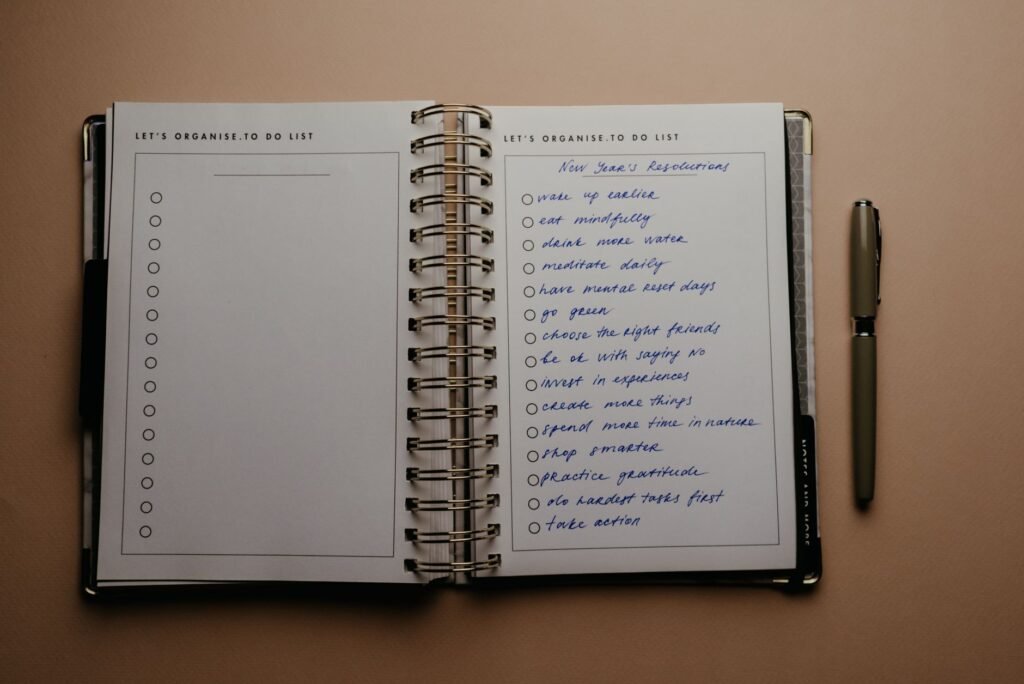
A gratitude journal is a notebook or app where you regularly write down specific things you are thankful for, usually a few items at a time. The goal is to shift attention toward good things that are easy to overlook. Entries work best when they are concrete and personal rather than general lists.
What goes into a gratitude journal entry
An entry can be three lines or a short paragraph. What makes it useful is detail. Writing “my family” every night turns into a chore quickly. Writing about one moment, and why it mattered to you that day, keeps the practice fresh.
| Vague entry | Specific entry |
|---|---|
| My friends | A friend texted to check on me after my interview |
| Good food | The soup my neighbor dropped off when I was sick |
| My job | A coworker covered my shift so I could see the recital |
| Nice weather | Walking home in the first warm evening of spring |
People tend to appear in the strongest entries. Surprises count too, such as a stranger’s kindness or a problem that resolved better than expected.
What gratitude journaling research has found
The best known study came from psychologists Robert Emmons and Michael McCullough, published in 2003. Participants were assigned to write about things they were grateful for, daily hassles or neutral events. According to the Greater Good Science Center at UC Berkeley, those who kept a gratitude journal weekly for ten weeks, or daily for two weeks, reported more gratitude, more positive moods, more optimism about the future and better sleep than the comparison groups.
Later studies have tested the practice in several countries and with varied groups, with generally similar findings. Results come from self reported feelings, and the effects are modest. A journal adds to wellbeing. It does not fix every problem.
The Greater Good summary also explains why writing, rather than only thinking, seems to help. Putting a thought into concrete words makes people more aware of it, which deepens its emotional effect.
A two week gratitude journal routine
Keep the journal where you will see it, such as on a nightstand, so the habit has a cue. Greater Good in Action suggests about 15 minutes a session, at least three times a week, for at least two weeks.
- Pick a notebook or a notes app you will actually open, and a regular time, such as before bed.
- Write up to five things you are grateful for from the past day or week.
- For each one, add a sentence about why it mattered or how it made you feel.
- Favor people over possessions, and depth over a long list.
- Once in a while, imagine your life without one of those good things. That contrast sharpens appreciation.
- After two weeks, read back through the entries and decide how often you want to continue.
When a gratitude journal starts to feel forced
Writing every single day can make entries feel repetitive, and some people find a few times a week keeps them more genuine. Vary the prompts. Write about a person one night, a place the next and something you learned after that. It can also help to think of good things as gifts rather than things you were owed, which makes an entry feel less like a checklist.
A gratitude journal is not a treatment for depression, anxiety or grief, and it should never pressure you to feel thankful about something painful. If low mood, hopelessness or worry is affecting your daily life, bring it up with your doctor or a licensed mental health professional.
Gratitude journal versus an everyday diary
A diary records what happened, good and bad, often at length. A gratitude journal is narrower and shorter, focused only on what went well and why. Many people keep both, or add a short gratitude section to the end of a regular journal entry. General journaling methods get their own guide, but the gratitude version is the easiest to start because it takes only a few minutes.
Frequently asked questions
How many things should I write in a gratitude journal?
Three to five items per entry is a common range. Greater Good in Action suggests writing up to five. Fewer items with more detail usually beat a long list, because explaining why each one mattered is what makes you slow down and actually feel the appreciation.
Is it better to keep a gratitude journal on paper or on a phone?
Either works. Paper removes the distractions that come with a phone and can feel more personal. An app is easier to carry and can send reminders. Choose whichever you are more likely to open regularly, since consistency does more than the format does.
Can kids keep a gratitude journal?
Yes. Younger children can draw a picture or say one thing aloud while a parent writes it down. Older kids can list a few items at bedtime. Keep it short and pressure free, and let them choose what to include rather than correcting their answers.
What is gratitude?
Gratitude is appreciation for the good things in your life. Psychologist Robert Emmons, whose research the Greater Good Science Center draws on, describes two parts, affirming that good things exist and recognizing that their sources lie outside yourself, such as other people or a higher power. That outward focus is why it tends to strengthen relationships.
How do you practice gratitude?
Try small, repeatable exercises beyond journaling. The Greater Good Science Center suggests writing a letter of thanks and delivering it in person, imagining your life without something good so you notice its value, and reflecting on how someone deliberately brought good into your life. Pick whichever practice you will keep doing.