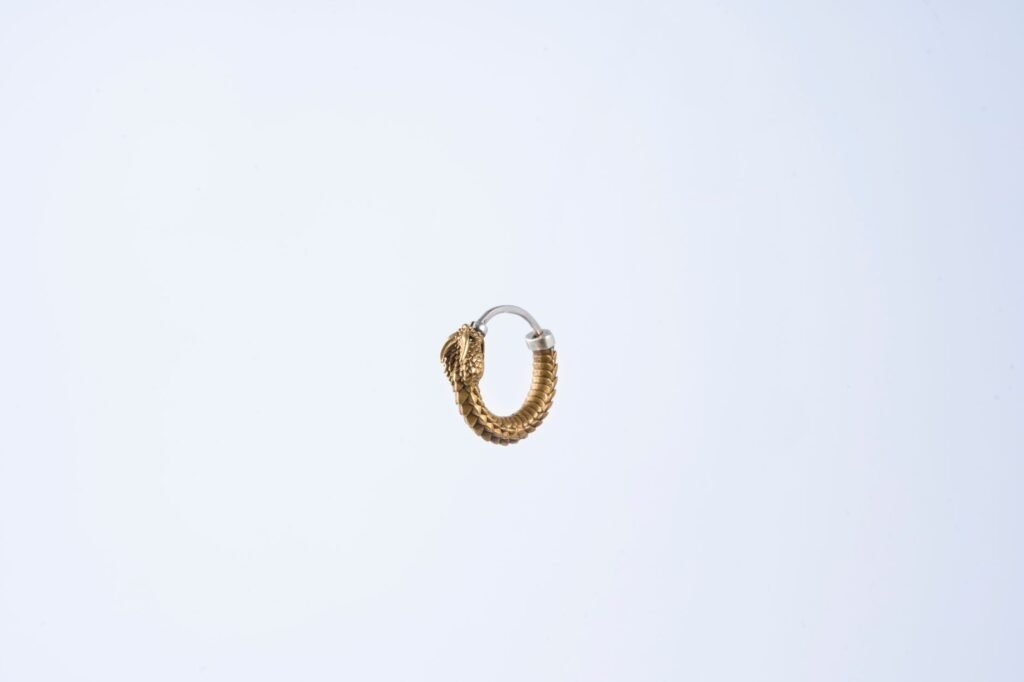
A huggie earring is a small hoop that sits snug against the earlobe instead of dangling below it, and it usually closes with a hinged bar that clicks shut. The name describes the fit. The hoop wraps the lobe so closely that it looks like it is hugging it, which is why people wear them daily and stack them.
Where a huggie sits compared with a hoop or a stud
Think of huggies as the middle ground. A stud sits flat on the front of the lobe and shows nothing underneath. A regular hoop hangs down and swings. A huggie wraps around the edge of the lobe with very little gap, so you see a small band of metal on the front and the bottom, and it barely moves when you turn your head.
| Style | How it sits | Typical closure | Good for |
|---|---|---|---|
| Stud | Flat on the front of the lobe | Post with a separate back | The most minimal look |
| Huggie | Wraps tight around the lobe edge | Hinged bar that snaps into the hoop | Daily wear, stacking several holes |
| Standard hoop | Hangs below the lobe with visible space | Latch back, hinge or thin wire | A bolder look that moves |
| Seamless ring | Tight circle with no visible clasp | Twist or push to open the ring itself | Healed cartilage or upper ear holes |
Huggies also tend to be chunkier than a thin hoop of the same size, often with a thick or domed band or a row of small stones.
The hinged bar is what separates a huggie from a mini hoop
Most huggies open at a hinge. One section of the hoop swings out, you thread it through the piercing from front to back, and you press it closed until you hear or feel a click. There is no loose back to drop down the sink, which is a big part of the appeal.
Some tiny hoops close with a thin wire that slots into a hollow tube. Those are small hoops rather than huggies in the usual sense, because the wire can bend and the fit is looser. If a listing uses both words, check the closure photo.
Snap the hinge gently. Forcing it at an angle wears the clasp, and a worn clasp is how huggies end up lost.
Sizing a huggie to the lobe you actually have
Huggie sizes are listed by inner diameter, the open space inside the hoop, and brands vary on how they measure it. Guessing from a photo is the fastest way to buy one that pinches or one that hangs like a regular hoop.
- Stand in front of a mirror and find the piercing.
- Hold a ruler under the lobe and measure the distance between the center of the piercing and the lobe’s bottom edge.
- Compare that distance with the inner diameter on the product page. A hoop close to that number hugs, a bigger one starts to dangle.
- For a second or third hole higher up the lobe, repeat the measurement from that hole, since the distance to the edge is longer.
A huggie that feels tight or leaves a dent after a few hours is too small. Size up rather than bending it.
Metals to look for when earrings leave your ears itchy
Earrings and earring backs are among the most common sources of nickel exposure, according to the American Academy of Dermatology, and a huggie sits in contact with the skin all day. The academy suggests jewelry that is nickel free or made from surgical grade stainless steel, 18, 22 or 24 karat yellow gold, pure sterling silver or platinum.
Plated pieces are the ones to read carefully. A thin gold layer over a base metal can wear through at the hinge, where it rubs most, and the metal underneath then touches your skin. Product pages should name both the plating and the base metal.
If an earring leaves a red, itchy or weeping rash that doesn’t clear after you stop wearing it, see a doctor or dermatologist rather than guessing at the cause.
Sleeping, showering and stacking with huggies
Because the hoop sits so close, there is little to snag on a pillow or a sweater, and plenty of people leave huggies in for days. Taking them out now and then still helps, since soap and skin oils collect in the hinge. A wipe with a soft cloth keeps it snapping cleanly.
Stacking works best when the hoops step down in size as they climb the lobe, so each one hugs its own hole without crowding the next. Pairing a smooth band with a stone set one keeps a stack from looking busy.
Frequently asked questions
Are huggie earrings the same as cartilage hoops?
Not quite. Huggies are sized mainly for earlobe piercings and usually close with a hinged bar. Cartilage hoops are often seamless rings or clickers made for the upper ear. A small huggie can work in a healed upper hole, but check the gauge and inner size with a piercer first.
Can you wear huggie earrings in a new piercing?
Most piercers want the original starter jewelry left in until the piercing has healed, because a snug hoop can press on fresh tissue and trap moisture. Ask the studio that did the piercing when it is safe to switch, and choose a nickel free metal for the first huggie you wear.
How do you clean a huggie earring?
Wash it in warm water with a drop of mild soap, work a soft toothbrush gently around the hinge, rinse, and dry it with a lint free cloth. Skip harsh cleaners on plated pieces, since they can wear the finish. Follow any care card that came with stones or fine gold.
Do you need pierced ears for huggie earrings?
Yes. A standard huggie's hinged bar passes through a piercing, so you need a pierced hole, most often in the lobe. If your ears are not pierced, look for clip-on hoops or ear cuffs, which grip the outside of the ear to give a similar close-fitting look without a hole.
How do you open huggie earrings?
Hold the hoop steady between your thumb and finger, then press the hinged section gently outward at the seam, using a fingernail if it is snug, until it swings open. To close it, line the bar up with the slot and press until it clicks. Move the hinge in line with the hoop, since twisting it wears the clasp.