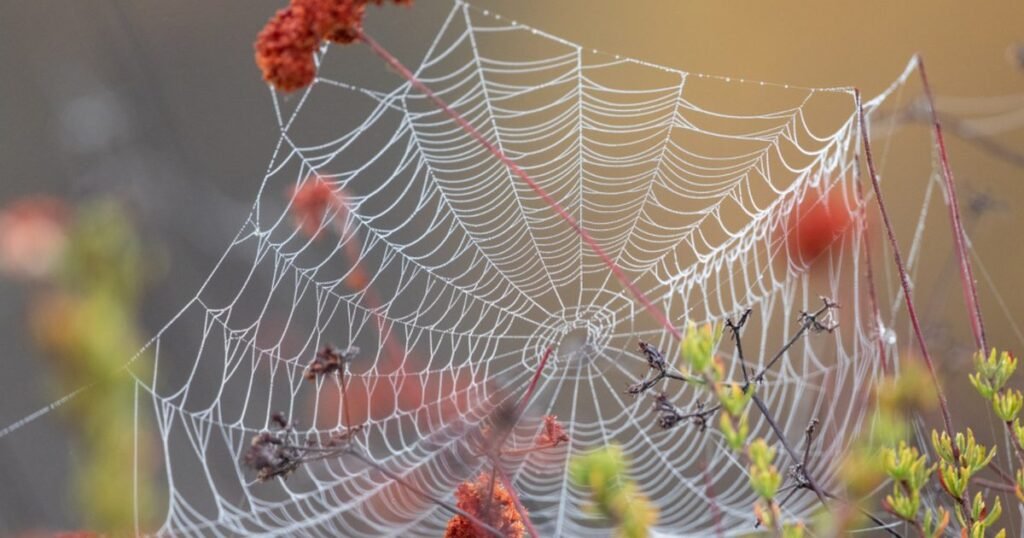
Spokes first, then sagging curves between them. Webs painted with straight connectors read as a wheel, and that single geometry detail is what separates a good one from a bad one.
Getting the web geometry right
- Pick an anchor point, usually a corner of the nail rather than the center. Off-center looks more natural.
- Draw four to six straight lines radiating out from it to the nail edges. These are the spokes.
- Connect adjacent spokes with short curved lines that dip toward the anchor point.
- Work outward in rings, keeping the spacing slightly uneven.
- Stop before the web fills the whole nail. Empty space makes it read as a web fragment rather than a doily.
The sag in the connectors is doing all the work. Real webs hang under their own weight, and reproducing that is what makes the pattern legible at small scale.
Why the black line thickens halfway across
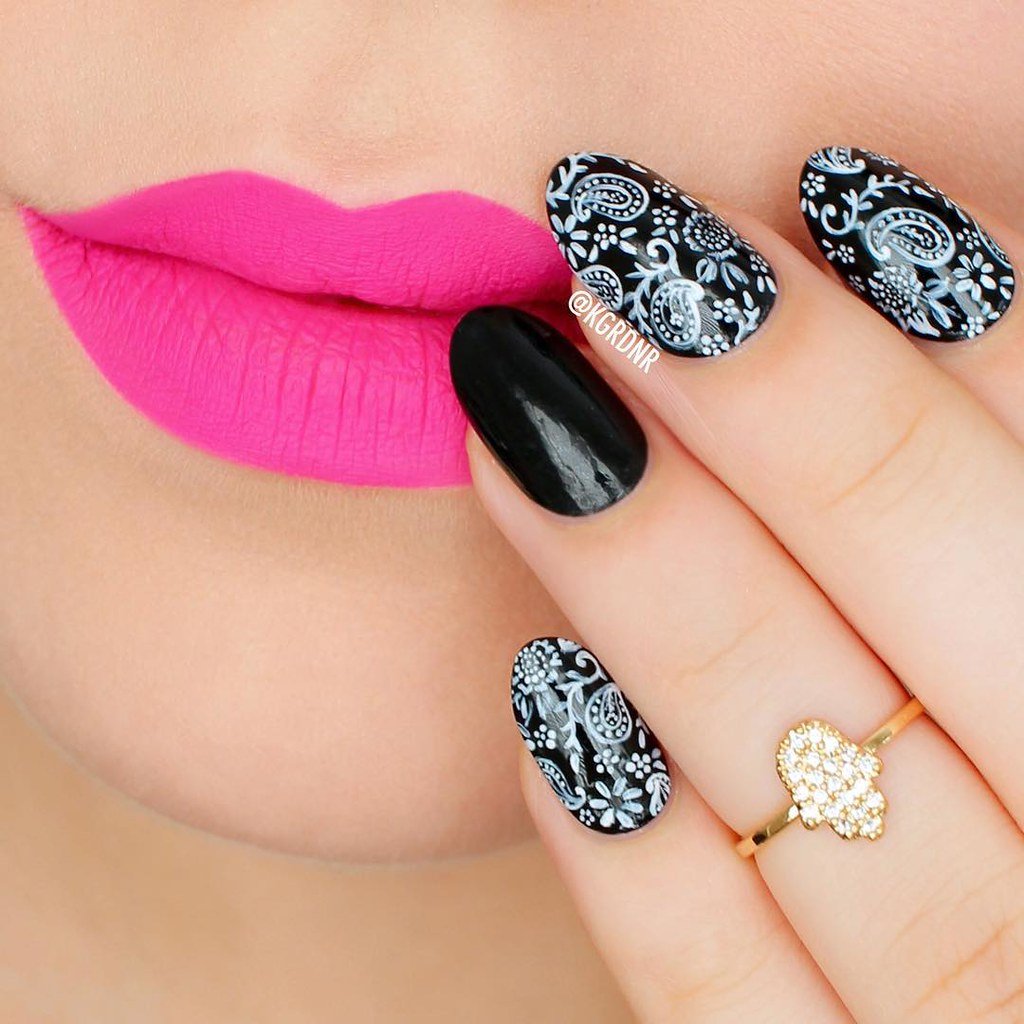
A loaded brush unloads fastest at the start of a stroke, so a spoke pulled in one long sweep runs heavy at the anchor and starves at the tip, or the wrist rolls over the curve of the nail and flattens the bristles. Both faults land in the same place every time, the clue that it is technique and not the polish.
Pull each spoke in two short strokes that meet in the middle, always dragging the brush toward yourself rather than pushing it away, and reload between spokes even when it feels wasteful. Rest the painting hand’s little finger on the table so the only thing moving is the brush.
The color split
| Approach | How it looks |
|---|---|
| Red base, black web | The classic, highest contrast |
| Black base, white web | Reads as the black suit version |
| Red and blue split nails | Alternating, no web needed |
| One eye shape per nail | Large white teardrop with black outline |
| Red base, black web, one eye accent | The most complete look across a set |
Painting the eye shape
The mask eye is a teardrop lying on its side, wider at the outer edge and tapering toward the nose side. Paint the white shape first and let it dry completely, then outline in black with a fine brush. Outlining while the white is wet drags gray into the shape and is the most common failure.
One eye per nail across two fingers reads better than trying to fit both eyes on a single nail, where they end up too small to be recognizable.
Prep that decides whether black bleeds
Web lines go fuzzy when the layer underneath is still soft. Red dries slowly because of its pigment load, and a base that feels touch dry can stay soft underneath, which lets fine black lines sink and spread. Give a red base longer than instinct says, or seal it with a thin clear coat and let that harden before any line work begins.
Oil is the other culprit. Cuticle oil or hand cream leaves a film that makes lines crawl and break, so wipe the nail with alcohol first. Remover and cleanser fumes build up fast in a small bathroom, so work by an open window, keep them well away from anything hot, and never tip remover into a bowl that has held a bleach based cleaner.
Shortcuts that work
- Spider gel. Stretched into threads rather than painted, which produces finer lines than a brush and needs less control.
- Stamping plates. A web pattern etched on a plate, picked up with a scraper and transferred. Consistent across all ten nails.
- Nail stickers. Least satisfying but genuinely fastest, and they sit flat under a top coat.
Rescuing a web that went wrong
A thick or crooked line is fixable while it is wet. A flat brush dampened with remover and blotted almost dry will slice along one side of the line and pare it back, taking the black without lifting the base, provided you use one confident pass rather than scrubbing.
If the geometry is the problem instead, add rather than subtract. Another ring of connectors absorbs an uneven gap, and a stray line can become a spoke if you extend it to the nail edge. When a nail is past saving, take it back to bare and repaint; that beats nine good nails and one rescued twice.
How many days a web set survives
Fine black line work over red shows chips badly because the contrast highlights any break. Cap the free edge, keep the densest part of the web away from the tip, and accept that this design has a shorter life than a plain color. Four or five days is realistic, and a fresh top coat on day three buys another two.