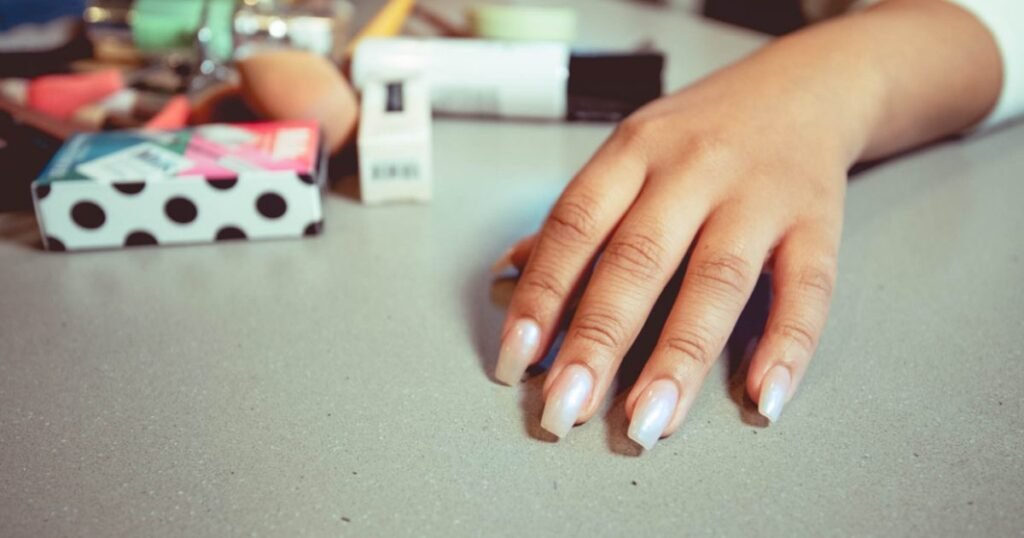
Dip suits blended color, not fine detail. Choose ombre, color blocking or a deep single shade, and leave line work to gel.
Why the technique shapes the design
Dip powder builds a thicker layer than gel polish because you are laying down acrylic powder rather than a thin liquid film. That thickness gives dip its durability and its slightly rounded finish, and it is also why fine painted detail tends to disappear under the final sealing layers.
Designs that work with the thickness rather than against it look better and last longer. Ombre in particular is easier in dip than in polish, because you can blend two powders while both are still loose.
Autumn shades that suit dip
| Shade | Why it works |
|---|---|
| Cinnamon and warm brown | Reads rich in a thicker finish |
| Oxblood | Depth improves with layer thickness |
| Olive and moss | Muted, less common than burgundy |
| Mustard | Needs the opacity dip gives it |
| Grayed mauve | Neutral that still reads seasonal |
| Chocolate with gold fleck | Fleck suspends well in powder |
Designs that hold up
- Two-tone ombre. Blend two adjacent autumn shades while the powder is loose. This is the technique’s best feature.
- Reverse French. Color at the cuticle instead of the tip, which also wears better since the tip takes the most contact.
- Single accent. Nine nails in one shade, one in a metallic. Simple and it survives the thickness.
- Color block. Two solid halves divided diagonally, taped before the second dip.
The jar habit that ruins a tub of powder
Plunging a wet nail straight into the tub carries resin and skin oil back into the powder. The tub turns lumpy, and a set done weeks later grips unevenly because some of that powder began hardening in the jar.
Pour instead. Tip a little into a clean dish, or spoon powder over the nail above a folded sheet of paper and return only what never met a wet surface. Wipe the rim before the lid goes back, and keep the activator brush out of the tub.
How to tell your layers are going on too thick
The difference shows from the side rather than from above, so sight along the nail at eye level rather than looking down at it.
| What you see | What it means | Correction |
|---|---|---|
| Cuticle line has lost its curve | Product is pooling at the base | Start the base coat a hair further from skin |
| Sidewalls bulge outward | Too many dips, no filing between | Shape the sides before the seal |
| The reflected strip of light breaks up | Surface is uneven rather than flat | File flat, then seal |
| Nails click loudly on a hard table | Heavier than the design needs | Drop one dip next time |
Two dips of color over the base suit most nails, three for a pale shade. Past that you add weight rather than coverage, and weight is what lifts a set off early.
Removal is where the damage happens
Dip is harder to remove than gel and that is where nails get wrecked. File the top layer to break the seal, then soak in acetone for fifteen to twenty minutes, then push the softened product off gently. If it resists, soak longer rather than scraping.
Picking or filing all the way down removes nail plate along with the product, and that is the thinning people blame on the powder itself. The product is not the problem, impatience at removal is.
Who should sit this technique out
If you bite or pick, this gives you something firm to pick at and the nail plate tends to come away with it. If your nails are already thin from a rough removal, take a stretch of bare weeks before going again. If you change shade with your mood, three weeks of one color is the wrong buy.
One more group. Resin and activator can leave skin red and itchy wherever they land, and a first reaction usually means a stronger one next time, so keep both off the skin and stop if it starts. Give the acetone soak the same respect: ventilated room, clear of flames or a hot appliance, never mixed with another remover.
Dip against gel and acrylic
Gel is thinner, cures under a lamp, lasts two to three weeks and takes fine detail well. Acrylic is sculpted and used mainly for extensions. Dip sits between them: no lamp, longer wear than gel, thicker than gel, and less versatile for art. If you want three weeks of a single rich color with no maintenance, dip is the right choice. If you want painted detail, it is not.