

Cover graphic by KnackDaily.
Clean granite with warm water and a pH neutral stone cleaner, dry it, and keep the sealer topped up. Granite is quarried rock with real pores in it, so the job is not just lifting soil off the surface, it is stopping liquids from getting below the surface in the first place.
Pores are the whole story with natural stone
Granite comes out of the ground as an interlocking mix of minerals with microscopic channels between them. How absorbent a slab is depends on which quarry it came from, and two counters in the same street can behave completely differently. A dense black slab may shrug off a puddle of oil, while a light speckled one drinks it in and holds a dark shadow for months.
Sealing is how you close that gap. An impregnating sealer is not a coating. It soaks into the pore network and lines it so liquids bead up and wait for you instead of wicking down. It wears away with use, faster around the sink and the cooktop where the counter gets scrubbed most.
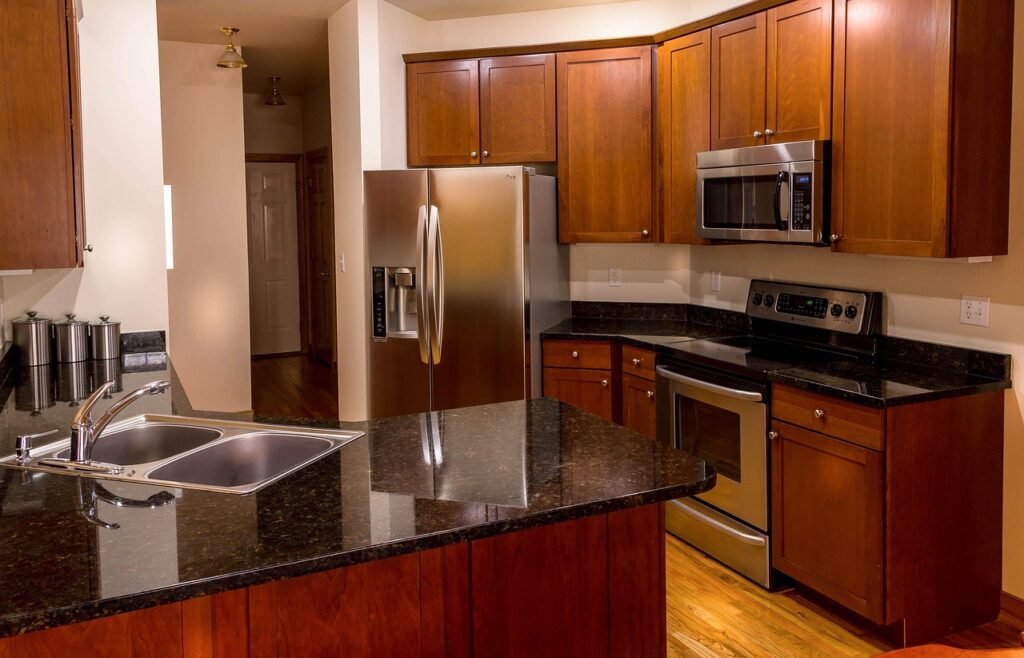
Telling when the sealer has given up
Leave a small puddle of water on the counter in a few spots and come back in fifteen or twenty minutes. Blot it dry and look at the stone. No change means the sealer is doing its job. A darkened patch that fades as it dries means liquid got in, and the slab is due for resealing.
Test near the sink, beside the stove and on an untouched corner, because those areas wear at different rates and the busy zones will fail long before the rest. Resealing is a wipe on job with a stone sealer from any hardware store, and the label will give the dwell and buff times for that product.
Draw stains out rather than scrubbing them in
- Work out the stain type. Oil, butter and cooking grease darken the stone evenly. Coffee, tea, wine and fruit leave a brownish tint. They need different poultice liquids.
- Mix a paste the consistency of peanut butter. Use baking soda with water for an oil stain, and baking soda with a little hydrogen peroxide for an organic stain, though not on dark stone where peroxide can lighten the color.
- Spread it thickly over the mark, overlapping the edges by a finger width.
- Cover with plastic wrap, tape the edges, and put a few small holes in the top so it dries slowly.
- Leave it for a day, then let it dry out completely. As the moisture evaporates it pulls the stain up into the paste.
- Scrape the dry poultice off with a plastic edge, rinse, and repeat if the mark faded but did not clear. Reseal that area afterwards, since the poultice takes the sealer with it.
Safe versus damaging on granite
| Product | Effect on the counter |
|---|---|
| pH neutral stone cleaner | Cleans without stripping sealer. The correct default |
| Warm water and a drop of dish soap | Fine occasionally. Used constantly it leaves a dulling soap film |
| Vinegar, lemon juice, citrus sprays | Degrades the sealer quickly, and etches any calcite bearing slab |
| Bleach and ammonia cleaners | Break down sealer and can discolor pigmented minerals. Never mix bleach with an acid, since that releases chlorine gas |
| Abrasive powders and scouring pads | Scratch the polished face, which needs a stone refinisher to correct |
| Cutting directly on the stone | Granite wins against your knives. The blades dull, and the sealer gets scored |
| Poultice paste for set stains | The only method that removes something already absorbed |
Not everything sold as granite is granite
Stone yards use the word loosely. Slabs marketed as granite are sometimes gneiss, gabbro or a dolomitic stone, and a few are marble that happens to look speckled. True granite is built from silicate minerals that shrug off household acids, but a calcite bearing lookalike will etch into a dull white mark the moment lemon juice sits on it.
You do not need to name your slab to stay safe. Treat every stone counter as acid sensitive and keep citrus, vinegar and descalers on another shelf. For certainty, the fabricator who installed it knows the trade name.