
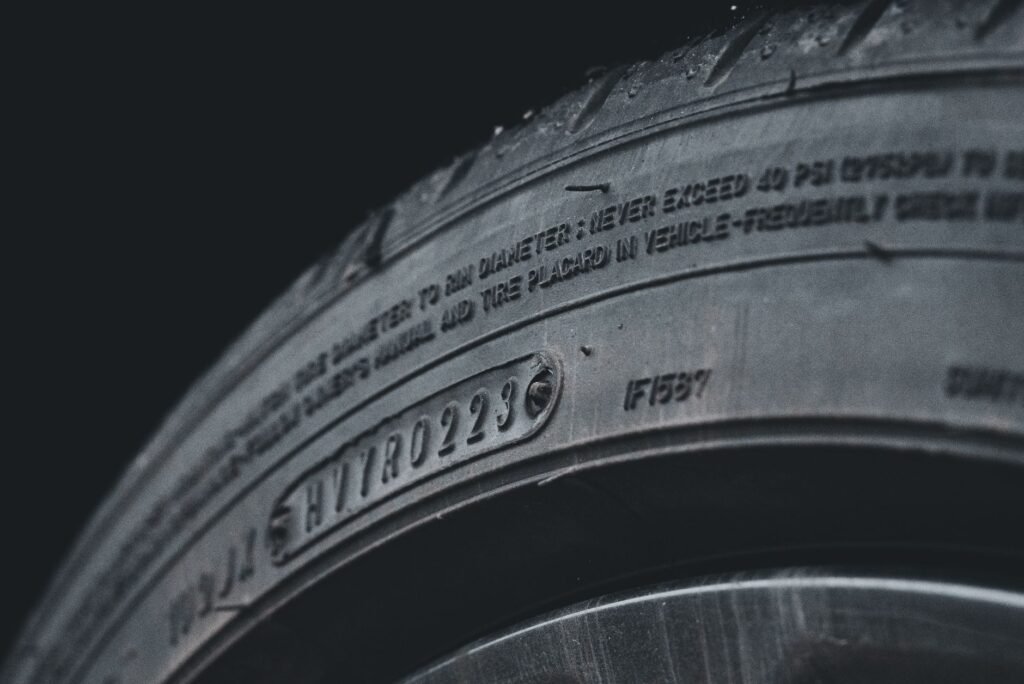
A sidewall code such as P225/65R17 95H breaks into five parts: type letter, section width in millimeters, aspect ratio, construction letter, and wheel diameter in inches. The two characters after the size are the load index and speed rating, and a separate DOT stamp carries the week and year of manufacture.
Where the code sits and which direction to read it
The size is molded into the sidewall in raised letters, on the outer face between the tread shoulder and the bead. It is not the largest text on the tire, and brand names are bigger, which is why people often read the wrong string first. Look for the block that mixes digits with a slash and a capital R, then start at its leftmost character and work right.
What the sidewall tells you is what is fitted right now. It does not tell you what the vehicle was designed around. That lives on a placard stuck to the driver door jamb, repeated on many cars inside the fuel filler door. If the two disagree, someone changed the fitment, and the placard is the reference worth trusting.
Breaking 225/65R17 into its five parts
Each segment answers a different question, and they always appear in the same order. Reading them in sequence takes seconds once you know what each slot is for.
| Segment | Example | What it tells you |
|---|---|---|
| Type letter | P | P is passenger, LT is light truck, ST is special trailer. No letter at all means the tire follows the Euro metric standard. |
| Section width | 225 | Width in millimeters at the widest point of the inflated tire, measured sidewall to sidewall, not across the tread. |
| Aspect ratio | 65 | Sidewall height as a percentage of section width. A lower figure means a shorter sidewall on the same width. |
| Construction | R | R is radial, which covers nearly every modern road tire. D means diagonal bias and B means belted bias. |
| Wheel diameter | 17 | Rim diameter in inches that the tire is built to mount on. It is the only figure in the code that is not metric. |
Because aspect ratio is a percentage, the same digits mean different sidewall heights on different widths. A 65 on a narrow tire produces a shorter sidewall than a 65 on a wide one, so two tires sharing that figure are not sharing a ride quality.
Load index and speed rating live after the size
Right after the wheel diameter you get a two or three digit number followed by a letter, printed as one group such as 95H. The number is a load index. It is a code rather than a weight, and it points at a row in a published load table where the carrying capacity per tire is listed. Tire shops keep that table on hand.
The letter is the speed rating and works the same way, mapping to a sustained speed in a standard table. Ratings run in rough alphabetical order with a few historical exceptions, so the letters are not worth reconstructing from memory.
A few extra marks travel with that group. XL, or Extra Load, means higher inflation pressure and a higher load index than the standard version of the same size. M+S is a mud and snow marking based on tread pattern alone. The three peak mountain snowflake symbol is a separate severe snow certification, and that is the one to look for on a winter tire.
The DOT stamp tells you the week the tire was built
Somewhere on the sidewall sits a string beginning with DOT, followed by a run of letters and digits. The part most owners care about is the final four digits. The first pair is a week of the year and the second pair is the year, so a code ending in 1219 marks the twelfth week of 2019.
- Find the raised DOT lettering on the sidewall.
- Read to the end of that string and isolate the last four digits.
- Treat the first pair as a week number running from 01 to 53.
- Treat the second pair as the last two digits of the year.
- If nothing is there, repeat the search on the opposite sidewall.
One quirk catches people out. On many tires the full code with the date appears on just one sidewall while the other face carries a shortened version. Check both faces before deciding the date was left off.
Build date is not an expiration date. Rubber ages at different rates depending on heat, sunlight and use. Vehicle makers and tire makers publish their own guidance on age and do not all agree, so treat the stamp as a point to raise with a shop, not a verdict.
Frequently asked questions
Does a higher aspect ratio mean a taller tire overall?
On the same section width and wheel diameter, yes. Aspect ratio sets sidewall height as a percentage of width, so raising it while holding the other two figures constant gives you more sidewall and a larger overall diameter. Change the width as well and the comparison stops being that simple.
What does it mean if there is no letter before the width?
A size printed without a leading P or LT follows the Euro metric standard. Those tires are common as original equipment on European models, and plenty of them are sold in the United States as well. The remaining segments read exactly the same way, so nothing about the method changes.
Can I fit a tire with a different load index or speed rating?
Going below either figure is the risky direction, because both are specified against what the vehicle can carry and how fast it is built to travel. Matching or exceeding the values on the door placard is the normal rule, and a shop will check the whole fitment before selling you a set.