
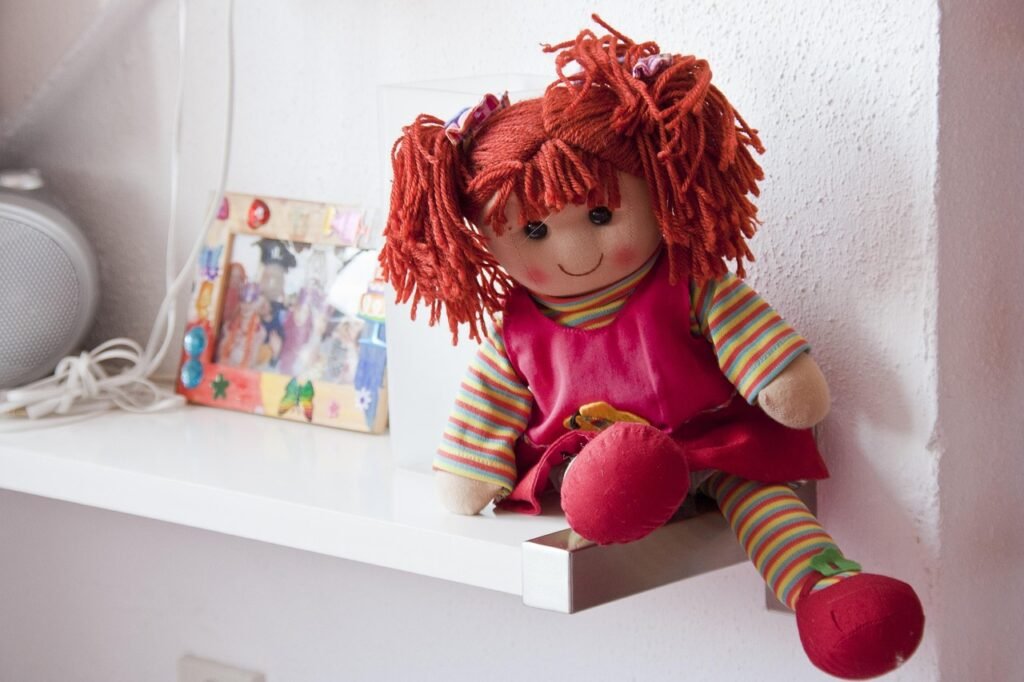
Partly. A physical doll exists and its ownership can be traced, but almost nothing else in the film does. The useful way to approach it is to follow the object rather than the story, because the object is the only part with a verifiable history. What you find at the end of that trail is a mass produced children’s toy, an account given by one person in 1970, and a chain of custody running through a Connecticut house to a comedian’s purchase in 2025.
The film and its paperwork
| Question | Answer |
|---|---|
| Based on a true story? | Partly, a real object with an invented plot around it |
| Based on a book? | No |
| Written by | Gary Dauberman |
| Directed by | John R. Leonetti |
| Lead cast | Annabelle Wallis, Ward Horton, Alfre Woodard |
| First shown | October 2014 |

The real doll is a rag doll, not porcelain
This is the single biggest gap between the film and the thing it points at. The doll people line up to see is a Raggedy Ann, the soft cloth doll with yarn hair and a triangle nose that was sold in enormous numbers through the twentieth century. It is floppy, faded and completely ordinary looking. The doll on screen is a tall porcelain figure with a cracked painted face, designed by the production to be frightening before it does anything.
That substitution is worth sitting with, because it tells you what kind of adaptation this is. A film that was reconstructing an account would show you the rag doll and make the fear come from the story. This film discarded the object’s appearance entirely and replaced it with something that reads as sinister in a single frame. The design choice is the argument: the filmmakers needed an image, not a record.
One nurse, one apartment, one account
The origin story is narrow. In 1970, according to Ed and Lorraine Warren, a student nurse named Donna was given the doll, shared an apartment with another nurse, and came to believe the doll was moving on its own. A medium was consulted and reportedly identified the doll as carrying the spirit of a young girl. The Warrens took the doll away with them. The later claims attached to it, including injuries and a road accident, come from the same source.
All of that rests on the Warrens’ own telling. There is no police report, no contemporaneous newspaper account and no second investigator, and academics who have looked at the case treat it as folklore rather than evidence. That does not mean nobody believed it. It does mean the story has exactly one origin point, which is unusual for a case with this much cultural weight.
Who has custody of the doll now
The object has a genuine, checkable history from the 1970s onward, which is more than can be said for the events. It was kept in the Warrens’ Occult Museum in Monroe, Connecticut, a collection housed on their own property. The museum was closed to the public in 2019 over local zoning rules, and the doll stayed in the house rather than going anywhere else.
In August 2025 the comedian Matt Rife announced that he and Elton Castee had bought the Warren home and its collection, taking on guardianship of the artifacts for a period of years. That transaction is a matter of public record and was widely reported at the time. It illustrates the split at the heart of this question: the doll is real enough to be bought and sold, while the haunting is not the kind of thing that appears on a bill of sale.
The cult plot was written for the screen
The 2014 film opens in Santa Monica in 1967 and moves to Pasadena, and its central threat is a home invasion by members of a cult, with a young couple and a newborn at the center. None of that appears in the Warrens’ account, which involves two adult roommates and no violence of that kind at all. The names, the locations, the timeline and the mechanism of the haunting are all inventions.
The film also gives the doll an explanation, a possession narrative with a cause and a rule set. The original account has no such structure. Adding one is what turns an anecdote into a two hour story, and it is the point at which the film stops drawing on anything outside itself.
What counts as evidence in a case like this
A helpful habit with this genre is to separate three claims that get spoken as if they were one. First, does the object exist? Here, clearly yes. Second, did someone report unusual experiences? Also yes, in the sense that a report was made and repeated for decades. Third, is there support for the report beyond the person making it? That is where this case runs out.
Readers asking this question are usually asking the third, and the honest answer is that the film is based on a story that was told, not an event that was established. The distance between those two is where most of this franchise lives.