No. The Nun is fiction, and no real investigation has ever involved a demonic nun in a Romanian abbey. The demon at the center of it does have a paper trail, but the trail leads to a book of ceremonial magic rather than to a haunted house. The face everyone recognizes was invented late, during post production on a different film, to fix a problem with that film’s villain.
The facts on the record
| Question | Answer |
|---|---|
| Based on a true story? | No, an invented story inside a fictional franchise |
| Based on a book? | No |
| Written by | Gary Dauberman, from a story by James Wan and Gary Dauberman |
| Directed by | Corin Hardy |
| Lead cast | Demian Bichir, Taissa Farmiga, Jonas Bloquet, Bonnie Aarons |
| First shown | September 2018, wide theatrical release |
Where the name Valak actually comes from
Valak is not a name the screenwriters made up. It appears, spelled variously as Valac, Ualac or Volac, in The Lesser Key of Solomon, the compilation of demonological material that circulated in manuscript form in the seventeenth century, and in Johann Weyer’s earlier catalogue of spirits. Those texts rank it as a president among demons, credit it with power over serpents, and say it reveals the location of hidden treasure.
They also describe what it looks like, and the description is nothing like the film. In the grimoire tradition Valak is a small boy with angel wings, riding a two headed dragon. There is no habit, no veil, no convent, and no connection to any Catholic religious order. The series took a genuinely old name out of a genuinely old book and bolted it onto an image the book never mentions. That is fair game for a horror film, but it is evidence of reading rather than of a true story.
The nun was a late addition to another film
The figure got its start in The Conjuring 2 in 2016, and not in the version of that film that was originally shot. James Wan has since shared concept art and behind the scenes images of the villain he first built, a horned demon with an animatronic design he has described as too far out of left field for the story he was telling. He wanted something that would press directly on the lead character’s Catholic faith rather than a monster from nowhere, and the demon nun was created and shot during additional photography to replace the creature already in the cut.
That sequence of events settles the question on its own. A character invented in post production to solve a creative problem is not a character lifted from a case file. By the time the 2018 film arrived, the nun was two years old and entirely the property of the screen.
No case file mentions a Romanian abbey
The claims made by Ed and Lorraine Warren, the investigators whose reputation the wider film series was built on, were mostly domestic and American, with the notable exception of a north London case that a different entry in the series dramatizes. Nothing in the material they published or promoted describes a 1952 Vatican inquiry in Romania, a cloistered order behind a sealed door, or a nobleman who opened a gateway beneath his castle. The abbey in the film does not exist and never did.
What ties the film to the rest of the series is a short framing scene set in 1971 in Wakefield, Massachusetts, which exists to hand the story forward to the earlier films chronologically. Remove that scene and the Romanian plot has no connection to any claimed investigation at all.
What the 1952 setting is built from
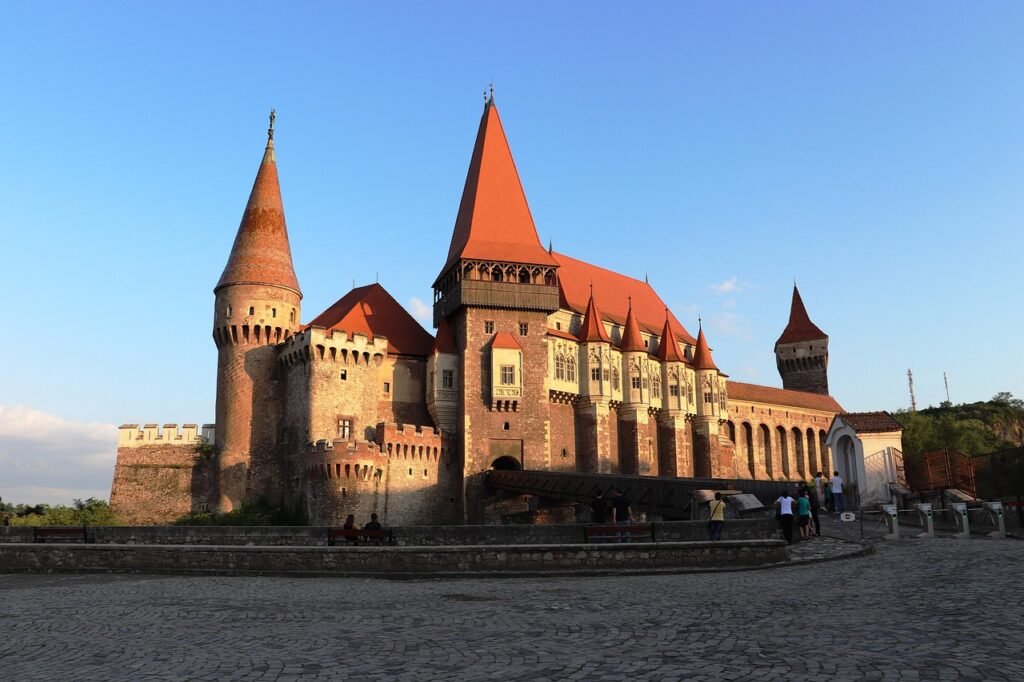
The production shot in Romania, and that is a large part of why the film feels like it is reconstructing something. Corvin Castle in Hunedoara supplies the exterior of the abbey, and other work was done in Sighisoara in Transylvania, at Mogosoaia, and in Bucharest, including at the Palace of the Parliament and at Castel Film Studios. Those are real buildings with real histories, and a genuine fortress photographs with a weight a built set has to imitate.
This is where the question usually goes wrong. A real location is not a real event, and the solidity of the stone does not transfer to the plot.
Telling franchise lore from claimed history
The films in this series mix three different kinds of material, and it helps to keep them apart. Some entries dramatize cases the Warrens publicly claimed to have worked. Some are built around objects that physically exist, whose stories rest on a single person’s account. And some, like this one, are pure invention written to expand the franchise. Only the first two have anything at all behind them.
The quickest test is to look for a named claimant. Cases the Warrens promoted always came attached to a family surname, a town and a date, because publicity depended on those details. When a film offers you a demon, a century and a country but never a person who says it happened to them, you are looking at lore rather than any kind of claim.