
No. Five Nights at Freddy’s is not based on a true story, and the 2023 film adapts a video game rather than any real case. Scott Cawthon built the first game in 2014 out of an insult about his own artwork. The part that is real is the setting: singing animatronic robots in pizza restaurants were a genuine American business.
From game to screen, the credited names
| Question | Answer |
|---|---|
| Based on a true story? | No |
| Based on a game? | Yes, the series created by Scott Cawthon, first released 2014 |
| Directed by | Emma Tammi |
| Written by | Scott Cawthon, Seth Cuddeback and Emma Tammi |
| Lead cast | Josh Hutcherson, Elizabeth Lail, Matthew Lillard, Piper Rubio |
| Released | 2023, Blumhouse and Universal Pictures |
The game started with a bad review, not a file
Cawthon had released a family game called Chipper and Sons Lumber Co., and players told him the main character looked like a scary animatronic animal. Rather than redesign it, he took the complaint as a brief and built a horror game around exactly that reaction. The first Five Nights at Freddy’s arrived in August 2014, spread through video creators reacting to it on camera, and turned into a franchise fast enough to set a record for sequels released in a single year.
That origin matters for the question being asked here. The concept came out of a reaction to a character model, not out of a news archive, and Cawthon has never presented the series as a retelling of something that happened.
Animatronic pizza restaurants really did exist
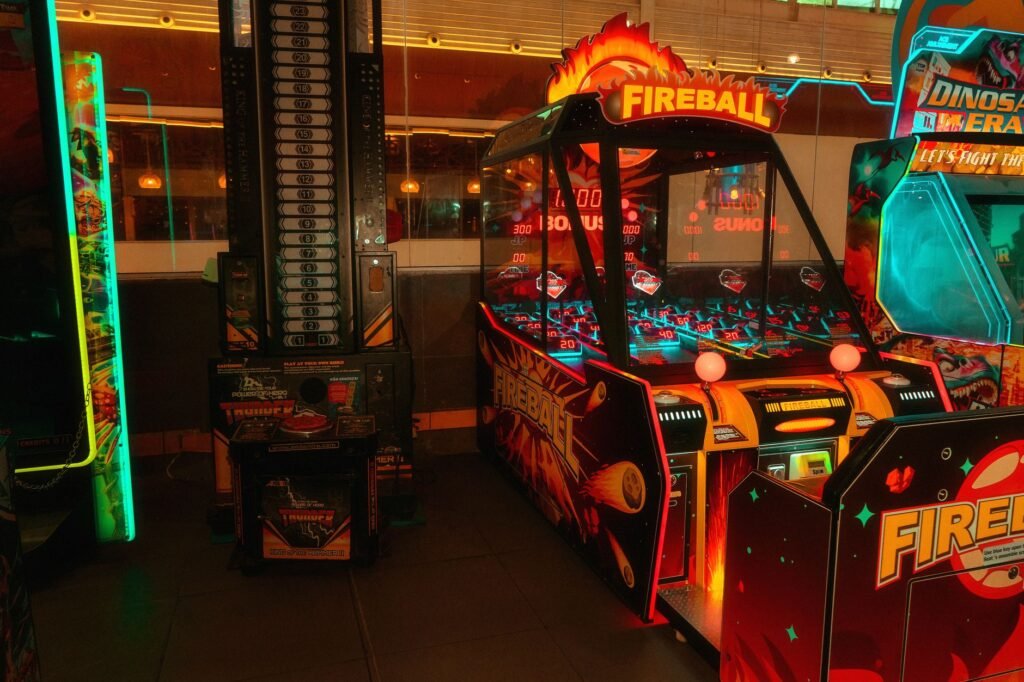
This is the layer people are half remembering. Chuck E. Cheese’s Pizza Time Theatre opened in San Jose, California in May 1977, founded by Atari’s Nolan Bushnell with Gene Landrum, built on the idea of moving arcade machines out of adult venues and into family ones. The entertainment was a stage of robot animals performing songs. A competitor, ShowBiz Pizza Place, opened in Kansas City in 1980 using animatronics built by Aaron Fechter’s Creative Engineering, a band known as the Rock-afire Explosion.
The two chains ended up under one company after Pizza Time Theatre’s 1984 bankruptcy, and the branding was consolidated by around 1990. Millions of American children spent birthdays in those rooms, watching machines with painted eyes perform on a timer in a dim dining hall. The game did not invent that atmosphere. It reproduced it.
Why the lore reads like something you nearly know
Cawthon’s games do not deliver their backstory in scenes. They scatter it across newspaper style clippings, phone recordings from a previous employee, and short pixel sequences hidden between nights. That is the shape of an archive rather than a plot, and an archive is what a real historical record feels like. Players then assemble timelines from the fragments, argue about them across a decade of sequels, and the resulting body of fan research looks from outside like investigation into something actual. It is elaborate invented fiction, documented meticulously by its audience.
What the film takes and what it leaves
The 2023 film carries the game’s central job, the night security shift at a shut down restaurant, and its characters come out of the series rather than out of any record. Cawthon shares the screenwriting credit with Emma Tammi, who directed, and Seth Cuddeback. The source credit on the film points at the game series and nowhere else, which is the cleanest documentary evidence available on the question.
It is worth remembering how fast the source material piled up. Between August 2014 and the following June, Cawthon shipped enough follow ups to take a Guinness World Record for the most video game sequels released in a single year, and the novels and spin offs kept coming after that. A decade of accumulated detail, written by one person at speed, is bound to contain contradictions, and contradictions are exactly what a community reads as suppressed information. Blumhouse and Universal then adapted the most stable parts of it, which is why the film feels narrower than the fan version of the story.
Separating invented lore from a record
- Find the source credit. Based on the video game names a product, not an event.
- Ask where a claim is documented. Real events leave contemporaneous reporting outside the fandom that repeats them.
- Notice in world evidence. Clippings and tapes inside a game are props the author wrote.
- Check the creator’s own account. Cawthon’s stated origin for the series is design feedback, which is a very different provenance.