
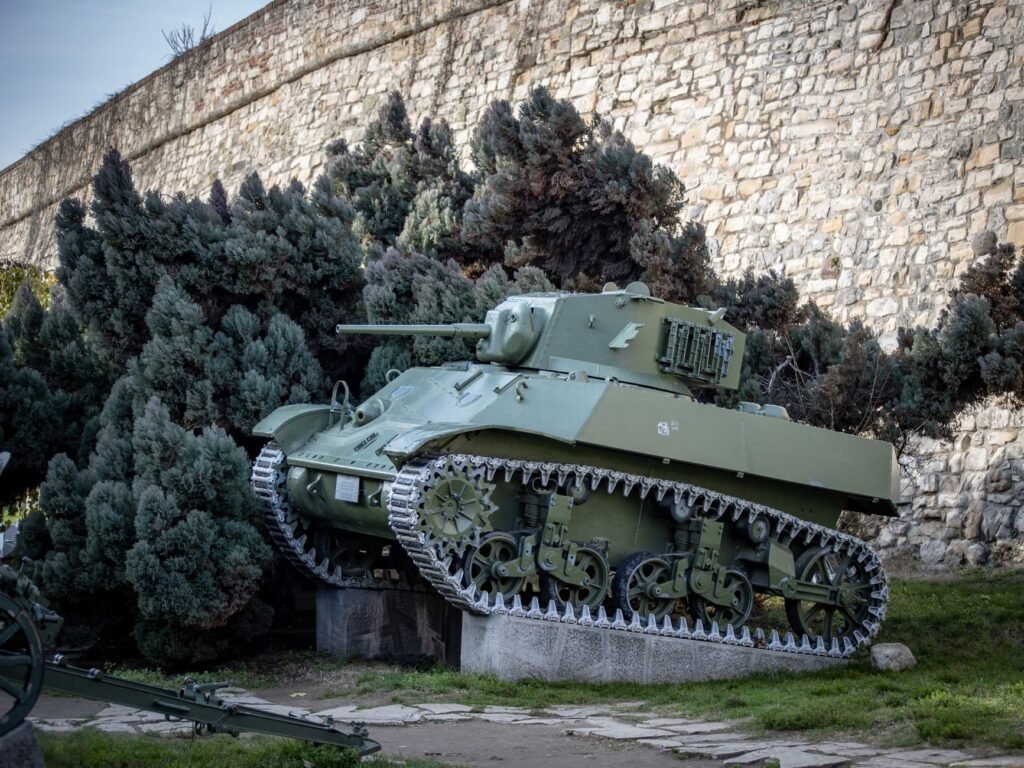
No. Fury is an original screenplay, not the story of a real crew. Wardaddy and the men inside the tank were written by David Ayer, who also directed. The conditions around them are another matter. The American tank crews of spring 1945 really were outgunned, and one of the German tanks on screen is the genuine article.
David Ayer’s tank film on paper
| Question | Answer |
|---|---|
| Based on a true story? | No, original screenplay |
| Based on a book? | No, though Ayer drew on the memoir Death Traps |
| Written and directed by | David Ayer |
| Lead cast | Brad Pitt, Shia LaBeouf, Logan Lerman, Michael Pena, Jon Bernthal |
| Setting | April 1945, during the Allied advance into Germany |
| Released | 2014 |
The crew is invented, their war is not
There was no tank named Fury with that crew inside it. What the film reconstructs is a situation rather than an incident: the last weeks of the war in Europe, with worn out American armored units pushing into a country that had stopped being able to win and had not stopped fighting. Ayer has pointed to military veterans in his own family as a source for the texture, and to Belton Y. Cooper’s memoir Death Traps, which documents how heavily American tank crews were being chewed through in combat.
That is a meaningful distinction for anyone searching. The film is not a reconstruction with the names changed. It is fiction built on researched conditions, which is why individual moments feel documented while the plot itself corresponds to nothing.

Death Traps and the arithmetic underneath the script
Cooper served as an ordnance officer responsible for tracking and replacing lost tanks, which gave him a grim vantage point on the attrition rate. His account is the reason the film keeps returning to the same idea: the crews knew their vehicle was not the equal of what it might meet, and they went out anyway. The men talk about replacements constantly, and they treat a new man in the seat as a statistic waiting to happen. That fatalism is drawn from the record, even though the men expressing it are not.
It also explains the film’s attitude to heroism. Nobody in the tank believes they are making history. The framing is closer to industrial hazard than adventure, and that is the part veterans of armored units have tended to recognize.
That Tiger is the real thing
The German tank in the film’s most famous engagement is not a mock up built on a modern chassis. It is Tiger 131, the only Tiger I in the world still in running condition, lent by The Tank Museum at Bovington in England. It had not appeared in a war film in more than sixty years. The consequence is visible on screen: the size, the sound and the way the vehicle moves and turns are all accurate because they are not being simulated.
It also makes the film’s central argument physically legible. The mismatch between a Sherman and a Tiger was not a matter of crew skill, it was armor and gun calibre, and a scene in which several American tanks have to work around a single German one is showing you a real tactical problem rather than inventing one. Ayer pushed the same standard through the rest of the production, sourcing period correct uniforms and weapons, and veterans of the war have generally responded well to the depiction of crew life inside the hull.
Where the film openly invents
The climax, in which a single crippled tank holds a crossroads against a far larger force, is written for the film. No source is credited for it, and nothing in the production materials presents it as a reconstruction. The same applies to the extended sequence inside a German apartment, which exists to give the characters a moral argument rather than to recount an event. Treat those two set pieces as the screenplay doing its job.
Reading the credits of a war film
- Written by, with no source line, means invented. Adapted work carries a second credit naming the book or article.
- Look for the survivor consultant. Films built on a real unit usually name the veterans or families involved, since that access is precisely what the marketing wants to advertise.
- Check the equipment separately. Authentic hardware is a production achievement, not a claim about the plot.
- Watch how the film ends. True accounts are constrained by what happened. Invented ones tend to end on a designed note.