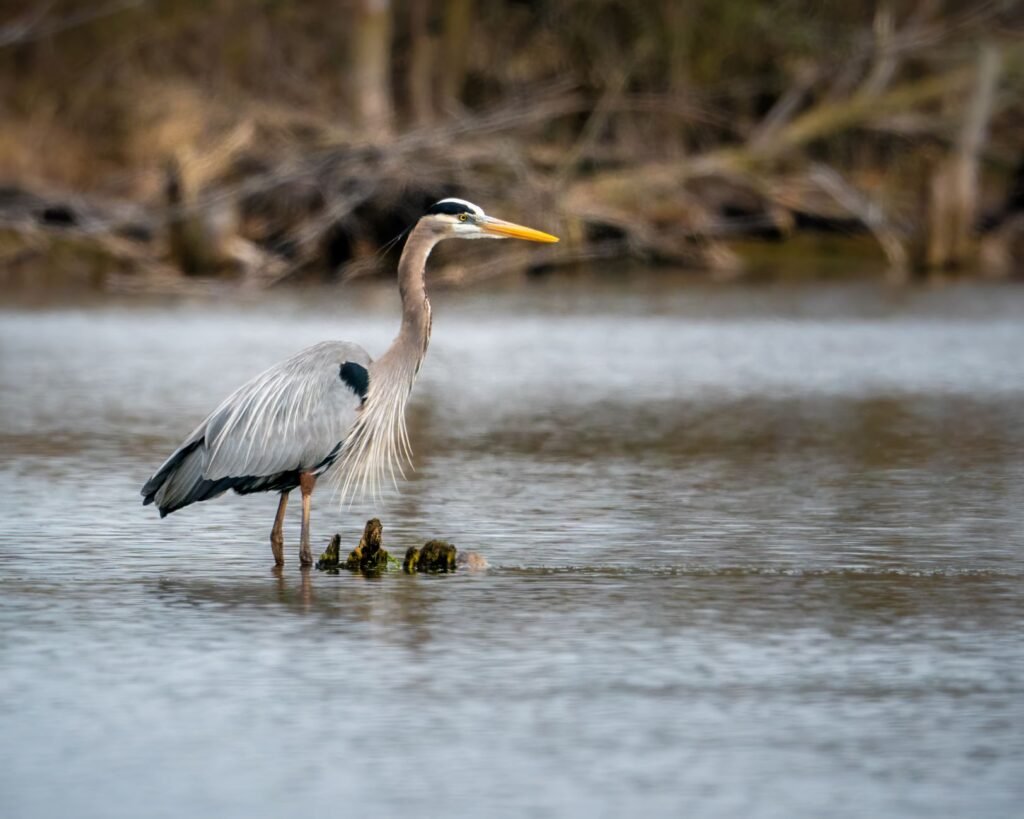
The answer is HERON, five letters. Herons stand at the edge of shallow water and wait for a fish to come within reach, which makes them the default picture of a marsh bird. Five squares is a crowded slot for this clue, though, and EGRET, SNIPE and CRANE fit it too, so test a crossing before you commit.
A heron hunts by refusing to move
Herons make up the family Ardeidae, and their favorite way of catching food barely looks like hunting. The most common technique is to sit motionless at the edge of the water, or stand in the shallows, and wait until prey comes within range. The other main method is to walk slowly, at around sixty paces a minute or less, snatching prey along the way.
For the grid, HERON is the safe opening guess because it names the marsh bird most people can picture, but it is far from the only standard answer.
Marsh birds sorted by the blanks they fill
Count your squares first, then expect to need a crossing, because the four-letter and five-letter rows are crowded.
| Letters | Answer | What points to it |
|---|---|---|
| 4 | RAIL | A shy bird of reed beds, or the family name |
| 4 | SORA | A small North American rail |
| 4 | IBIS | A long, downcurved bill |
| 4 | TEAL | A small dabbling duck |
| 5 | HERON | The default, a tall wading hunter |
| 5 | EGRET | White feathers or plumes in the clue |
| 5 | SNIPE | A very long, slender bill |
| 5 | CRANE | A tall bird that flies with its neck out |
| 5 | STILT | Extremely long legs |
| 5 | WADER | A general term, seen in British grids |
| 6 | MUDHEN | The coot, by its nickname |
| 7 | BITTERN | A booming call, or camouflage |
| 7 | MOORHEN | A dark rail of ponds and marshes |
Watch the neck to tell a heron from a crane
Herons, cranes, storks and ibises are all long-legged and long-necked, and at a distance they blur together. Flight separates them. A heron flies with its neck drawn back, while cranes, storks, ibises and spoonbills fly with their necks stretched straight out.
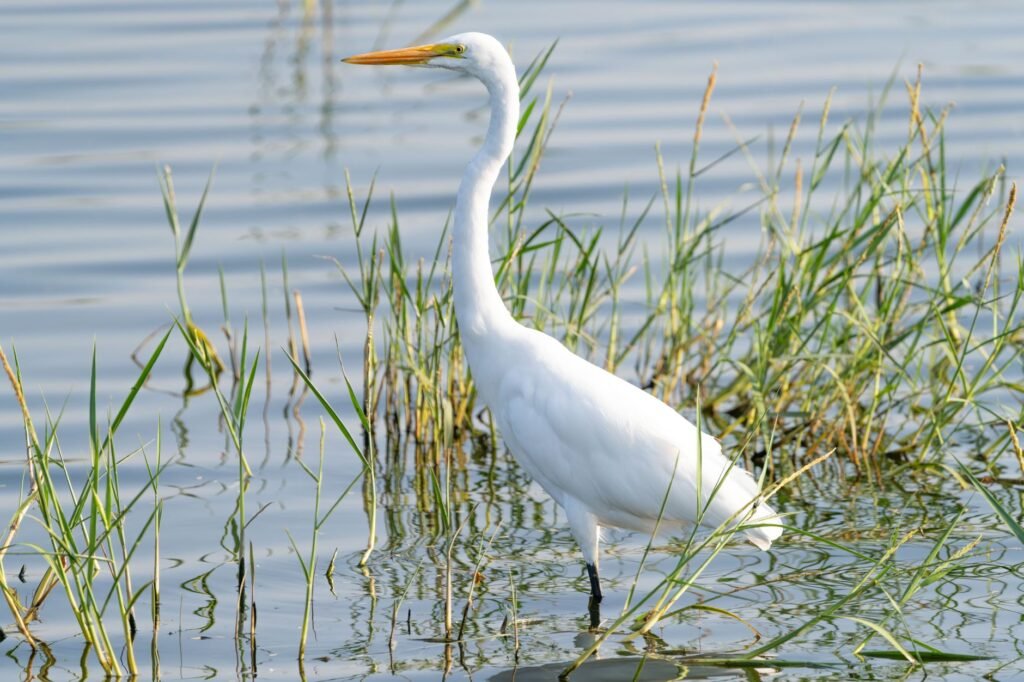
EGRET is the near miss from the other direction. Egrets do not form a biologically distinct group from herons. They are herons that are mostly white or carry decorative plumes, and the name follows the look rather than the family tree. Those plumes came at a price: around the end of the nineteenth century, great egrets were killed in large numbers so their feathers, sold as aigrettes, could decorate hats. Numbers have since recovered thanks to conservation measures, and the great egret is now the symbol of the National Audubon Society.
The rail family is heard more than it is seen
RAIL is the four-letter answer with the strongest claim on this clue, because rails are birds of exactly the places a marsh clue describes. The family, Rallidae, favors dense vegetation in damp places near lakes, swamps and rivers, with reed beds a particular favorite, and many species are laterally compressed, narrow from side to side. In general, rails are shy, secretive and difficult to observe.
SORA is the other four-letter rail. It breeds in marshes across much of North America, and it is more often heard than seen, calling with a descending whinny from inside the vegetation. MUDHEN and MOORHEN belong to the same family. Mud hen is a nickname for the American coot, a bird commonly mistaken for a duck, though ducks are only distant relatives. The moor in moorhen is used in its old sense of marsh, not the open upland that moorland means now.
The bittern’s disguise and the snipe’s legacy
BITTERN fills seven squares and suits any clue with a hint of concealment. Bitterns belong to the heron family but are shorter-necked and more secretive than their relatives. When an American bittern senses it has been seen, it stays motionless with its bill pointed upward, and its cryptic coloring blends it into the surrounding foliage. It is easier to hear than to find: the male’s booming call has been compared to a congested pump, and the bird’s folk names include stake driver and thunder pumper.
SNIPE comes with a piece of military vocabulary attached. By 1773, British soldiers in India were using snipe as a verb for shooting at men one by one from a hidden place, a borrowing from hunting the bird as game, and sniper followed in 1824. The bird itself fits five squares, carries a very long, slender bill, and keeps to wet meadows, bogs and marsh edges behind camouflaging plumage.
Frequently asked questions
What is a four-letter marsh bird in crosswords?
RAIL and SORA are the standard four-letter answers. Rails are shy birds of reed beds and damp thickets, and the sora is a small North American rail that is more often heard than seen. IBIS and TEAL also fit four squares when the clue mentions a curved bill or a duck.
Is the answer HERON or EGRET?
Both take five squares, and both are herons, since egrets are simply herons that are mostly white or carry decorative plumes. The two words share only the R in the middle square, so almost any crossing separates them. A clue that mentions white feathers or plumes points to EGRET.
Which marsh birds have seven letters?
BITTERN and MOORHEN. The bittern is a secretive member of the heron family that freezes with its bill pointed upward when it senses it has been seen, and the moorhen is a dark member of the rail family whose name uses moor in its old sense of marsh.