
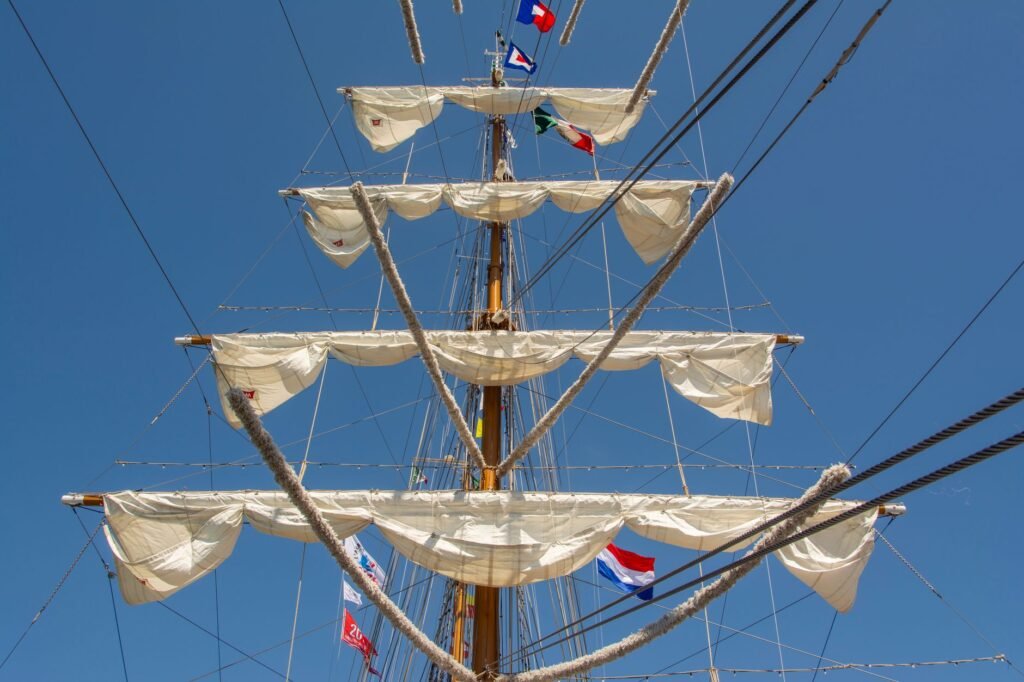
The answer is AHOY, four letters. It is the hail one vessel gives another, and for wording this plain it is the default in almost every grid. AVAST fills five squares, AYE AYE and LAND HO fill six, and SHIP AHOY covers eight when the entry runs across the middle of the puzzle.
Ahoy hails, avast stops, belay secures
These words are not interchangeable, and knowing what each one actually does will save you a wrong guess. Ahoy is a hail, a call across water to get another crew’s attention. Avast is an order to stop or hold what you are doing, which is why it almost never appears as a greeting no matter how many pirate costumes suggest otherwise. Belay means to make a line fast around a cleat or pin, and by extension to cancel an order, which is where belay that comes from. Land ho is the lookout’s report from the masthead. Heave ho is a pulling chant, timed so that a whole crew hauls on the same beat.
Puzzles do draw on those differences, though not always with much care. An editor who wants AVAST will usually say stop or hold somewhere in the wording, and one who wants AHOY will say hail, greeting or call. When the clue is as bare as “Sailors cry” you are getting no such help, which is why the square count ends up doing most of the work and why it pays to leave the slot empty until a crossing gives you a first letter.
Hailing words and how wide they run
| Letters | Answer | What it means |
|---|---|---|
| 3 | AYE | Yes, in a vote or to an order |
| 4 | AHOY | A hail to another vessel |
| 4 | YOHO | A chant syllable, chiefly in songs |
| 5 | AVAST | Stop, hold |
| 6 | AYEAYE | Order received and will be carried out |
| 6 | LANDHO | The lookout’s sighting call |
| 8 | SHIPAHOY | The full hail |
| 9 | YOHEAVEHO | The hauling chant, spelled out |
Aye, aye aye, and the animal that took the name
The single aye is a yes, familiar from voice votes where the ayes have it. Doubling it changes the job: aye aye acknowledges an order and promises to carry it out, which is a different act from simply agreeing. Setters enjoy the pair because the doubled form also names an animal. The aye-aye is a nocturnal lemur found only in Madagascar, notable for an unusually long, thin middle finger it uses to extract grubs from wood. So a clue reading “Aye aye sayer” might want a sailor, and a clue reading “Aye-aye, for one” wants a primate. Read the hyphen and the wording carefully before you commit.
Where the apostrophe sits changes the answer
Sailor’s cry, singular, points at something one voice shouts: AHOY, AVAST, LAND HO. Sailors’ cry, plural, points at something a crew produces together, which pushes you toward the work chants, YO HEAVE HO and the shanty repertoire generally. Editors are not always consistent about the mark, and some puzzle listings drop it altogether, so use it as a hint rather than a rule. The length of the slot remains the stronger signal.
The chants are worth a moment because they were working tools rather than entertainment. A shanty had a lead singer and a crew response, and the job decided the song: one rhythm for hauling a line in short bursts, another for the long steady tramp around a capstan raising an anchor. That structure is why so many of the surviving words are call and answer pairs, and why a plural clue in a grid so often resolves to something repetitive rather than to a single shout.
Short, open and easy to shout
Run through the list and one shape repeats. Almost every call is one or two syllables, and almost every one ends on an open vowel: ahoy, yo ho, land ho, avast being the odd one out. These were words meant to cross a gap of open water, over wind and canvas, to a crew that could not see your face. Whatever the reason each particular word was chosen, the ones that lasted are the ones you can bellow. That is also why they fit crossword grids so neatly, since vowel heavy short entries are exactly what a constructor needs to hold a corner together.
It also explains why the nautical corner of crossword vocabulary is so much larger than the subject deserves. AFT, ALEE, KEEL, MAST, PROW, SPAR, HELM and OAR are all short, all vowel friendly and all unambiguous, so editors keep them in circulation long after solvers stopped meeting them anywhere else. Learn the group as a set and the whole family turns up together.