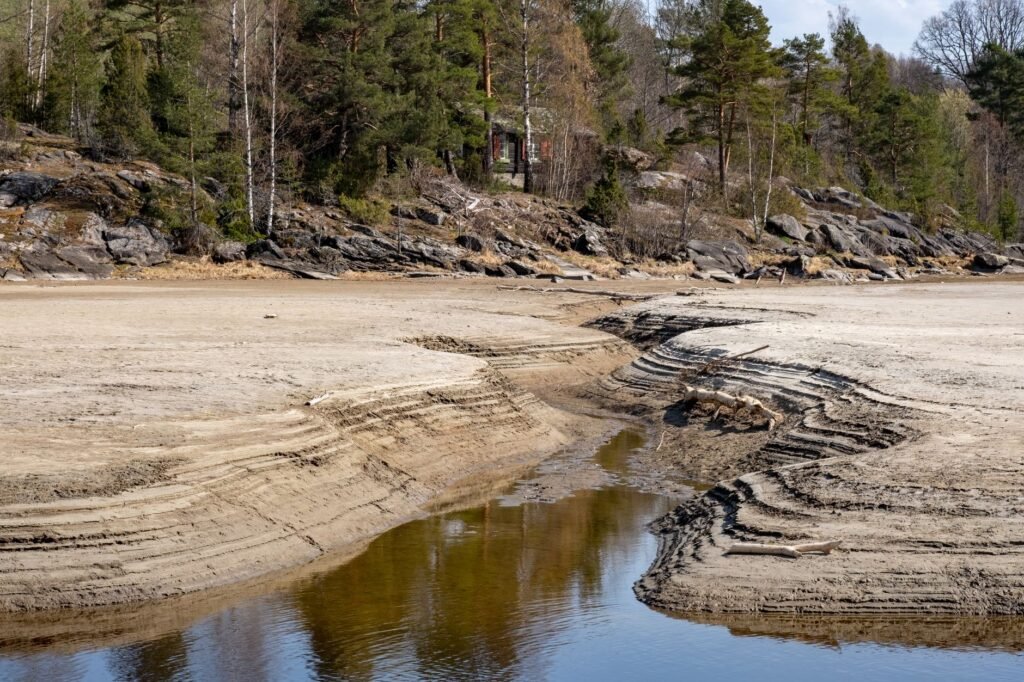
The answer is SILT, four letters. Sediment is anything that has settled out of a moving fluid, which means the clue can be standing on a riverbed or at the bottom of a bottle. Unqualified wording points at SILT. If the clue mentions wine, a cask or a barrel, the puzzle wants LEES instead, and five squares usually means DREGS.
Where the clue is pointing: river or bottle
Setters lean on this word precisely because it straddles two worlds. Geology uses sediment for the load a river carries and drops: gravel, sand, silt, clay, all of it sorted by how fast the water is moving when it lets go. Winemaking uses it for the solids that fall to the bottom of a tank after the yeast has finished. The definition covers both without favoring either, so the wording around the clue carries all the signal. A bare “Sediment” and four blanks is the geological reading. Add a single vinous word and the target moves.
Silt is a grain size, not a substance
Silt is not a mineral. It is a size band, sitting between sand above it and clay below it, and a grain qualifies on diameter alone regardless of what it is made of. You can sort the three by feel without any equipment. Dry sand grates audibly between finger and thumb. Wet clay is sticky and will hold whatever shape you press it into. Silt feels like flour when dry and slippery rather than sticky when wet, and it will not hold a shape.
That fineness is why silt travels. Sand drops out as soon as a current slows, but silt particles stay in suspension for miles and settle only in genuinely still water, which is why floodplains and lake beds are made of it. Readers who have already worked through our fertile soil clue will recognize silt as one of the three fractions behind that answer, doing a different job here.
Bury any of these deep enough and for long enough and the size band decides what rock you end up with. Compacted sand becomes sandstone, compacted clay becomes shale, and compacted silt becomes siltstone. Sedimentary is the adjective for the whole family, and any clue reaching for that adjective is telling you plainly that the geological branch of the word is the one in play.
What silt does when nobody moves it
Left alone, silt fills things in. Harbours need dredging because every tide brings a little more of it. Reservoirs have a working life measured in decades rather than centuries for the same reason, since the lake behind a dam is exactly the still water silt has been waiting for. The Nile case is the famous one: the annual flood used to spread fresh silt across Egyptian fields, and once the Aswan High Dam held that load back in its reservoir, downstream farmers had to replace it with manufactured fertiliser.
The wine words solvers reach for too late
LEES are the dead yeast cells and grape solids that drop out after fermentation. Far from being waste, they are often left in deliberately, and some winemakers stir them back through the wine for months to build a fuller, bready texture. DREGS is the same material described with contempt, which is why the word survives mainly in the phrase about the dregs of society and in draining a cup to the dregs. Coffee gives you GROUNDS, seven letters, which turns up whenever the clue mentions a pot or a cup.
Running the list against your blanks
Count the squares before you decide which world the clue is in:
| Letters | Answer | What triggers it |
|---|---|---|
| 4 | SILT | Plain wording, or any river or harbour hint |
| 4 | LEES | Wine, cask, barrel or vat in the clue |
| 5 | DREGS | The worthless last of something |
| 6 | SLUDGE | Tanks, drains, industrial wording |
| 7 | DEPOSIT | Neutral wording, often geological |
| 7 | GROUNDS | Coffee in the clue |
| 8 | ALLUVIUM | Explicitly geological phrasing |
One more thing worth knowing: SILT works as a verb as well as a noun, so a clue built around a channel closing up can want SILTS or SILTED instead. If your crossings hand you a fifth or sixth letter that will not fit the noun, try the verb before you abandon the word.
Frequently asked questions
Should I write SILT or LEES for a four letter Sediment clue?
Go with SILT unless the clue mentions wine, a cask, a barrel or a vat. Those words are the signal that the puzzle wants LEES, and setters rarely use them by accident.
What is the difference between silt and clay?
Both are fine soil fractions defined purely by particle size, with clay being the finer of the two. In practice silt feels powdery and will not hold a shape, while wet clay is sticky and molds easily.
Can DREGS be correct when the clue is singular?
Yes. Sediment is a mass noun, so it gives no clue about number, and DREGS is a word that only exists in the plural. A plural looking entry is not a mismatch here.