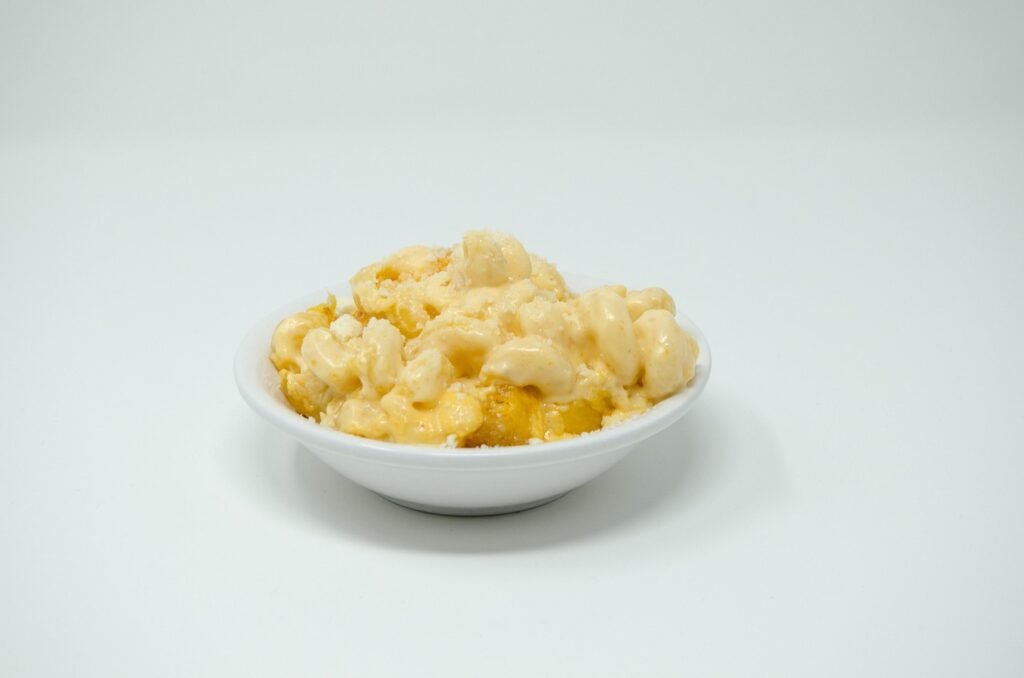
Yes, mac and cheese is one of the better creamy dishes to freeze. A sauce built on a flour and butter roux has starch molecules holding the liquid, and that scaffolding survives ice crystals far better than a plain cheese and cream sauce. Freeze it assembled but unbaked, then bake it straight from frozen for the best texture.
Why a flour thickened sauce survives the cold
The enemy in any frozen sauce is separation. Fat and water want to part company once crystals force them apart, and cheese sauce is mostly fat and water held in a truce. A roux changes the odds. Starch granules from the flour swell and trap liquid in a gel, so even when the sauce breaks a little on thawing, the starch pulls it back together as it heats.
Cheese choice matters just as much. Young, high moisture cheeses such as mozzarella and mild cheddar melt smoothly and re-melt smoothly. Aged cheddar, parmesan and anything low in moisture has tighter protein bonds and tends to go slightly gritty. A sauce that leans on evaporated milk, cream cheese or a spoonful of sodium citrate stays glossy through a freeze and a reheat because those ingredients keep the fat emulsified without relying on heat alone.

Assemble, freeze, then bake
- Boil the pasta two minutes short of the package time. It will absorb sauce in the freezer and again in the oven, and undercooked elbows end up right where fully cooked ones end up mushy.
- Make the sauce slightly looser than you want to eat it. Add an extra quarter cup of milk per pound of pasta to cover what the starch drinks up.
- Combine, then cool the pan to room temperature before it goes near the freezer. Warm food in a freezer grows large crystals in everything around it.
- Cover the surface with plastic wrap, then foil over that. Leave the breadcrumb topping in a separate bag and scatter it on at baking time.
- Bake from frozen, covered, at a moderate temperature until the center is hot, then uncover, add the topping and brown the surface.
Whole pan or single servings
| Format | Freeze in | Reheat note |
|---|---|---|
| Family pan | Foil tray or freezer safe baking dish | Long covered bake, uncover at the end |
| Single portions | Ramekins or a muffin tin, then bagged | Fastest option, easy to overcook |
| Flat slab in a bag | Zip bag laid flat on a sheet pan | Snap off what you need, reheat in a pan |
Reheating without a broken sauce
Slow and covered is the whole rule. Steam trapped under foil reheats the middle before the edges dry out, and moderate heat gives the starch time to reabsorb any liquid that separated. Stir a splash of whole milk or cream into single portions halfway through and the sauce comes back glossy.
The microwave works for one bowl if you drop the power to half and stir every minute. Full power drives the water out of the sauce in bursts and leaves you with oily edges and a cold core. A skillet is the sleeper option: break frozen mac into a nonstick pan with a little milk, cover, and let it steam back to life, then press it down and let the bottom crisp into a crust.
Quality stays good for about two to three months. Nothing multiplies in a working freezer, so the countdown is only about flavor and how much moisture the pasta has given up.