
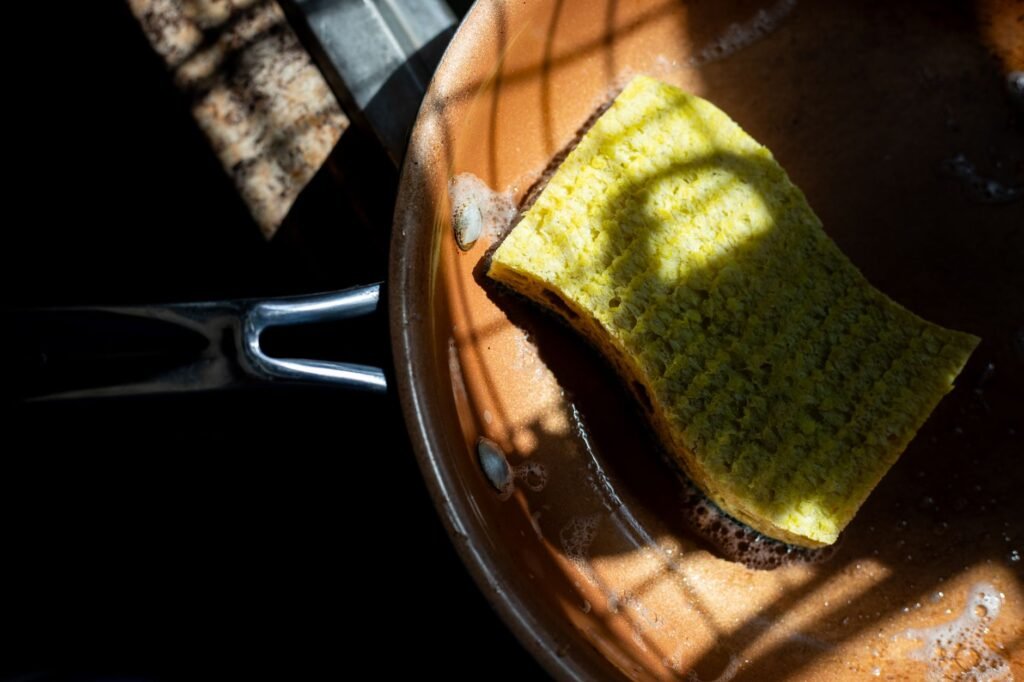
To clean a burnt pan, cover the scorched area with water, add baking soda, bring it to a simmer, and scrape the loosened bits with a wooden spatula. If a dark layer remains, leave a thick baking soda paste on it for several hours, then scrub. Stubborn carbon usually needs a vinegar and baking soda fizz.
Match the cleaning method to your pan surface
Stainless steel can take a firm scrub. Coated pans cannot, and the wrong pad can strip a nonstick surface in one session. Check what you are holding before you reach for anything abrasive.
| Pan surface | Safe approach | Avoid |
|---|---|---|
| Stainless steel | Simmer, baking soda paste, vinegar fizz | Leaving it soaking for days |
| Nonstick | Simmer and paste with a soft sponge | Metal tools, scouring pads |
| Ceramic coated | Paste and a nylon brush | Metal tools, scouring pads |
| Enameled cast iron | Simmer, then paste with a nylon brush | Metal scrapers that chip enamel |
Bare cast iron and copper follow their own rules, and each has a separate guide on this site.
The simmer and scrape for stainless steel
Start here, because it removes most fresh scorching with almost no effort. Pour in enough water to cover the burnt area, or use half water and half white vinegar, and add a few spoonfuls of baking soda. Bring it to a boil, lower it to a simmer, and push at the edges of the burn with a wooden or silicone spatula as the liquid bubbles.
Let the pan cool until you can handle it, pour out the liquid, and scrub what is left with a nonscratch pad. Food that burned minutes ago often lifts completely at this stage.
Stay close while it simmers. If the water boils away, the pan scorches all over again, and a dry pan on a hot burner is how most of these messes start in the first place.
Baking soda paste for scorch marks that stay put
For a film that survived the simmer, Arm and Hammer suggests a paste of roughly three parts baking soda to one part water, spread thickly over the dark patch. Give the paste a few hours on the scorch, or the whole night, to soften the residue, then scrub in small circles. On the sides of a pot, where paste slides down, press a paper towel coated in paste against the stain so it stays in contact.
A lemon half makes a handy scrubber here. Sprinkle baking soda into a thin layer of water and use the cut side of the lemon to work the slurry over the stain. The fruit is soft enough for coated pans, though a nylon brush still does more work.
The vinegar fizz for a thick carbon crust
- Pour white vinegar into the pan until the bottom is covered by at least half an inch.
- Bring it to a boil and let it simmer briefly.
- Move the scorched pan away from the heat and set it on a trivet or cold burner.
- Add about a cup of baking soda. It will foam hard, so do this over the sink if the pan is small.
- Wait until the bubbling stops, pour it out, and scrub with more baking soda.
Repeat once or twice for very heavy burns. Each round tends to lift another layer.
Habits that leave stainless pans scratched or warped
Steel wool will remove carbon, but it also leaves fine scratches that food grips on the next time you cook. Save it for the outside bottom of a pan if you use it at all. Plunging a very hot pan into cold water is another habit to drop, since the sudden temperature change can warp thinner pans so they rock on the burner.
Most burns come from heat that is too high for too long, or a pan left empty on a lit burner. Medium heat and a little oil prevent the next cleanup. If you ever smell overheated nonstick coating, turn off the burner, open a window and let the pan cool before you touch it.
Frequently asked questions
Can I put a burnt pan in the dishwasher?
A dishwasher rarely removes baked on carbon, and the heat can set the stain harder. Many coated pans also lose their finish faster when washed in a dishwasher. Clean the burn by hand first, then check the pan maker's care instructions before deciding whether the dishwasher is allowed at all.
Why does my stainless pan still look stained after cleaning?
A faint brown or rainbow tint can remain after the burnt food is gone. Try one more round of the baking soda paste first. If the tint stays, check the pan maker's care page, which usually names the cleaner it recommends for restoring the original finish.
How do I clean the burnt outside bottom of a pan?
Turn the pan upside down in the sink, cover the dark areas with a thick baking soda paste, and let it sit for several hours. Scrub with a nonscratch pad and rinse. The outside bottom of stainless pans can take firmer scrubbing than the cooking surface can, because food never touches it.
How do I season a stainless steel pan?
Heat the clean, dry pan, wipe a very thin film of cooking oil over the inside, and keep heating until the oil just starts to smoke, then let it cool and wipe out the excess. Stainless steel needs no seasoning to prevent rust the way cast iron does, but this thin layer can help reduce sticking.
How do I clean a burnt nonstick pan?
Use a baking soda paste rather than scrubbing. Cover the burnt area with a thin layer of warm water, sprinkle in baking soda, and let the paste sit for several hours or overnight, as Arm and Hammer suggests for coated pans. Wipe it off with a soft sponge, and skip metal tools and scouring pads, which strip nonstick coatings.