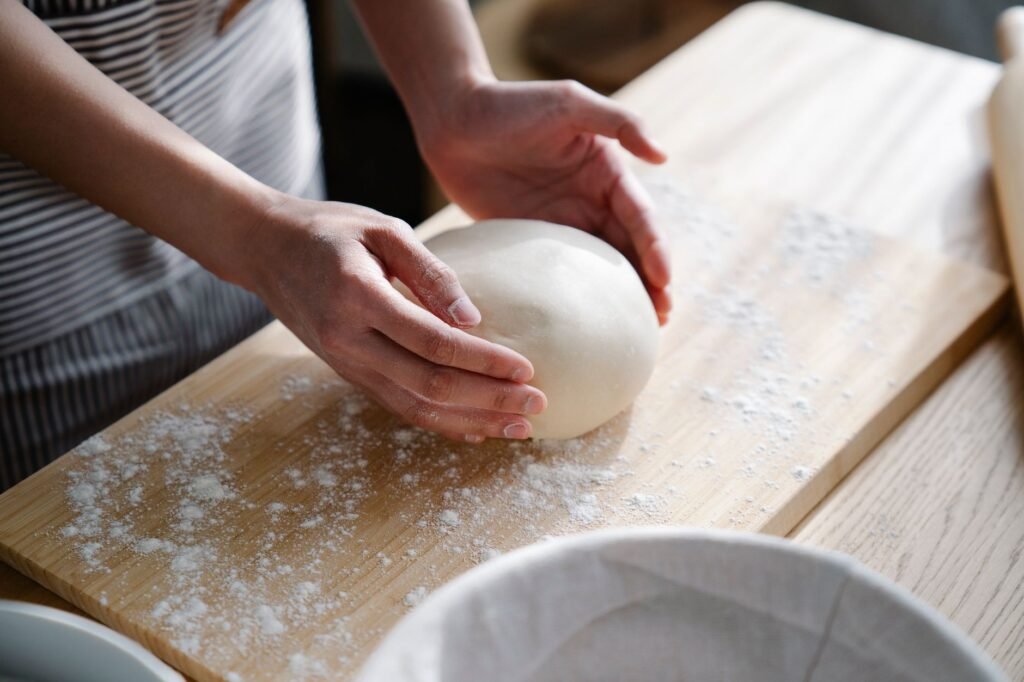
To make pizza dough at home, mix finely milled 00 flour with lukewarm water, salt and a pinch of yeast, then let it rise at room temperature for 12 to 24 hours. Divide it into balls, give them a short second rise, stretch by hand, and bake on a preheated stone or steel.
What 00 flour does to a homemade crust
The 00 label comes from the Italian milling scale, where 00 is the finest, whitest grind. King Arthur describes its version as a blend of hard and soft wheat. The hard wheat gives the dough enough strength to stretch thin without tearing, and the soft wheat adds starch for a crust that is crisp rather than hard.
| Flour | Protein (King Arthur figures) | Best suited to |
|---|---|---|
| 00 pizza flour | Blend of hard and soft wheat | Thin, blistered, Neapolitan style pies |
| All-purpose | 11.7% | Classic crusts with a moderate chew |
| Bread flour | 12.7% | Thick, airy pan pizza |
Protein varies by brand, so check the nutrition panel on your bag if you swap flours.
A 00 flour pizza dough recipe by weight
This follows the King Arthur Neapolitan style crust, which makes two pizzas of 10 to 12 inches. A kitchen scale gives the most consistent results.
- Weigh 232 grams (about 2 cups) of 00 pizza flour into a bowl.
- Add 1/8 teaspoon instant or active dry yeast, 1/2 teaspoon sugar and 8 grams (1 1/4 teaspoons) table salt.
- Pour in 170 grams (3/4 cup) of lukewarm water, between 105 and 115 degrees F.
- Stir until no dry flour remains. The dough will look shaggy, and that is fine.
- Cover the bowl and leave it at room temperature for at least 12 hours and up to 24.
The long rise that replaces kneading
That tiny amount of yeast is deliberate. A slow overnight rise gives gluten time to develop on its own and builds more flavor than a fast, heavily yeasted dough. There is no kneading session in this method.
After the rise, turn the dough onto a floured surface. Hold it at both ends, pull one end away, fold it back over itself, and repeat from the other side. Divide it in half, about 200 grams per piece, shape each into a smooth ball, and let them rest for 45 minutes to an hour while the oven heats.
Kitchens vary, so read the dough as well as the clock. In a warm room it may look bubbly and slack well before 12 hours, and in a cool one it may need the full day. A good dough has grown noticeably, shows bubbles on the surface and feels soft and airy when pressed.
Stretching pizza dough into a round without tears
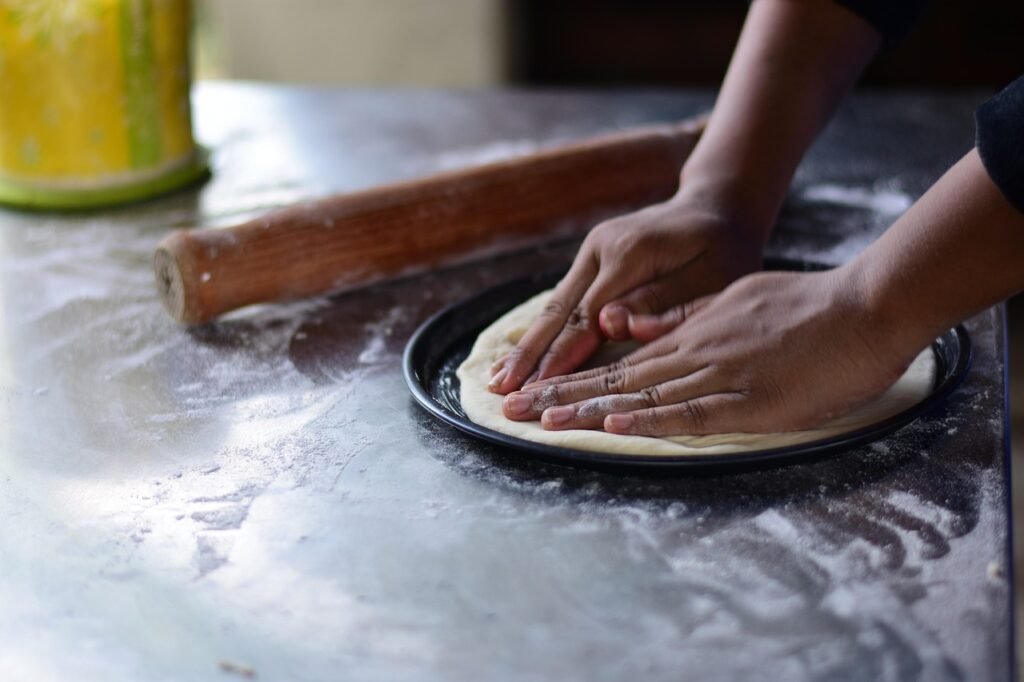
Press the center of a ball flat with your fingertips, leaving a thin border untouched. That border traps gas and puffs into the bubbly rim. Then drape the dough over your knuckles and rotate it, letting its own weight do the stretching until it reaches 10 to 12 inches.
Skip the rolling pin, which squeezes out the air you waited all night for. If the dough keeps springing back, cover it and give it ten minutes to relax. A small hole can be pinched shut. Top lightly, since a heavy layer of sauce and cheese weighs down a thin 00 crust.
Getting enough heat out of a home oven
Put a baking stone or steel on a rack in the center of the oven and preheat to 500 to 550 degrees F, whichever your oven allows. Give it a full preheat so the surface is soaked with heat, not only the air.
Slide the pizza on from a floured peel. King Arthur’s timing is about 6 minutes on a steel or 7 on a stone. For more color on top, move the pie under the broiler for 2 to 3 minutes and watch closely, because it goes from browned to burnt quickly. Give the stone a few minutes to recover its heat before the second pizza goes in.
Frequently asked questions
Can I use all-purpose flour instead of 00 flour?
Yes, all-purpose flour makes a good pizza. The crust comes out a little chewier and less delicate than a 00 crust, and the dough may feel slightly different in your hands. Start with the same weights and add a spoonful of water if the dough feels stiff after mixing.
Can I let pizza dough rise in the refrigerator instead?
Many bakers do a cold rise in the fridge for a day or more to fit their schedule and deepen flavor. Cold slows the yeast, so plan on a longer rise and let the dough balls warm on the counter before shaping, since cold dough fights back when you stretch it.
Why is my homemade pizza crust pale and soft?
Pale, soft crusts usually point to an oven or stone that was not hot enough when the pizza went in. Preheat the stone or steel longer at the highest setting, bake on a center rack, and try a short broiler finish. Too many wet toppings can also steam the crust.
How long does pizza dough last in the fridge?
Plan on a day or two. King Arthur's make-ahead pizza dough can stay refrigerated for up to 36 hours, and Red Star Yeast says its pizza dough keeps in the fridge for up to 48 hours. Cold slows the yeast without stopping it, so freeze any dough you won't bake in that window.
How do you make pizza dough without yeast?
Use baking powder instead. Stir flour, baking powder and salt together, add milk and a little oil, knead a few times and let the dough rest 10 minutes, with no rise needed. Press it into a round, bake it without toppings at 400 degrees Fahrenheit for about 8 minutes, then add toppings and bake until golden.