
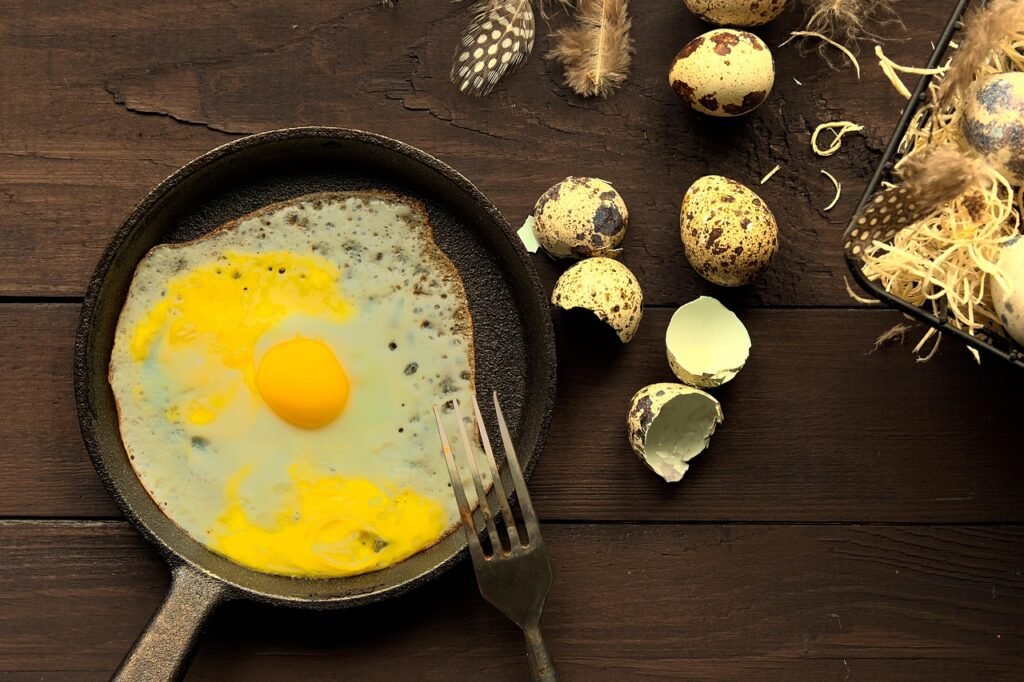
Wash the pan while it is still warm with hot water, a stiff brush or chainmail scrubber and a little dish soap if you want it, dry it completely on a burner, then rub in a very thin film of oil. The drying step protects the pan far more than anything you do with the washing step.
Seasoning is a polymer, not built up grease
A seasoned surface is not oil sitting on iron. Heating a thin layer of oil past its smoke point drives off the volatile parts and pushes the remaining fat molecules to link together into a hard, continuous film bonded to the metal. Chemically it has more in common with a varnish than with the oil in the bottle, which is why it is slick, why it does not wipe off, and why a good one is almost black.
Understanding that settles the soap argument. A cured polymer is not dissolved by a surfactant, so today’s dish soap lifts food residue and leaves the film alone. The warning survived from an era when soap was made with lye, which genuinely did attack the film. What does destroy seasoning is different: prolonged soaking, because water works its way under the film through any gap and rusts the iron beneath it, and dishwasher detergent, which is strongly alkaline and runs hot for an hour. A long simmer of something acidic will thin the film too.

Washing it while it is still warm, step by step
- Clean the pan while it is still warm, since food releases far more easily than it will once everything is cold and set.
- Run hot water in and scrub with a stiff brush, a chainmail scrubber or a plastic scraper. Add a drop of dish soap if the pan cooked something greasy.
- For welded on food, simmer an inch of water in the pan for a minute and scrape while it is hot, or scour with coarse salt and a paper towel.
- Rinse, then dry with a towel.
- Put the pan back on a burner over medium heat for a minute or two until no moisture remains anywhere, including the handle and the underside.
- Off the heat, rub in a few drops of a neutral oil with a paper towel, then wipe it back off until the surface looks dry rather than glossy. A visible oil layer turns sticky in storage.
What the film survives and what strips it
| Treatment | Effect on seasoning |
|---|---|
| Hot water and a stiff brush | Harmless. The intended routine. |
| A small amount of dish soap | Harmless on a cured film. |
| Chainmail scrubber | Fine. It takes off stuck food and leaves the bonded layer. |
| Coarse salt scour | Fine, and useful for sticky residue. |
| Leaving the pan to soak in the sink | Rust under the film. The most common way pans are damaged. |
| Dishwasher | Strips the film and leaves the pan gray and rusting. |
| Long acidic simmers | Thins the film over time and can leave a metallic taste. |
| Oven self clean cycle | Burns the film off completely and can warp or crack the iron. |
Bringing back a rusted pan
Orange patches mean bare iron met water and air, usually after a soak or a stint in a damp cupboard. Scrub the rust off down to gray metal with steel wool, a scouring pad or salt, and do not be gentle, since you are removing iron oxide rather than protecting a finish that is already gone. Wash, dry on the burner, then wipe on the thinnest possible coat of oil and bake the pan upside down in a hot oven for an hour with a tray underneath. Repeat that bake two or three times and the surface darkens and starts behaving again.
Storage, and the habit that undoes all of it
Store the pan bone dry with a paper towel between it and anything stacked on top, which lets trapped moisture escape instead of pooling. Never leave it wet in the sink overnight, never leave water standing in it, and never put it away warm and lidded, because the condensation that forms inside is enough to start rust. Cooking in the pan often is the best maintenance there is, since every fried egg and seared steak adds another whisper of polymer to the surface.