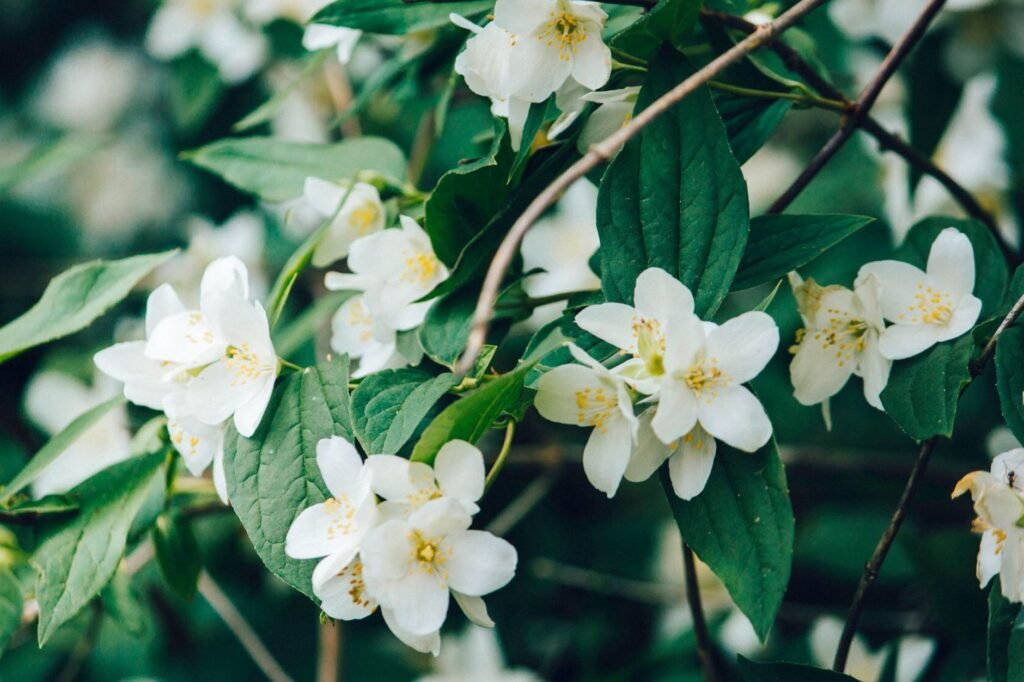
Jasmine roots from semi hardwood cuttings taken once the season’s new growth has begun to firm up. Before you cut anything, check which plant you own, because several popular climbers are sold as jasmine without belonging to the genus at all, and they do not all behave the same way.
Sort out which jasmine is on your fence
The name travels widely, mostly because so many unrelated vines share that sweet evening scent. Real jasmines belong to the genus Jasminum. The rest borrowed the label from perfume sellers and nursery tags.
| Sold as | Actually | Quick tell | Propagation note |
|---|---|---|---|
| Common or poet’s jasmine | Jasminum officinale | Leaves divided into small leaflets, white starry flowers | Semi hardwood cuttings, roots readily |
| Arabian or sambac jasmine | Jasminum sambac | Thick glossy paired leaves, heavy waxy blooms | Semi hardwood cuttings, wants real warmth |
| Star or confederate jasmine | Trachelospermum jasminoides | Milky sap when a stem is cut | Cuttings work, expect a slower timeline |
| Carolina jessamine | Gelsemium sempervirens | Yellow trumpet flowers, not white stars | Treated as a toxic plant, handle with gloves |
| Night blooming jasmine | Cestrum nocturnum | Scent arrives only after dark | A nightshade relative, cuttings root easily |
Milky sap is the fastest field check. No true jasmine bleeds white, so if a cut stem weeps milk you are holding star jasmine and should wipe the blade before it gums up.
Semi hardwood is a stage, not a season
Softwood is this spring’s growth, floppy and bright green, and it collapses before it can root. Hardwood is last year’s stem, stiff and brown, and it has lost most of its capacity to form new roots. The window you want sits between them, where the shoot has hardened enough to hold its shape but has not turned woody.
Test by bending. A suitable piece flexes and then snaps with an audible crack. A piece that folds over without breaking is too soft, and one that refuses to bend at all is too old. Most gardens offer this stage in mid to late summer, though the exact timing shifts with your climate and how hard the plant was pruned.
Taking the cutting and giving it somewhere to root
- Cut in the cool of the morning, when the stems are full of water rather than already stressed by sun.
- Take a shoot about the length of your hand, slicing just below a leaf joint where the rooting tissue is concentrated.
- Strip the leaves from the lower half and pinch out any flower buds, since blooming and rooting compete for the same reserves.
- Halve each remaining large leaf across to cut water loss without removing the surface the cutting feeds itself with.
- Powder the base with rooting hormone if there is some on the shelf, then push the stem into potting soil cut with sand or perlite.
- Tent a clear bag or a dome over the pot, propped clear of the foliage, and set it in dappled shade well away from direct sun.
Rooting commonly runs from a few weeks to two months or so. Bottom warmth shortens it, cool nights drag it out, and gentle resistance when you tug the stem tells you roots have formed.
Layering, for anyone whose cuttings keep failing
Jasmines climb, which means long flexible stems are already within reach of the ground. Layering exploits that. Bend a low stem down, scrape a shallow wound on the underside where it meets the soil, pin it flat with a bent wire or a stone, and bury that section while the tip stays above ground.
The advantage is that the buried stem keeps drinking from its parent for as long as rooting takes, so there is no race against drying out. Check by lifting gently after a couple of months, and once roots have formed, sever the link and lift the new plant. It is slower than a tray of cuttings and it succeeds far more often, which is a trade worth taking with a plant you only need one copy of.
Frequently asked questions
Will jasmine cuttings root in a jar of water?
Occasionally, though the success rate is poorer than a gritty mix and the roots that form are weak and prone to collapsing at potting time. Woody stems in particular go soft at the buried end long before rooting. A covered pot of sandy medium is the more dependable route.
When is the best time of year to take jasmine cuttings?
Mid to late summer suits most gardens, because that is when the current season's shoots have firmed up without turning woody. The plant is the real calendar. Bend a shoot, and when it snaps cleanly rather than folding, the wood is at the stage you want.
Why do my jasmine cuttings wilt and go black at the base?
Two usual causes. The wood was too soft, so the stem could not hold water long enough to root, or the medium stayed too wet and the buried section rotted. Use firmer wood, a grittier mix, and keep the cover off the foliage so moisture does not sit on it.