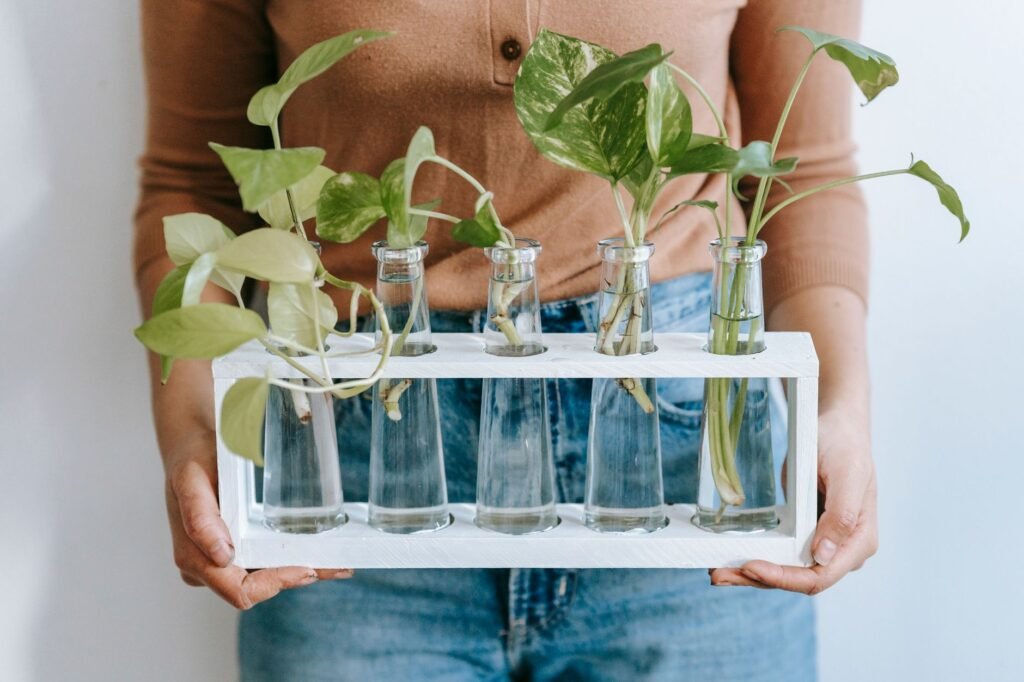
Cut just below a node, drop it in a glass with the node underwater and the leaf above it, and put the glass somewhere bright. Roots appear within a few weeks. The part most guides skip is what happens next, because roots grown in water are built differently from roots grown in dirt.
The brown bump on the stem does all the work
Run a finger along a pothos vine and you will feel small raised nubs, one at each point where a leaf joins. That nub is a node, and it is a dormant root primordium waiting for contact with moisture. On an older vine it may already have pushed out a short brown aerial root, which is the same structure partway started.
Everything else on the vine is decoration. A leaf snipped off with its stalk and nothing else will float in a jar looking perfectly healthy for weeks and never produce a single root, because it carries no growth point. That is the most common wasted effort with this plant, and it costs nothing to avoid once you know where to look.
So the cut is simple. Find a node, place your blade a short distance below it, and make sure the piece you keep has at least one node plus one or two leaves to feed it.
Setting up a jar that actually roots things
- Take a piece with two or three nodes, cutting cleanly with scissors that have been wiped down.
- Strip off every leaf low enough to end up underwater. A drowned leaf rots and fouls the jar for everything else standing in it.
- Use a narrow vessel so the cutting stands upright instead of sliding under.
- Fill so the nodes are covered and the remaining leaves stay clear of the surface.
- Park it where daylight reaches but direct sun does not, since a sunny sill heats the glass and cooks tender new roots.
- Swap the water whenever it clouds or smells, which also resupplies the dissolved oxygen roots need.
Timing runs from a couple of weeks to considerably longer, with warmth and light doing most of the work. A cutting taken in the short dark days sits still far longer than one taken in a bright warm stretch, and neither case means the piece has failed.
A jar root and a pot root are different organs
A root grown in a jar is thin, pale, brittle and noticeably hairless. It develops open channels through its tissue that ferry oxygen down from the stem, because water holds far less oxygen than the air pockets in a pot do. It also never builds the fuzz of fine root hairs that pull moisture out of a solid medium, since it is already surrounded by moisture on every side.
Drop that root system straight into a dry pot and it cannot do the job asked of it. The plant wilts, people blame transplant shock, and the real story is a root built for one environment being handed another. Soil roots are thicker, whiter, branched and covered in hairs, which is why a plant that has lived in dirt can never simply be moved to a vase either.
Stay in the jar, or move over slowly
Keeping a pothos in water permanently is a real option and plenty of people do it for years. Two things keep it healthy. Plain water carries almost no nutrition, so the cutting needs a liquid feed at a much weaker strength than a potted plant would get. And the water needs refreshing on a regular rhythm, because stagnant water runs low on oxygen and the roots suffocate before they starve.
If you do want it in a pot, move while the roots are still young rather than after they have filled the glass, since short roots adapt and long ones mostly die back. Pot into a mix you keep genuinely damp for the first stretch, then stretch the intervals week by week until you are watering it like any other houseplant. New growth appearing at the top is the signal that fresh soil roots have taken over.
Frequently asked questions
Can a pothos live in water forever?
Yes, many do. The two requirements are a very dilute liquid feed, since plain water offers nothing to eat, and regular refreshing so the roots keep getting oxygen. Growth stays slower and leaves usually come out smaller than the same plant would manage in a pot.
Why is my pothos cutting rooting but not growing new leaves?
That order is normal. The cutting spends its stored energy building a root system first, and top growth resumes only once those roots can supply it. Bright light and warmth shorten the pause. A cutting with roots and no new leaf after many months is usually short on light.
Should you change the water or just top it up?
Change it. Topping up leaves behind the slime and mineral residue that build on the glass, and it does little for oxygen levels. Pour the old water out, give the jar a quick rinse, and refill. Water at room temperature is easier on new roots than a cold pour out of the faucet.