
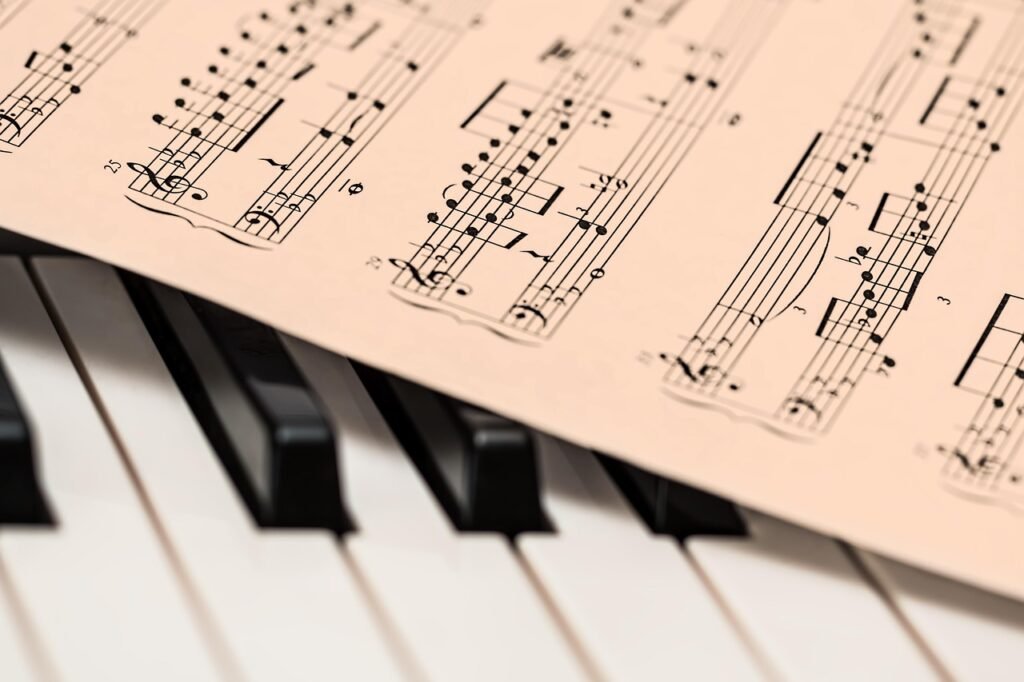
To read sheet music, learn which note each line and space of the staff stands for, then learn how long each note shape lasts and what the numbers at the start of the piece mean. Pitch tells you which key to press, rhythm tells you when and for how long, and piano music shows both hands at once.
The staff, the clefs and the piano grand staff
Music is written on a staff of five horizontal lines and the four spaces between them. Notes placed higher on the staff sound higher. The symbol at the left edge, the clef, tells you which notes those lines represent.
The treble clef, also called the G clef, curls around the second line from the bottom and marks it as the G above middle C. The bass clef, or F clef, puts its two dots around the fourth line from the bottom and marks the F below middle C. Piano music stacks the two together into a grand staff, joined by a brace, with the right hand usually reading the treble staff and the left hand the bass.
Middle C sits exactly between them. It’s written on a short extra line, called a ledger line, just below the treble staff or just above the bass staff. Find middle C on your keyboard near the center and use it as your anchor.
Naming the notes on treble and bass lines
| Staff | Lines, bottom to top | Spaces, bottom to top | Memory aid |
|---|---|---|---|
| Treble | E G B D F | F A C E | Every Good Boy Does Fine; the spaces spell FACE |
| Bass | G B D F A | A C E G | Good Boys Do Fine Always; All Cows Eat Grass |
Memory phrases get you started, but don’t rely on them forever. Readers who get fluent learn a handful of landmark notes, such as middle C, treble G and bass F, and count up or down by step from the closest one. A note on a line moves to the space directly above, then to the next line, and so on through the musical alphabet from A to G.
A sharp sign raises a note to the very next key, usually a black one, and a flat lowers it. A natural sign cancels either.
Note shapes and how long each one lasts
| Note | What it looks like | Beats in 4/4 time |
|---|---|---|
| Whole note | Open oval, no stem | 4 |
| Half note | Open oval with a stem | 2 |
| Quarter note | Filled oval with a stem | 1 |
| Eighth note | Filled oval with a stem and one flag | 1/2 |
A dot after a note adds half of that note’s value, so a dotted half note lasts three beats. Each note has a matching rest symbol that means silence for the same length. Eighth notes that sit side by side are often joined by a beam instead of separate flags.
Time signatures and key signatures at the start of each line
The stacked numbers after the clef are the time signature. The bottom number tells you which note gets counted, with 4 meaning the quarter note. The top number tells you how many of them fit in each measure, the section between two vertical bar lines. So 3/4 means three quarter note beats per measure, the feel of a waltz. A large C stands for common time, the same as 4/4. In 6/8, the eighth notes are grouped in threes, so it usually feels like two big beats per measure.
Sharps or flats clustered right after the clef form the key signature. They apply to every note of that name for the whole piece, in every octave, unless a natural sign cancels one.
A practice routine for reading at the keyboard
- Spend five minutes naming notes out loud from a beginner book without playing.
- Clap and count the rhythm of a short line before touching the keys.
- Play the right hand alone slowly, then the left hand alone.
- Put both hands together at a tempo where you never have to stop.
- Pick a new, easier piece often, since sight reading improves with lots of simple music rather than one hard piece drilled for weeks.
Keep your eyes on the page instead of your hands whenever you can. That habit feels awkward for a while, and it’s the one that eventually makes reading automatic.
Frequently asked questions
How long does it take to learn to read sheet music?
It depends on how often you practice and how complex the music is. Most beginners can name notes and count basic rhythms within a few weeks of short daily sessions. Reading quickly enough to play new pieces smoothly takes longer and grows mostly through regular sight reading of easy material.
Do I need to learn both clefs for piano?
Yes. Piano music uses the grand staff, with the treble clef usually for the right hand and the bass clef for the left. Many beginners learn treble first because it's familiar from other instruments, but pieces quickly require both, so practice naming bass clef notes from the start.
What do the numbers above the notes mean in piano music?
Small numbers written above or below notes in piano music are usually fingering suggestions. The thumb is 1 and the little finger is 5 on each hand. They help you choose a hand position that makes the next notes easier, especially in beginner books and scale exercises.