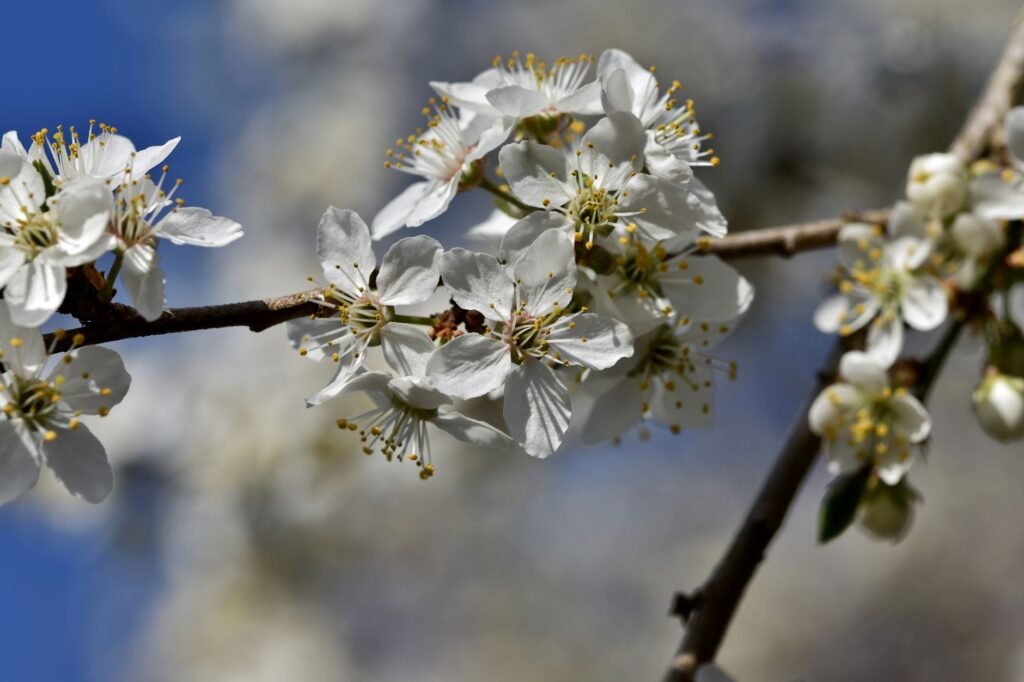
Cherries grow on trees, forming from spring blossoms that must be pollinated before a small green fruit develops, swells and ripens in early summer. The trees need a long cold winter to bloom well, and most sweet cherry varieties need a second, compatible tree nearby to set fruit.
Sweet and tart cherries come from two different trees
The cherries most Americans eat come from two tree species. Sweet cherries are the large, dark or blush fruits eaten fresh by the handful. Tart or sour cherries are smaller and sharper, and most end up in pies, preserves, juice and dried fruit.
| Sweet cherry | Tart cherry | |
|---|---|---|
| Botanical name | Prunus avium | Prunus cerasus |
| Fruit | Large and sweet, often dark red | Smaller, higher acid, lower sugar |
| Pollination | Most need a second variety | Self-fertile, one tree is enough |
| Main use | Eating fresh | Pies, preserves, drying |
| Tree size | Large unless grafted on a dwarfing rootstock | Smaller, around 15 to 20 feet |
Both belong to the genus Prunus, the same group as plums, peaches, apricots and almonds.
Winter chill comes before the blossoms
A cherry tree spends winter dormant, and it needs a long cold spell to wake up properly. Growers count this as chilling hours, the time spent at cool temperatures over winter. The University of California’s integrated pest management program says cherries need between 800 and 1,200 chilling hours.
Without enough chill, bloom is weak and uneven and fruit set suffers. That is why cherries are a crop of places with real winters, and why gardeners in mild climates look for low chill varieties. Your county extension office can tell you which varieties suit your area.
Spring frost is the other hazard. Iowa State University’s extension service notes that sweet cherries bloom earlier and are more prone to late frost damage, while tart cherries bloom later and dodge more of it.
Pollination turns cherry blossoms into fruit
Each blossom has to receive pollen, carried mostly by bees, before a cherry can form. Tart cherries are self-fertile, so pollen from the same tree works and a single tree bears fruit. Most sweet cherries are self-sterile, so they need pollen from a different, compatible variety that blooms at the same time.
Virginia Tech’s extension guide lists Stella, Lapins and Sweetheart among the self-fertile sweet cherries, and Iowa State adds BlackGold and WhiteGold. With any other sweet variety, plan on two trees, or ask a nursery which pollinizer pairs with the one you want.
A lone sweet cherry that blooms heavily every spring but never produces is often missing a partner. Tart and sweet cherries can pollinate each other when their bloom times overlap.
From green stone fruit to ripe cherry
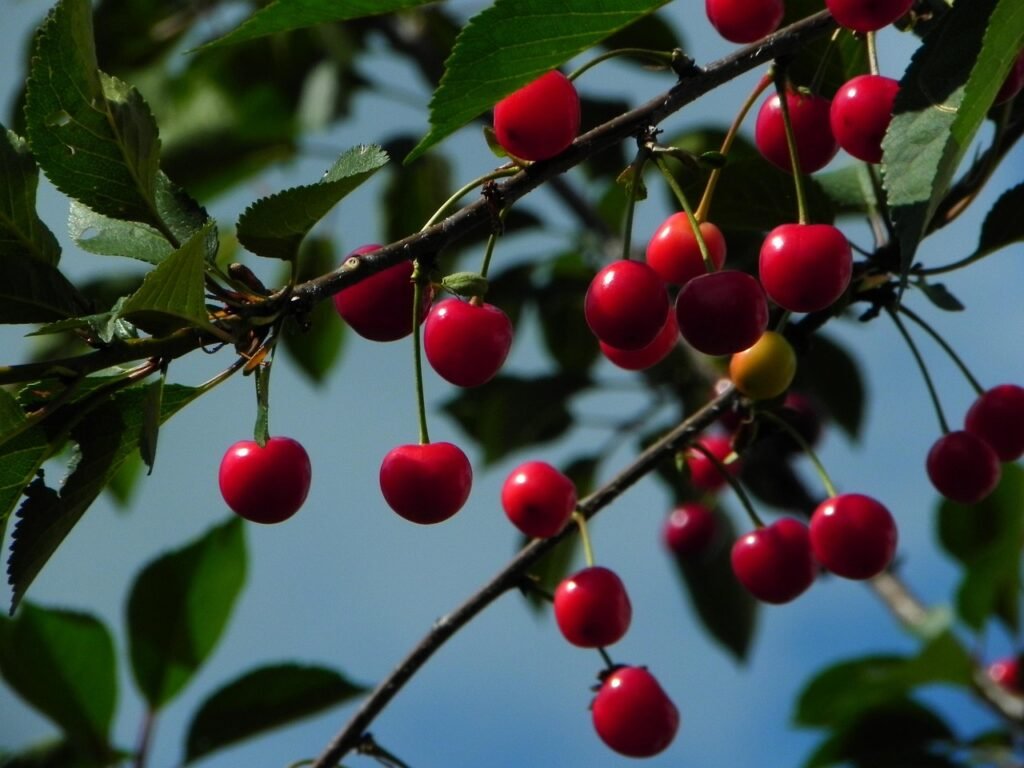
After pollination the petals drop and a small, hard green fruit appears. A cherry is a drupe, or stone fruit, like a peach or plum. The pit at the center holds the seed, and the flesh builds up around it as the fruit swells and colors.
Cherries ripen only on the tree. UC’s pest management program advises picking when the fruit is firm and has reached full color, because cherries will not ripen after they are picked.
Two things can spoil a crop right at the end. Rain near harvest can split the fruit, and Virginia Tech reports that as much as 90 percent of sweet cherries may crack in bad conditions. Birds are the other threat, and netting the tree is the usual home garden defense.
How many years before a young cherry tree bears
Patience is part of growing cherries. Virginia Tech’s cherry growing guide says sweet cherries on vigorous rootstocks typically start fruiting around year five or six, while trees on dwarfing rootstocks can produce by year three. Tart cherries generally start earlier.
Life span differs too. Iowa State notes that tart cherries may survive 20 to 25 years in Iowa, while sweet cherries there seldom last more than 10. Climate plays a big part, so treat those as local figures.
Growing a tree from a pit is possible but unpredictable. Nursery cherries are grafted onto rootstocks, and a seedling is unlikely to match the fruit it came from.
Frequently asked questions
Do cherries grow on bushes?
The sweet and tart cherries sold in stores grow on trees, though dwarf varieties and trees on dwarfing rootstocks stay compact enough for small yards. Some shrubs, such as bush cherries, produce small cherry-like fruit, but they are different plants from the orchard cherries most people picture.
Why does my cherry tree flower but not produce fruit?
Poor pollination and frost are the usual causes. A self-sterile sweet cherry with no compatible variety nearby will bloom and drop its flowers. A late spring frost during bloom can kill blossoms too. Young age, too little sun and heavy pruning can also reduce the crop.
Can you grow cherries in a warm climate?
It is harder, because cherries need a long spell of winter cold to bloom well. The University of California's pest management program puts the requirement at 800 to 1,200 chilling hours. In mild regions, ask your county extension office for low chill varieties suited to your area.
How do you grow a cherry tree from seed?
Soak the cleaned pits for a day, then chill them in a plastic bag of barely moist peat and sand in the refrigerator. University of Georgia Extension stratifies fruit seed at 34 to 38°F for 12 to 20 weeks, depending on species, and plants each seed as soon as it sprouts. Expect a tree unlike its parent.
What does a cherry tree look like?
Look for dark brown to gray bark marked with distinct horizontal lines called lenticels, and elliptical leaves 1 to 3 inches long with toothed edges. NC State Extension describes sweet cherry flowers as white, in small rounded clusters that open with the leaves in spring. Tart cherry trees are smaller and more spreading.