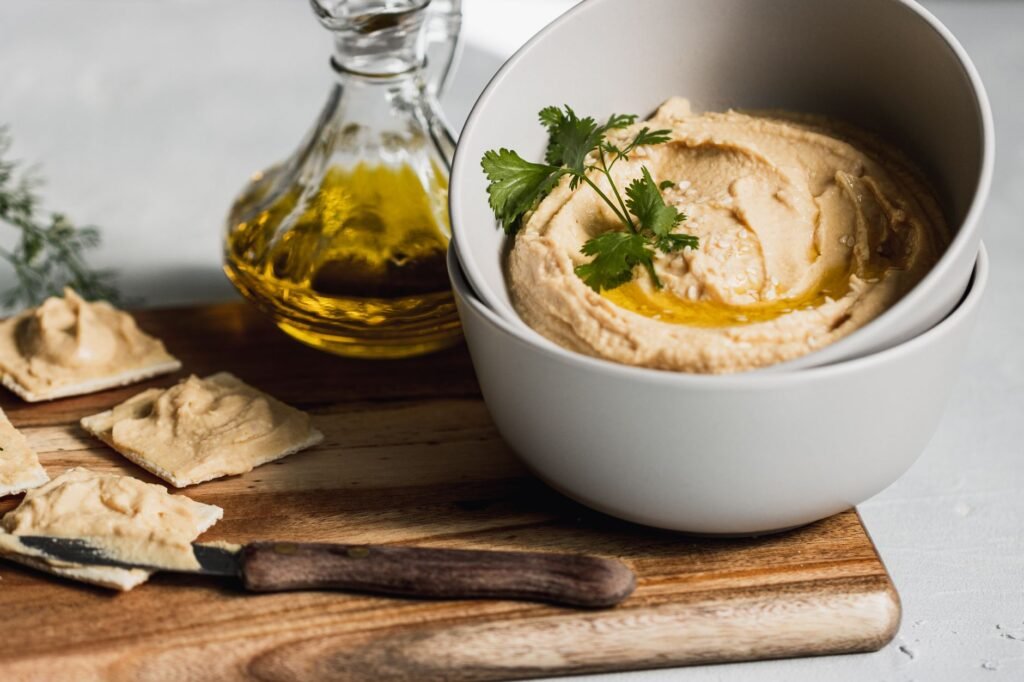
Hummus you blended yourself usually holds a quality window of about three to five days in a sealed container, while an opened store tub commonly runs closer to a week. The gap comes from acidity and from how much handling the batch gets, not from the chickpeas themselves.
A puree runs down a different clock than solid food
Take a roast or a wedge of cheese out of the refrigerator and most of the mass is protected by its own outside layer. Blend chickpeas into a paste and that protection disappears. Every particle has been exposed, and the food processor whips air through the entire batch while it runs, so oxidation is not something happening only at the top of the tub.
Two other properties stack on top of that. The paste is wet, since tahini, citrus juice, and cooking liquid all go in, and it sits close to neutral rather than being genuinely sour the way a pickled spread is. Moisture, dissolved air, and mild acidity together describe conditions that spoilage organisms find comfortable, which is why a bean dip gives you a narrower window than a dry or a heavily vinegared food would.
Your batch and a factory tub are not really the same product
A commercial recipe is engineered for distribution. It typically carries more citrus or a food acid worked in deliberately, it is portioned and sealed under conditions where no utensil ever enters it, and the printed date reflects testing done on that exact formula. Your version is tuned for taste, which usually means less acid, and it meets a spoon on day one.
| Form | Usual quality window | What shifts it |
|---|---|---|
| Homemade, plain, sealed | Roughly three to five days | How much lemon went in, how clean the container was, how quickly it got cold |
| Homemade with fresh garnish | Shorter, often two to three days | Chopped herbs and tomato release water and soften first |
| Store tub, opened | Commonly five to seven days | The recipe acidity plus whatever date is stamped on the lid |
| Store tub, still sealed | Follow the printed date | Never opened, never contacted by a utensil |
| Frozen, plain | Months for quality | Texture splits on thawing and needs to be beaten back together |
The film of olive oil on top is doing real work
Smooth the surface flat with the back of a spoon, then pour a thin layer of oil across the whole top before the lid goes on. The oil sits as a physical barrier between the paste and the air in the container, which is what keeps the top from drying into a leathery skin and from darkening while the rest stays pale.
Be clear about what it does and does not accomplish. It protects texture and appearance, and it slows the drying that makes leftovers taste stale. It is not a preservative and it does not buy you extra days of safety. Repour a little after each time you dig in, because a scooped crater breaks the seal and leaves fresh surface exposed.
Stop signs, plus the habits that keep waste down
A sour or sharp aroma that reads as fermented rather than citrus means the batch is finished. So does a puffed lid, visible bubbling, or a fizzy texture on the tongue. Any fuzzy growth sends the entire container out, since a soft paste lets threads travel below the surface where you cannot see them. Plain liquid pooling on top is different and is usually just separation.
- Cool a fresh batch quickly in a shallow container before the lid goes on, so warmth does not sit trapped in the middle.
- Serve from a small side bowl and keep the storage container untouched by the dipping.
- Use a clean utensil every time rather than the one already on your plate.
- Keep the container on a rear shelf rather than inside the door, since door storage rides a warmer swing every time the appliance opens.
- Blend a smaller amount more often, or freeze half in portions the day you make it.
The habit that changes the most is the last one. Most batches go bad because they were bigger than the week they had to live in, not because anything went wrong with the storage.
Frequently asked questions
Can you freeze hummus?
Plain batches freeze acceptably in small portions with a little headspace left in the container. Expect the texture to separate as it thaws in the refrigerator, then beat it smooth again with a splash of water or oil and a squeeze of citrus. Garnished versions freeze poorly.
Is liquid pooling on the surface a bad sign?
Usually not. A blended bean paste holds water loosely and some of it rises while the container sits, which is ordinary separation you can stir right back in. Judge by aroma instead. Plain pooled liquid smells like nothing much, while a batch that has turned smells sharp.
Does the olive oil layer make hummus last longer?
It protects the surface from air, so the top stays soft and pale instead of drying and darkening. That is a texture and appearance benefit rather than a safety one. Treat the storage window as unchanged and keep the oil trick for quality alone.