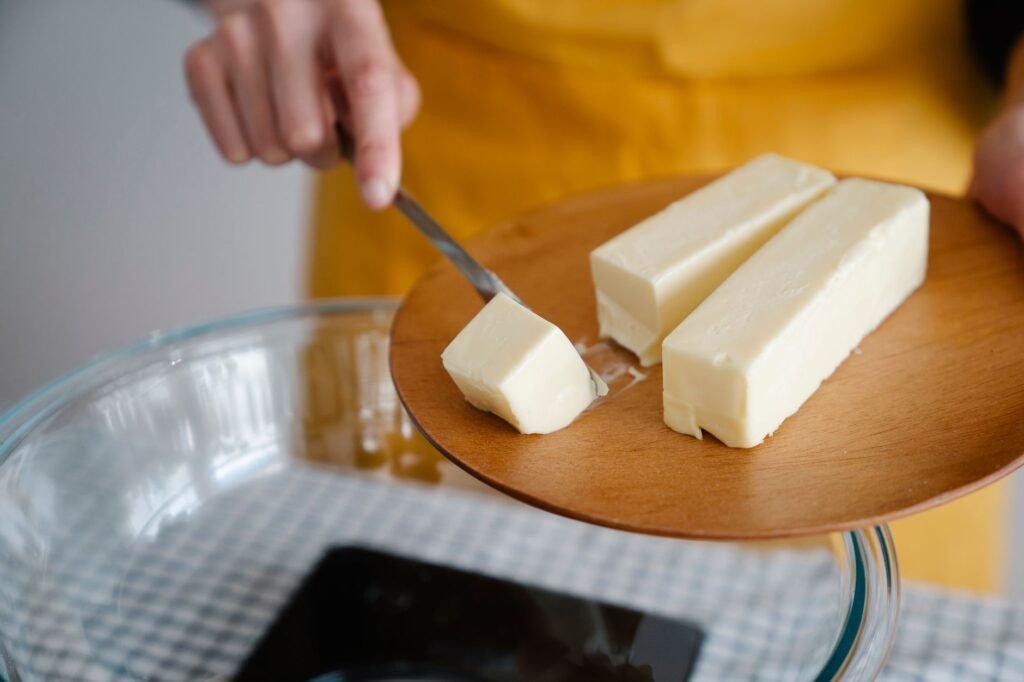
Cut the stick into thin slices and spread them out on a plate, and they reach room temperature in roughly ten minutes. Properly softened butter dents under a finger but still holds its shape. Melted or greasy butter will not cream, and that changes how the bake turns out.
The slice method, about ten minutes
- Unwrap the cold stick and lay it on a cutting board.
- Cut it into slices about the thickness of a coin. Thinner is faster.
- Spread the slices out in a single layer on a plate, not stacked.
- Leave them on the counter. Ten minutes in a normal kitchen, less in a warm one.
- Press one with a finger. If it dents and holds the dent, it is ready.
This works because softening is limited by surface area, not by time. A whole stick has to warm from the outside in, and the center is still fridge cold long after the outside has gone soft.

Faster options when you have five minutes
- Grate it. Run the cold stick over the large holes of a box grater. The shreds are soft almost immediately. Hold the butter in the wrapper so your hand does not melt it.
- Flatten it. Put the stick between two sheets of parchment and roll over it with a rolling pin or press with a flat pan. A thin sheet softens in a couple of minutes.
- Warm bowl. Fill a metal bowl with hot water, wait a minute, tip the water out, dry it, and invert the bowl over the butter on the counter. The trapped warm air does the work without touching the butter.
- Microwave, carefully. A few seconds at the lowest power, turn the stick, repeat. Stop before you see any shine or liquid at the edges.
How to tell when it is ready
| State | Finger test | What happens in the mixer |
|---|---|---|
| Fridge cold | No dent at all | Stays in lumps, will not take air |
| Room temperature | Dents, holds the shape | Creams pale and fluffy, what you want |
| Too soft | Finger sinks through | Air collapses, batter looks loose |
| Melted | Pools on the plate | Cannot cream, bakes flat and dense |
If you went too far
Butter that has started to melt is not ruined, it is just no longer right for creaming. Put it back in the fridge for ten minutes and check again, since partly melted butter re-firms unevenly and needs a second look. If it fully liquefied, save it for a recipe that calls for melted butter, such as brownies, muffins, or quick breads, and start over with a fresh stick for anything that asks you to cream butter and sugar together.
Planning ahead beats rescuing
If you bake often, take the butter out when you take the eggs out, before you read the rest of the recipe. Twenty minutes of doing nothing gets the whole stick to the right state with no plate, no grater, and no risk of overshooting in the microwave.