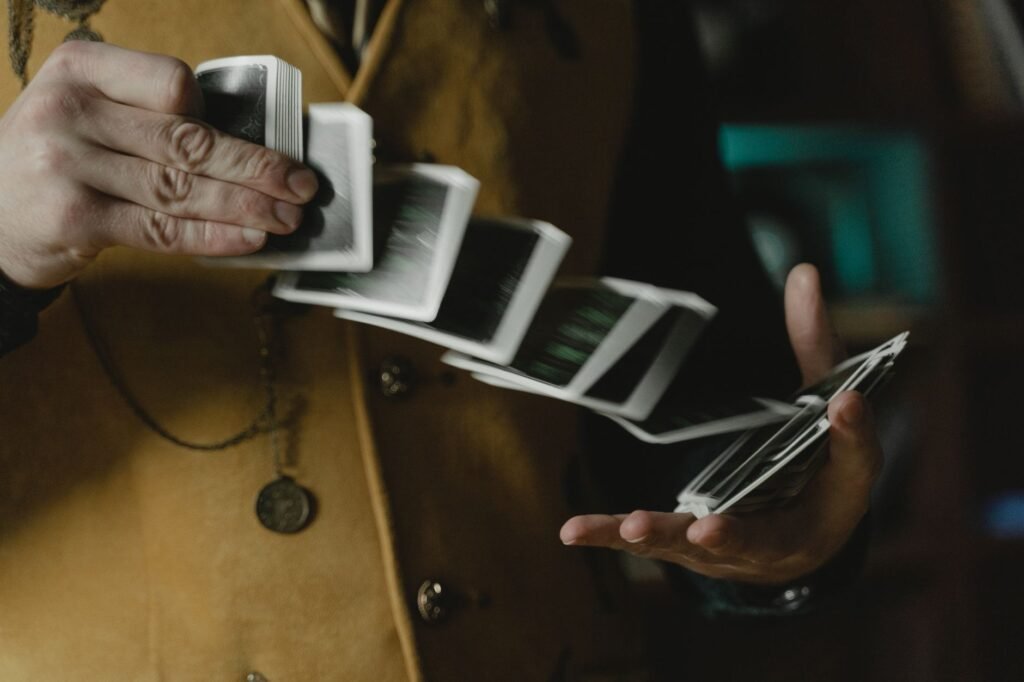
To do magic tricks, start with self-working card tricks that rely on a hidden setup instead of sleight of hand, then learn one basic move such as the French drop coin vanish. Practice each trick in front of a mirror until it looks natural, and control where your audience looks.
Beginner magic tricks sorted by skill needed
Close up magic, performed a few feet from the audience with ordinary objects, is the easiest place to begin. You need no special gear, and a borrowed deck feels more convincing than a trick prop.
| Trick | Props | Skill required |
|---|---|---|
| Key card location | Any deck of cards | None, the setup does the work |
| French drop coin vanish | One coin | A single sleight, practiced daily |
| Jumping rubber band | Two rubber bands | A quick finger move |
| Rising card from the deck | A deck | A hidden finger push |
Master one trick completely before moving to the next. A single routine done smoothly impresses more than five done nervously.
The key card trick, step by step
- Shuffle the deck, and as you square it up, glance at the bottom card. This is your key card. Remember it.
- Spread the cards and ask a friend to pick one, look at it and show it to everyone except you.
- Set the deck down and have them place their card on top of the pile.
- Ask them to cut the deck and complete the cut. Your key card now sits directly on top of their card.
- Let them cut a few more times. Single complete cuts do not break the pair apart.
- Spread the cards face up toward yourself, find your key card, and the next card toward the face is theirs.
Build a little drama at the end. Deal cards one by one and stop on theirs, or ask them to think of the card while you pretend to read their mind.
Misdirection, or steering where people look
People watch what you watch. If your eyes follow your right hand, the audience follows it too, and your left hand is free to do the secret work. Misdirection is less about quick movements and more about giving attention a reason to go somewhere else.
Talking helps. A short story or a question, often called patter, gives the audience something to focus on while the method happens. Natural pauses help too. A hand that stays still at the key moment draws less notice than one that jerks away.
Learning the French drop coin vanish
Hold a coin horizontally between the thumb and fingertips of your left hand, palm facing up and slightly toward you. Bring your right hand over as if to take it, with your right fingers covering the coin from the audience’s view.
At the moment your right fingers close around the coin, relax your left thumb and let the coin drop into your left fingers. Close your right hand as though it holds the coin and move it away, watching it the whole time. Let your left hand fall to your side naturally. Open your right hand slowly to show it empty.
The move fails when the left hand looks tense. Practice until the drop takes no thought.
Rehearsing a trick before you perform it
Practice in a mirror first, then film yourself, because a camera catches flashes the mirror hides. Work out your patter out loud so the words come without hesitation. Perform for one friend before trying a group.
Two old rules still hold. Do not repeat a trick for the same audience, since they will know what to watch for on the second run. And do not explain how it works. Keeping the secret protects the trick, and it keeps the moment of surprise intact for everyone who sees it later.
Plan for mistakes, too. If a card turns up in the wrong place, treat it as a pause rather than a failure and move on to a backup trick you know well. An audience that never learns what was supposed to happen never knows anything went wrong.
Frequently asked questions
What is the easiest magic trick for kids to learn?
The key card trick is a good first choice because it needs no sleight of hand and works with any deck. Kids only need to remember one card and follow the steps. Practicing the reveal, and a bit of storytelling to go with it, gives them confidence in front of family.
Do I need to buy special props to do magic?
No. Many strong tricks use borrowed everyday items such as cards, coins, rubber bands and pens. Gimmicked props from magic shops can create effects that are hard to do otherwise, but they are not required to start, and borrowed objects often convince people more.
How long does it take to learn a sleight of hand move?
It depends on the move and on how often you practice. Short daily sessions work better than one long weekend session, because muscle memory builds with repetition. Keep practicing until the move feels automatic, then practice performing it for people before relying on it.
How can you learn magic tricks for free?
Start at your public library, which usually has beginner magic books to borrow. Many professional magicians post free lessons online, and a borrowed deck of cards and a coin are enough to practice the key card trick and the French drop. Rehearse in a mirror, then film yourself to catch any flashes before you perform.
How do you become a magician?
Master a few tricks until they look effortless, build them into a short routine with your own patter, and perform often, first for friends and then at small gatherings. A magic club can speed things up. The International Brotherhood of Magicians has more than 200 local rings worldwide that offer feedback and performance opportunities to newcomers and pros.
Are magic tricks real?
No. Magic tricks are illusions, and each one has a hidden method, such as a secret setup, sleight of hand or a gimmicked prop. Misdirection keeps the audience looking elsewhere while the method happens. The skill lies in hiding that method so well that the effect feels impossible, which is why magicians keep their secrets.