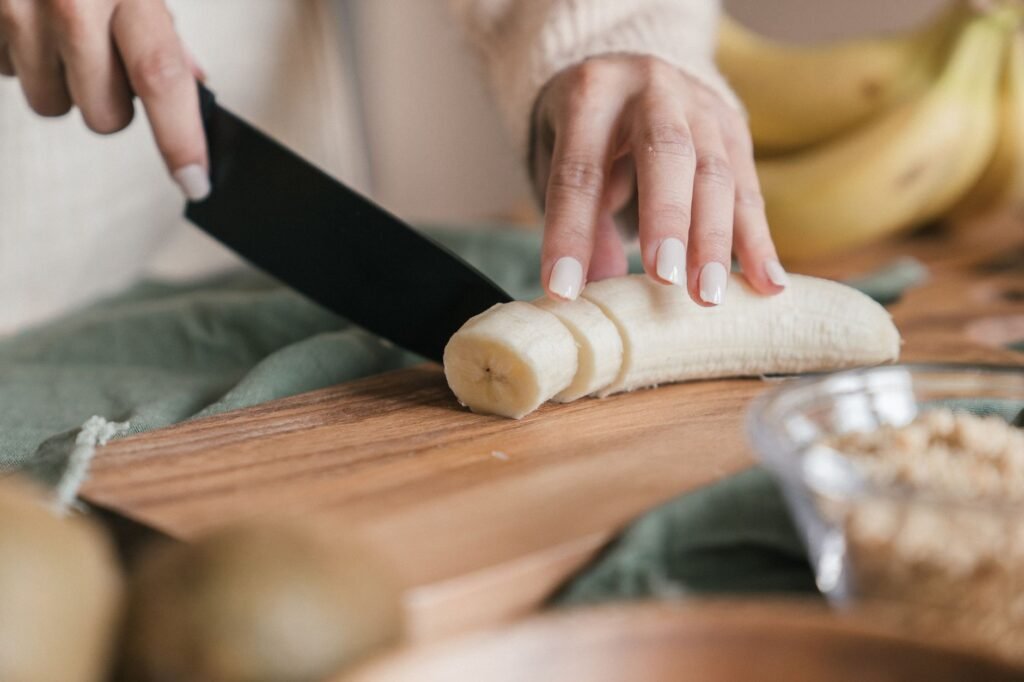
Slice firm, ripe bananas about 1/8 inch thick, dip the slices in diluted lemon juice, and dry them at 140 degrees F in a dehydrator for 8 to 10 hours. They come out tough and leathery with a little snap at the thinnest edges. The very crunchy chips sold in bags are usually fried.
Choosing bananas that slice cleanly
The ideal banana for drying is solid yellow or yellow with a few brown flecks. Colorado State University’s food preservation guide says to skip overripe or bruised fruit, and there is a practical reason too. Very soft bananas smear on the knife, stick to the trays and dry into gummy blobs rather than rounds.
For fried chips, many cooks go the other way and use firmer, greener bananas or plantains, which hold their shape in hot oil. For dried chips, yellow fruit with a firm center gives the sweetest result.
Plan on a full tray per few bananas. Slices shrink a lot as they dry, so a batch that fills four dehydrator trays ends up as a modest jar.
Drying banana slices in a dehydrator
These steps follow the Colorado State University guide to drying bananas, which is tested home preservation advice.
- Mix a dip. Bottled lemon juice mixed 1 cup to 1 cup of cold water works, or ascorbic acid at 1 teaspoon of powder to 2 cups of water.
- Peel the fruit and slice it into rounds about 1/8 inch thick. Even thickness means the whole tray finishes together.
- Drop the slices into the dip for a few minutes, then drain them.
- Lay them on the trays in a single layer, not touching.
- Dry at 140 degrees F. Expect 8 to 10 hours, turning the slices every 3 to 4 hours.
- Test a few pieces once cooled. They should be tough and leathery with no moist spots in the center.
Using an oven when you have no dehydrator
An oven can do the same job at the same 140 degrees F, but it is slower. The CSU guide notes it may take up to twice as long as a dehydrator. Many ovens don’t hold a temperature that low accurately, so an inexpensive oven thermometer on the rack tells you what is really happening.
Line baking sheets with parchment so the slices don’t stick, space them out, and flip them at the same intervals you would in a dehydrator. Rotate the pans front to back as well, since most ovens run hotter in one corner.
Plenty of recipes bake banana slices at a higher oven setting for a shorter time. That browns and crisps the edges faster, but the sugars can scorch quickly, so stay nearby and pull any slices that darken early.
Chewy, crisp or fried, and what each method gives you
Home dried bananas surprise a lot of people because they aren’t crunchy. That is normal. The table sums up the trade offs.
| Method | Heat | Time | Texture |
|---|---|---|---|
| Dehydrator | 140 degrees F | 8 to 10 hours | Tough and leathery, chewier in thick slices |
| Oven at dehydrator heat | 140 degrees F, checked with a thermometer | Up to about twice as long | Similar to the dehydrator |
| Oven at a higher setting | Follow your recipe | Much shorter, watch closely | Crisper edges, browner color |
| Deep fried | Follow a tested recipe and use a thermometer | Minutes per batch | Crunchy, the style sold in bags |
If you fry, use a heavy pot, keep the oil well below the rim, dry the slices before they go in, and never leave hot oil unattended. Packaged chips are often coated in sugar or honey as well, and the ingredient list tells you which.
Keeping homemade banana chips dry in storage
Let the chips cool fully before packing them. Warm fruit sealed in a jar releases moisture that condenses on the lid and softens the batch. If you see droplets inside the container in the first few days, the slices need more drying time.
Store them airtight in a cool, dry, dark place, or in the fridge or freezer. CSU says dried fruits keep well for six to 12 months stored that way. Throw out any chips that show mold or smell off.
Frequently asked questions
Why are my homemade banana chips chewy instead of crunchy?
Dehydrated bananas are supposed to end up tough and leathery, not glassy crisp. Thin, even slices get closer to a snap, and a little extra drying time helps. The truly crunchy chips sold in stores are usually fried, which drives out moisture a different way and adds fat.
Do you have to dip bananas in lemon juice before drying?
It isn't mandatory, but a dip in diluted lemon juice or ascorbic acid slows browning and gives a lighter, more appealing color. Colorado State University's guide includes it as a pretreatment step. Without it, the chips taste fine but turn tan to brown as they dry.
Can you make banana chips in an air fryer?
Many air fryers have a dehydrate setting that runs at low heat, and that works for small batches of thin slices. Check the manual for the temperature range and tray limits of your model. On the regular air fry setting, slices brown quickly, so check them every few minutes.
Can dogs eat banana chips?
It is better not to. PetMD notes dried banana pieces can soak up water and swell if a dog swallows them unchewed, risking a blockage, and store bought chips often carry added sugar, salt or preservatives. Fresh banana in small amounts is a safer treat, and dogs with diabetes or weight problems need a vet's approval.
Are banana chips healthy?
It depends on how they are made. Home dried chips are banana with the water removed, keeping its fiber and potassium but concentrating the sugar. USDA data lists banana chip snacks at about 519 calories and 33.6 grams of fat per 100 grams, compared with about 346 calories and under 2 grams of fat for dehydrated banana.